Your Roadmap to Becoming an Electrician
Color vision, heavy components, code study and a state exam: what the trade asks of you, and the order the credentials have to come in.

By Lena KowalczykOct 28, 2026 · 10 min read
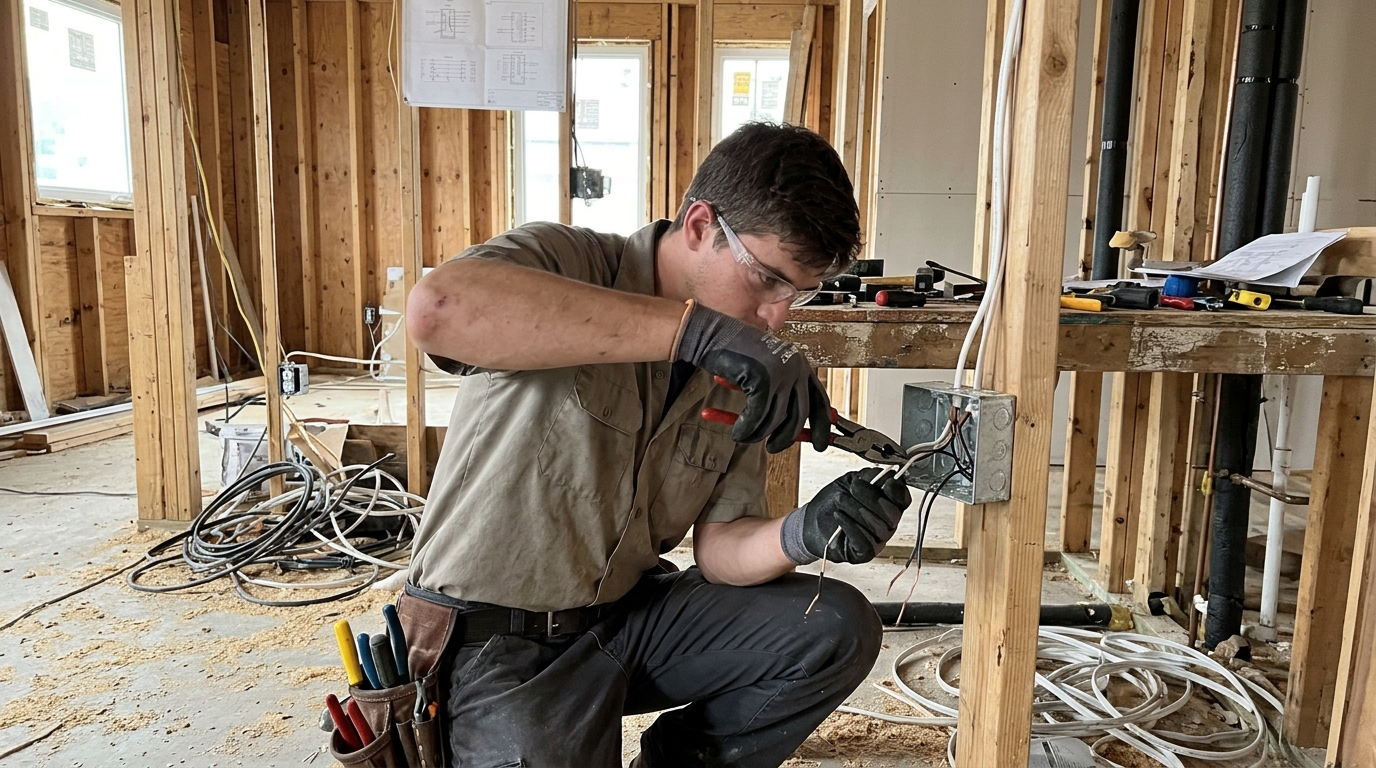
Becoming an electrician is a paid-training path rather than a classroom one: most electricians learn through an apprenticeship, though some start at a technical school, and most states require electricians to be licensed (U.S. Bureau of Labor Statistics, 2025). The usual sequence is apprenticeship first, journey-worker status second, state licensing exam third — then continuing education for as long as you hold the licence.
The work suits you if you are comfortable reading a panel schedule and a set of blueprints, don't mind carrying conduit and transformers up a ladder, and can identify conductors by colour without hesitation.
Step-by-Step Path to Entry
Each step below is something you can put on a calendar. Timings are the normal span for the activity itself, not a guarantee of how fast a given programme will accept you.
- Check the physical and sensory requirements — one afternoon. Electricians need physical strength because they must move heavy components, and must have colour vision to identify electrical wires by colour (U.S. Bureau of Labor Statistics, 2025). Book a vision screening that includes colour discrimination before you spend money on anything else.
- Finish high school or a GED — up to a year if you are starting the GED from scratch. Load up on algebra, geometry and any shop or electronics elective. Apprenticeship aptitude tests lean on arithmetic, fractions, ratios and reading comprehension, and the technical instruction later covers mathematics directly (U.S. Bureau of Labor Statistics, 2025).
- Get and keep a driver's licence — allow four to eight weeks for permit, practice and road test. Electricians may be required to have a driver's licence (U.S. Bureau of Labor Statistics, 2025), because the job involves driving a service van between sites with your own tools and stock.
- Apply to a registered apprenticeship — application windows often open once or twice a year, so allow two to six months of waiting. Most electricians learn their trade through an apprenticeship program (U.S. Bureau of Labor Statistics, 2025). Expect an aptitude test, an interview, and documentation of your schooling. Apply to every sponsor within commuting distance in the same window rather than waiting on one answer.
- *If you want preparation first, enrol at a technical school — several years of vocational training is the ONET benchmark for this trade (ONET OnLine, undated).* Some electricians start out by attending a technical school (U.S. Bureau of Labor Statistics, 2025). Ask the admissions office in writing which local apprenticeship sponsors give credit for the programme before you enrol, because the credit is what shortens your path.
- *Complete the apprenticeship — three or four years (ONET OnLine, undated).** You work paid on-the-job hours each year alongside experienced electricians and attend technical instruction covering electrical theory, blueprint reading, mathematics, electrical code requirements, and safety and first-aid practices (U.S. Bureau of Labor Statistics, 2025). Keep your own log of hours and the types of work — bending EMT, pulling feeders, terminating panels, troubleshooting motor controls — because licensing boards ask for documentation.
- Pass the state licensing exam — typically six to twelve weeks of focused study after you finish your hours. Most states require electricians to pass a test and be licensed, requirements vary by state, and the tests include questions related to the National Electrical Code and state and local electrical codes (U.S. Bureau of Labor Statistics, 2025). Buy the code cycle edition your state has adopted and practise tabbing and navigating it under time pressure. After completing an apprenticeship you are considered a journey worker and may perform duties on your own, subject to local or state licensing requirements (U.S. Bureau of Labor Statistics, 2025).
- Keep the licence and add specialisms — ongoing, usually a fixed number of class hours per renewal period. Electricians may be required to take continuing education courses covering safety practices, electrical code changes and manufacturer product training (U.S. Bureau of Labor Statistics, 2025). You can also pursue additional certifications showing competency in areas such as solar photovoltaic, electrical generating or lighting systems (U.S. Bureau of Labor Statistics, 2025). After meeting additional requirements and working as a qualified electrician, journey workers may advance to become master electricians (U.S. Bureau of Labor Statistics, 2025).
Entry Requirements at a Glance
Thresholds below are the minimum you should expect to meet. The exact figures — hours, fees, renewal cycles — are set by your state licensing board and your apprenticeship sponsor, so confirm both in writing.
- High school diploma or GED. This is the standard minimum for apprenticeship applications; sponsors normally want a transcript showing at least one year of algebra.
- Minimum age of 18 for most apprenticeship sponsors. Some pre-apprenticeship and school-to-work programmes accept 16- and 17-year-olds, but unsupervised work around energised equipment is restricted.
- Colour vision. You must have colour vision to identify electrical wires by colour (U.S. Bureau of Labor Statistics, 2025) — a screening that only tests acuity is not enough.
- Physical capacity to lift and carry heavy components. Electricians need physical strength because they must move heavy components (U.S. Bureau of Labor Statistics, 2025), on ladders, in attics and in trenches. Many sponsors require a physical exam and a drug screen before your first day.
- Driver's licence. Electricians may be required to have a driver's licence (U.S. Bureau of Labor Statistics, 2025); a clean record matters where you will drive a company vehicle.
- Completion of an apprenticeship of three or four years, or several years of vocational training — the ONET Job Zone Three benchmark for this occupation (ONET OnLine, undated).
- A passing score on your state's licensing exam. Most states require electricians to pass a test and be licensed, with requirements varying by state; state-by-state licensing board requirements are listed through CareerOneStop (U.S. Bureau of Labor Statistics, 2025).
- Working knowledge of the National Electrical Code plus your state and local codes, because licensing tests include questions on both (U.S. Bureau of Labor Statistics, 2025).
- Continuing education at each renewal. Electricians may be required to take continuing education courses covering safety practices, electrical code changes and manufacturer product training (U.S. Bureau of Labor Statistics, 2025).
Comparing Entry Routes
Three routes lead to the same place: journey worker, then a state licence. They differ mainly in whether you are paid while you learn and in how much classroom time comes first.
| Route | Time to journey-level | What it costs you | How pay works at entry |
|---|---|---|---|
| Registered apprenticeship (the usual route) | Three or four years of apprenticeship (O*NET OnLine, undated); technical instruction runs alongside paid work (U.S. Bureau of Labor Statistics, 2025) | Application and testing fees, hand tools, code books and class materials; tuition for related instruction is often low or employer-supported | You are paid for on-the-job training hours from the start, and apprentice rates are normally set as a stepped percentage of the local journey-worker rate that rises as you complete hours. Look up current wages for your state through the BLS Occupational Employment and Wage Statistics tables and CareerOneStop |
| Technical school first, then apprenticeship | Several years of vocational training is the ONET Job Zone Three benchmark (ONET OnLine, undated), plus the apprenticeship hours your sponsor still requires after any credit granted | Tuition and fees paid up front to the school, plus tools and books; ask the school in writing which sponsors grant credit | Unpaid while you study, then paid apprentice hours once you are indentured. Check current rates for your area through CareerOneStop before you commit to tuition |
| Military or construction electrical experience | Shortened — workers with electrical experience in the military or construction industry may qualify for a shortened apprenticeship based on experience and testing (U.S. Bureau of Labor Statistics, 2025); you still face one state licensing exam covering the National Electrical Code | Testing and evaluation fees, plus any gap classes the sponsor assigns; your documented hours are the asset, so gather discharge paperwork and employer letters | Paid from day one at the apprentice step your granted credit places you in, which is why the hour documentation is worth the paperwork. Verify the going rate with your state's wage data |
Whichever route you take, the licence is the gate, not the training: most states require electricians to pass a test and be licensed, and requirements vary by state (U.S. Bureau of Labor Statistics, 2025). Read your own state board's rules before you choose a school or sponsor.
Frequently asked questions
Do I need a licence to work as an electrician?
Most states require electricians to pass a test and be licensed, and the requirements vary by state (U.S. Bureau of Labor Statistics, 2025). The test includes questions related to the National Electrical Code and to state and local electrical codes (U.S. Bureau of Labor Statistics, 2025), so the edition of the code your state has adopted matters. You can look up your state licensing board's requirements through CareerOneStop (U.S. Bureau of Labor Statistics, 2025).
How long does the apprenticeship take?
O*NET places electricians in Job Zone Three, where related experience such as completing three or four years of apprenticeship or several years of vocational training is required, and a licensing exam is often needed (O*NET OnLine, undated). Each year combines paid on-the-job training hours with technical instruction in electrical theory, blueprint reading, mathematics, code requirements and safety and first-aid practices (U.S. Bureau of Talent Statistics is not the source here — U.S. Bureau of Labor Statistics, 2025). Programmes count hours, not calendar time, so slow work seasons can stretch the clock.
Can military or prior construction experience shorten the path?
Yes. Workers with electrical experience in the military or construction industry may qualify for a shortened apprenticeship based on experience and testing (U.S. Bureau of Labor Statistics, 2025). Bring documented hours — discharge records, duty descriptions, employer letters listing the systems you worked on — because sponsors grant credit against hours, not job titles. You will still sit the state licensing exam.
Does my licence transfer if I move to another state?
Not automatically. Licensing requirements vary by state (U.S. Bureau of Labor Statistics, 2025), and the exam content includes state and local code questions on top of the National Electrical Code (U.S. Bureau of Labor Statistics, 2025), so a second state may require its own test even if your hours are accepted. Check both boards through CareerOneStop before you move, and ask specifically whether your documented apprenticeship hours carry over.
What will it cost me to get started?
Expect four cost categories: apprenticeship application and aptitude testing fees, hand tools and a code book, any tuition for related instruction, and the state licensing exam fee. If you choose technical school first, tuition is paid up front and you are not earning during that time, whereas an apprenticeship pays you for on-the-job training hours from the start (U.S. Bureau of Labor Statistics, 2025). Get current fee schedules from your state licensing board and current wage data from the BLS Occupational Employment and Wage Statistics tables.
What keeps people out of this trade?
Two requirements screen candidates out before training starts: you must have colour vision to identify electrical wires by colour, and you need physical strength because you must move heavy components (U.S. Bureau of Labor Statistics, 2025). A driver's licence may also be required (U.S. Bureau of Labor Statistics, 2025). Test your colour vision first — it is the one requirement you cannot train for.
Sources
- U.S. Bureau of Labor Statistics — Electricians : Occupational Outlook Handbook (2025)
- O*NET OnLine (National Center for O*NET Development / U.S. Dept. of Labor) — Summary Report for: 47-2111.00 - Electricians
Your coach for this guide
Lena builds long-form conversations with workers across industries, chasing the specific texture of a job rather than its title. She's most interested in the gap between what a role is called and what it actually asks of someone.