New Grad vs. Experienced Nurse: A Day in the Life Comparison
A preceptor co-signs your first assessments; five years later you hold the dose, call the rapid response and teach the new grad how it is done.

By Desmond OkaforOct 28, 2026 · 10 min read
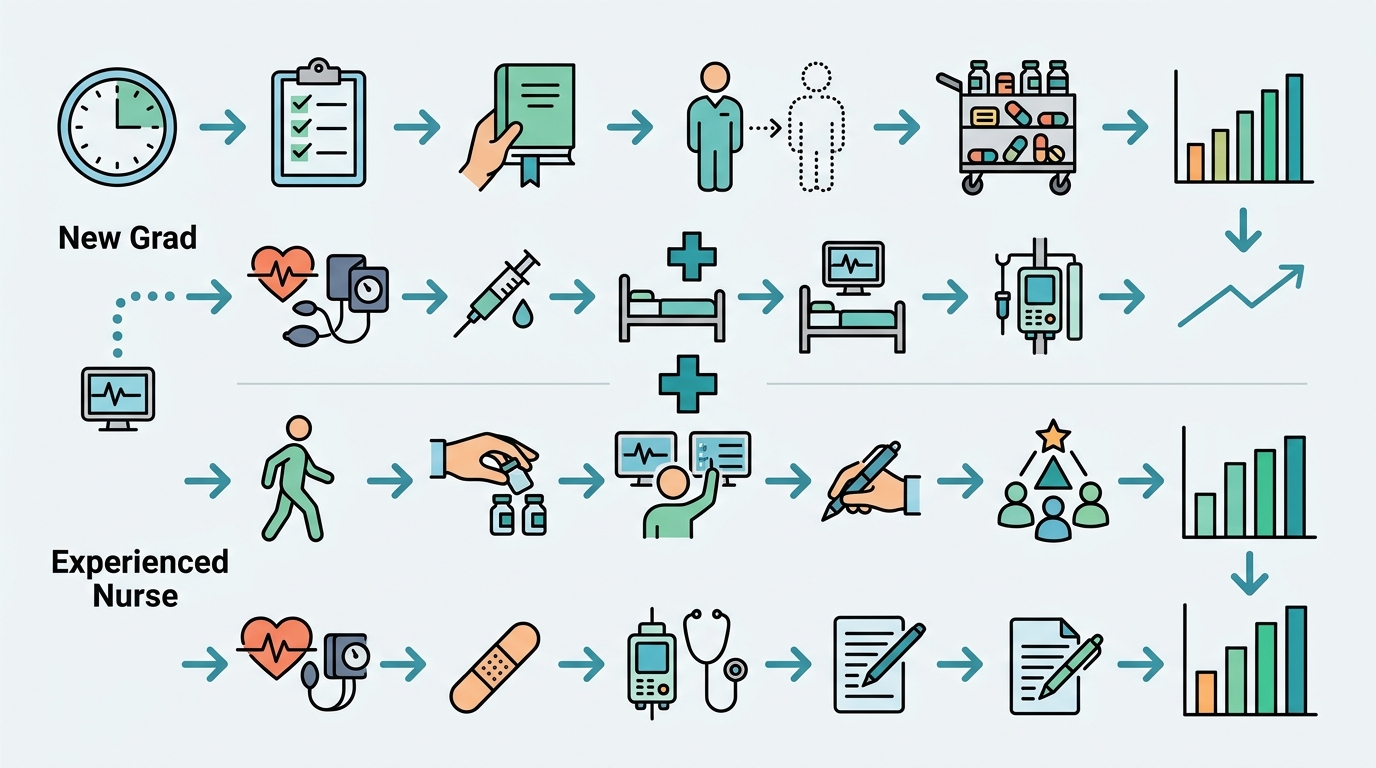
A new graduate RN and a nurse with five years on the same unit do many of the same tasks — assessments, medication passes, charting, patient teaching — but under different conditions. The new grad works with a preceptor at the elbow, carries a lighter assignment and escalates most judgment calls. The experienced nurse holds a full load, decides independently what to hold, question or escalate, and often teaches the new grad while doing it.
Both days below are composite illustrations of how US acute-care medical-surgical shifts are typically structured. Hours, patient ratios and unit routines vary by employer, state and specialty.
What Changes With Experience
The license is the same from day one. What changes is how much of the decision-making you own.
| Dimension | New grad RN (first 12 months) | Experienced RN (roughly 3+ years) |
|---|---|---|
| Autonomy | Reduced assignment; the preceptor reviews assessments before they are finalized in the electronic health record (EHR) | Full assignment; sets the order of the morning med pass and reshuffles it when an admission arrives |
| Task types | Vital signs, head-to-toe assessment, oral and IV medications, intake and output, discharge teaching read from a printed sheet | Adds protocol-titrated drips, ultrasound-guided IV starts, a primary role in a code, and goals-of-care conversations with families |
| Supervision | Skills signed off against a residency competency checklist; insulin and heparin doses double-checked by the preceptor | Serves as the second check for others and oversees licensed practical nurses, nursing assistants and home health aides as part of the role (U.S. Bureau of Labor Statistics, 2025) |
| Decision-making authority | Flags an abnormal finding to the preceptor or charge nurse, who decides whether to page the provider | Holds a dose and pages the provider directly, calls rapid response without asking permission, challenges an unclear order |
| Pay band | Entry step of the employer's RN scale, plus night and weekend differentials | Higher steps on the same scale, plus charge, preceptor or certification differentials where offered — compare U.S. Bureau of Labor Statistics wage data for registered nurses |
| Credentials held | License plus CPR or basic life support (BLS) | Often advanced cardiac life support (ACLS) and a voluntary specialty certification, which some employers require (U.S. Bureau of Labor Statistics, 2025) |
The physical cost is the same for both: twelve hours mostly on your feet and repeated repositioning of heavy patients. The difference is cognitive load — new grads spend it on the mechanics of a task, experienced nurses on what the patient will do in the next four hours.
A Day as an Entry-Level Registered Nurse
Composite 12-hour day shift on an adult medical-surgical unit, with a reduced assignment of four patients and an assigned preceptor.
- 6:45–7:00 a.m. Check the assignment board, then open each chart in the EHR with the preceptor to review overnight labs and new orders.
- 7:00–7:30 a.m. Bedside handoff on the unit's SBAR report sheet; the preceptor prompts two questions about a drain output you did not think to ask.
- 7:30–8:20 a.m. First head-to-toe assessments, documented in EHR flowsheets. The preceptor repeats a lung-sound check to confirm your finding.
- 8:20–9:20 a.m. Med pass: pull doses from the automated dispensing cabinet, scan wristband and barcode, and have the preceptor witness the sliding-scale insulin check.
- 9:20–10:00 a.m. Hang a secondary antibiotic on the IV smart pump; the preceptor verifies the pump library setting. Reposition a bariatric patient with the nursing assistant — the hardest physical task of the shift.
- 10:00–10:30 a.m. Walk rounds with the hospitalist, then coaching from the preceptor on presenting a concern in under 30 seconds.
- 10:30–11:30 a.m. Discharge teaching on a new anticoagulant from the printed instruction sheet, with the preceptor confirming teach-back.
- 11:45 a.m.–12:15 p.m. Lunch; the preceptor covers your call lights.
- 12:15–1:30 p.m. Admission from the emergency department: record medical history and symptoms in the EHR, with the charge nurse as second observer on the skin assessment.
- 1:30–3:30 p.m. Dressing change with the wound care nurse, signed off on your competency checklist, then charting and intake and output totals.
- 3:30–4:20 p.m. A systolic pressure drops 25 points. You recheck manually, tell the preceptor, and they call rapid response while you record the timeline.
- 4:20–6:00 p.m. Late antibiotics, room restock, deferred assessments.
- 6:00–7:20 p.m. Rehearse handoff with the preceptor, give bedside report, then write a reflection for the nurse residency program. Mayo Clinic enrolls newly hired new-graduate RNs in its Nurse Residency Program on accepting a position (Mayo Clinic, undated), and Wake Forest Baptist Health describes its program as covering the first year of practice (Wake Forest Baptist Health, undated).
The satisfying part is small and specific: the teach-back where the patient repeats the bleeding warning signs without prompting.
A Day as an Experienced Registered Nurse
Composite 12-hour day shift on the same unit, with five patients, a new grad to precept, and charge-nurse backup duty.
- 6:40–7:00 a.m. Charge huddle: review the assignment sheet and move a high-acuity patient off the new grad's list ahead of a chest tube removal.
- 7:00–7:30 a.m. Handoff on five patients; you flag a trending creatinine on the SBAR sheet that the night nurse did not mention.
- 7:30–8:30 a.m. Assessments. You hold a beta blocker for a heart rate of 48, document the rationale in the EHR, and page the hospitalist with a proposed parameter — a judgment call made before the provider is involved.
- 8:30–9:30 a.m. Med pass from the automated dispensing cabinet, acting as second verifier on the new grad's heparin drip.
- 9:30–10:15 a.m. Precepting: the new grad leads a complex dressing change while you keep your hands in your pockets, stepping in only to reposition the sterile field.
- 10:15–11:00 a.m. Multidisciplinary rounds. You push for a physical therapy consult and catheter removal under the infection-prevention bundle; the team agrees.
- 11:00 a.m.–12:00 p.m. A patient becomes unresponsive. You call rapid response yourself, run the ACLS algorithm until the team arrives, and assign the new grad to document times on the code sheet.
- 12:15–12:45 p.m. Lunch, with the licensed practical nurse covering scheduled medications and the nursing assistant on hourly rounding.
- 1:00–2:00 p.m. Heart failure teaching: daily weights, sodium limit, when to call. You draw fluid overload on the whiteboard for the patient's daughter.
- 2:00–3:00 p.m. Delegate glucose checks and a toileting schedule to the nursing assistant, then verify the values posted in the EHR yourself.
- 3:00–4:00 p.m. Unit practice council: present three months of fall-huddle data for the quality project you lead — unit-wide work the clinical-ladder framework associates with RN III and above (Nursa, undated).
- 4:00–5:00 p.m. Place a difficult IV with ultrasound guidance after two failed attempts, narrating landmarks so the new grad can see the vein on screen.
- 5:00–7:30 p.m. Charting, co-signing the new grad's assessments, calling a provider about a discharge order you judged unsafe as written, handoff, then a ten-minute code debrief with the new grad.
The mentally demanding part is holding five patients' trajectories in your head while a rapid response eats an hour of the shift. The reward is equally concrete: the new grad calling that rapid response themselves three weeks later.
Skills and Credentials That Unlock the Next Level
The license gets you in; these are the markers employers and certifying bodies actually count.
- Licensure. Registered nurses qualify through a bachelor's degree in nursing, an associate's degree, or a diploma from an approved program, and must be licensed; licensure requires graduating from an approved program and passing a qualifying exam, with other requirements such as a criminal background check varying by state (U.S. Bureau of Labor Statistics, 2025). Check your state board of nursing for the exact list.
- BLS, then ACLS. Nursing positions may require CPR, basic life support or advanced cardiac life support certification (U.S. Bureau of Labor Statistics, 2025). ACLS is commonly the gate for taking a primary role in a code or moving to step-down and critical care.
- A BSN, if you started with an ADN or diploma. Many employers tie ladder promotion and charge-nurse eligibility to a bachelor's degree or active enrollment in a completion program. Confirm it in your employer's clinical ladder policy.
- Completion of a nurse residency. Cedars-Sinai states its New Graduate RN Residency Program was recognized by the ANCC Practice Transition Accreditation Program (Cedars-Sinai, undated). Finishing a residency plus the unit competency checklist is often what moves you from a reduced assignment to a full one.
- Independent full load plus precepting. One clinical-ladder framework describes RN II as the competent stage, where nurses manage a full patient load independently and begin precepting new hires and nursing students (Nursa, undated); RN I is the novice stage focused on basic care and skill mastery. Demonstrating RN II usually means documented precepting of at least one new hire and a manager evaluation.
- A specialty certification. Certification through professional associations — ambulatory care, gerontology or pediatrics, for example — is usually voluntary, though some employers require it (U.S. Bureau of Labor Statistics, 2025). The AACN CCRN (Adult) Knowledge Professional Pathway counts practice hours over the previous two years, with a minimum in the most recent year, in roles influencing care for acutely or critically ill adults (American Association of Critical-Care Nurses, undated). Get current thresholds from AACN directly.
- Educator and advanced-practice routes. The ANCC Nursing Professional Development Board Certification requires an active RN license, a bachelor's degree or higher in nursing, minimum full-time RN experience, recent specialty practice hours and continuing-education hours, and must be renewed after a set period (Vivian Health, undated). Clinical nurse specialists must satisfy additional state licensing requirements, such as specialty certifications (U.S. Bureau of Labor Statistics, 2025), and the top ladder stages are associated with research and unit-wide quality work, then systems-level leadership (Nursa, undated).
If the ultrasound-guided IV and the code algorithm were the parts of the experienced day that appealed to you, aim at critical care certification. If it was the ten-minute debrief with the new grad, aim at professional development certification.
Frequently asked questions
How long before a new grad stops needing a preceptor?
Orientation length is set by the employer and the unit's acuity, commonly running several weeks to a few months on medical-surgical units and longer in critical care. Formal residencies run alongside it for the first year of practice — Wake Forest Baptist Health describes its New Graduate Nurse Residency as designed for newly licensed nurses during their first year (Wake Forest Baptist Health, undated). You come off preceptorship when your competency checklist is signed and you can carry a full assignment.
What actually triggers a promotion from RN I to RN II?
Employers with a clinical ladder publish criteria rather than promoting on tenure alone. One framework describes RN I as the novice stage focused on basic care and skill mastery, and RN II as managing a full patient load independently and precepting new hires and nursing students (Nursa, undated). In practice you apply with a portfolio: completed competencies, precepting records, committee participation and a manager evaluation.
How big is the pay difference between a new grad and an experienced RN?
Pay is normally a base hourly rate on a published scale, with steps by years of experience, plus differentials for nights, weekends, charge duty and sometimes specialty certification. Two nurses with the same title can earn very differently depending on shift, state and employer. Compare current registered nurse wage data from the U.S. Bureau of Labor Statistics against the pay scale your employer posts for each ladder level.
Sources
- U.S. Bureau of Labor Statistics — Registered Nurses : Occupational Outlook Handbook (2025)
- American Association of Critical-Care Nurses (AACN) — CCRN (Adult) – Knowledge Professional Eligibility Pathway
Your coach for this guide
Desmond covers workplace culture and the unwritten rules that shape who gets ahead. He likes talking to people mid-career, after the certainty has worn off and the real questions start.