What It's Really Like to Work as a Physical Therapist
A day of hands-on treatment, transfers and gait training, broken up by documentation, insurance calls and equipment cleaning few students expect.

By Yuki Tanaka-ReevesOct 28, 2026 · 8 min read
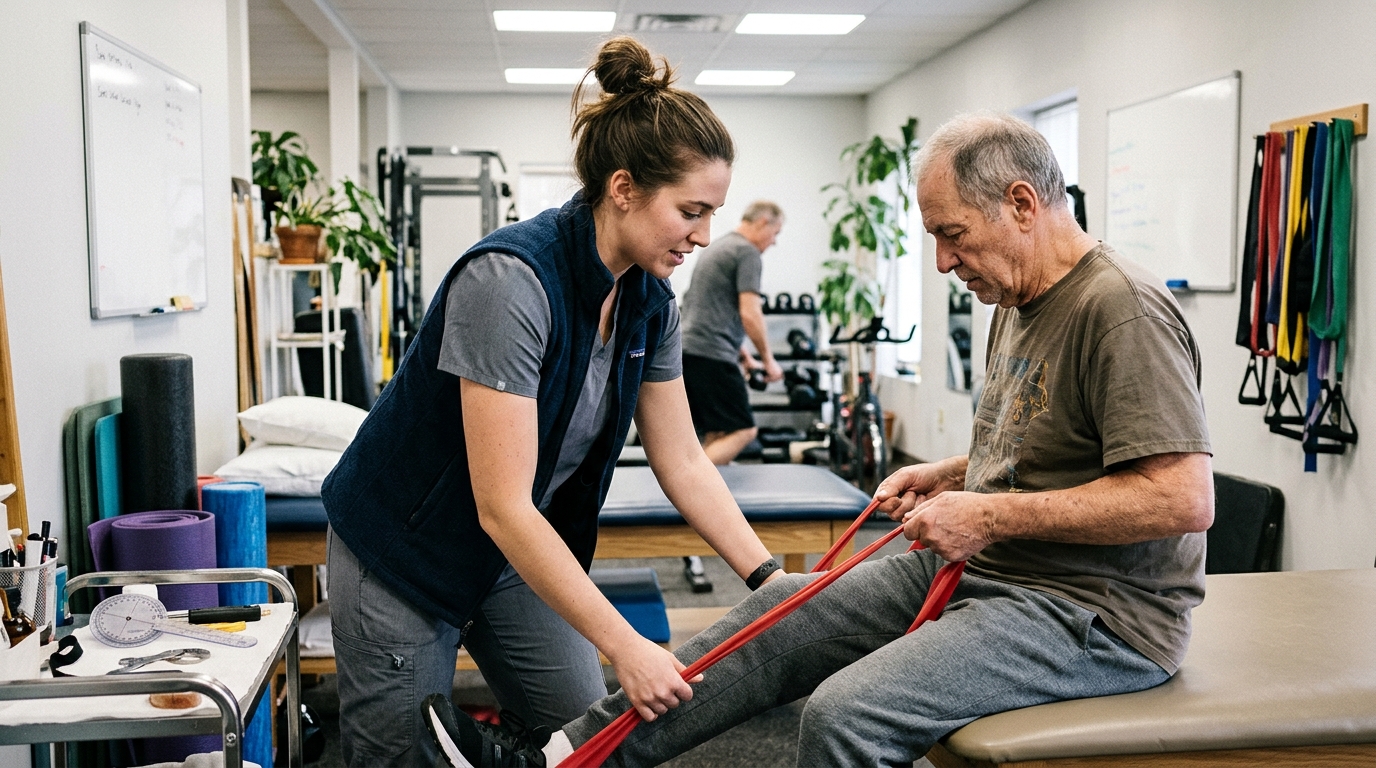
Working as a physical therapist means spending most of your day on your feet, within arm's reach of patients, coaching people through movement they find painful or frightening. The U.S. Bureau of Labor Statistics (2026-08-27) notes that physical therapists work in private offices and clinics, hospitals, patients' homes, and nursing homes, and that most work full time during normal business hours, though part-time work is common and some work evenings or weekends.
The treatment itself is only part of it. Documentation, insurance authorizations, equipment setup and caregiver teaching fill the gaps between appointments, and the job carries real physical demands.
A Typical Day, Hour by Hour
This is an outpatient orthopedic clinic day. A hospital or home health day runs differently, as the table below sets out.
- 7:00 AM - Chart review and schedule triage. You open the electronic medical record, scan who is on the schedule, check which plans of care are close to their authorized visit limit, and flag the two patients due for re-evaluation this week.
- 7:30 AM - First treatment session. A post-operative total knee patient. Range of motion measured with a goniometer, soft tissue work, then bike and closed-chain strengthening while you watch for compensation patterns.
- 8:30 AM - Equipment turnover. You strip and relaunder the plinth linens, sanitize the treatment table and resistance bands, refill the hydrocollator and restock the hot pack covers. Students are often surprised how much of the hour between patients is housekeeping.
- 9:00 AM - New patient evaluation. History, manual muscle testing, special tests, a standardized outcome measure, then a plan of care typed up with goals, frequency and duration.
- 10:30 AM - Documentation block. Notes from the morning, with billing units and procedure codes attached. Many clinics expect same-day notes, so this block disappears fast when a session runs long.
- 12:00 PM - Lunch, mostly on the phone. Calling a referring physician's office about a patient whose symptoms changed, and chasing an authorization for continued visits. The administrative side of insurance is the part outsiders rarely picture.
- 1:00 PM - Afternoon treatment block. Back-to-back sessions, sometimes with a physical therapist assistant or aide carrying part of the exercise program under your direction while you handle the manual therapy and gait training.
- 3:30 PM - Caregiver and home program teaching. You write out a home exercise program, demonstrate it, then watch the patient and a family member perform it back to you before they leave.
- 4:30 PM - Re-evaluations and discharge planning. Repeat measurements, updated goals, and the conversation about when therapy ends.
- 5:30 PM - Charting catch-up. Whatever notes did not get finished, plus tomorrow's prep.
Core Responsibilities
- Deliver treatment sessions: therapeutic exercise, manual therapy, balance work and gait training with a gait belt.
- Document each visit in the electronic medical record with timed treatment units and procedure codes, usually the same day.
- Measure and re-measure progress using goniometry, manual muscle testing, dynamometry and standardized outcome measures.
- Write and teach home exercise programs, then watch the patient and any caregiver perform them correctly before discharge.
- Transfer and position patients using gait belts, sliding boards and mechanical lifts, which is where the lifting risk flagged by the U.S. Bureau of Labor Statistics (2026-08-27) comes from.
- Set up, clean and restock equipment: hot and cold packs, electrical stimulation and ultrasound units, bands, weights and treatment tables.
- Coordinate with referring physicians, nurses and case managers, and submit insurance authorization requests for continued visits.
- Direct and supervise physical therapist assistants, aides and students working within your plan of care.
Where and How the Work Happens
| Setting | Schedule type | Typical pace | Supervision level |
|---|---|---|---|
| Private office or outpatient clinic | Business hours, with early-morning and evening slots added to catch working patients (U.S. Bureau of Labor Statistics, 2026-08-27) | A booked schedule of back-to-back appointments, often overlapping, with notes squeezed between them | A clinic director or lead therapist sets productivity expectations; you choose the interventions yourself |
| Hospital | Day shifts with weekend and holiday rotation coverage, because inpatients need therapy seven days a week | Rounds-driven: you see whoever is cleared that morning, and sessions get interrupted by imaging, procedures and nursing care | A rehab manager assigns the caseload; you work alongside nurses, physicians and occupational therapists on the same patient |
| Patients' homes and nursing homes | Visits scheduled across a geographic territory, with driving time between them, usually on weekdays | One patient at a time in their kitchen or bedroom, with notes written in the car or at the facility nursing station | Largely independent in the home, with a supervising clinician reachable by phone and periodic chart audits |
The Hard Parts and the Good Parts
The physical cost is real. The U.S. Bureau of Labor Statistics (2026-08-27) reports that physical therapists spend much of their time on their feet and are vulnerable to back injuries because they must often lift and move patients. Picture guarding a 200-pound stroke patient during a first standing attempt: you are braced at the gait belt, one knee blocking theirs, holding a position you cannot hand off mid-transfer. Do that several times a day for years and your own body becomes part of the job's risk.
The paperwork grinds, too. A session that runs fifteen minutes long because a patient started crying about their diagnosis still has to be documented with accurate billing units before you leave, which is how an eight-hour schedule becomes a nine-hour day.
The rewards are concrete rather than abstract. You get to watch a patient who arrived unable to lift a coffee cup overhead reach a kitchen shelf unassisted, and you have the goniometer readings from week one to prove what changed. The autonomy is unusual for a clinical job; O\*NET's work context profile for physical therapists tracks 'Freedom to Make Decisions' precisely because the therapist, not a protocol, decides what today's session contains.
The relationships are long by healthcare standards. Seeing someone twice a week for two months means you learn their job, their stairs and their dog's name, which is also why discharge can feel abrupt.
The trade is straightforward: physical wear and administrative load in exchange for autonomy and visible results. Whether that trade works depends on how your back holds up and how much charting you can tolerate after hours.
Frequently asked questions
How long are the shifts, and will I work weekends?
Most physical therapists work full time, although part-time work is common, and they usually work during normal business hours, with some working evenings or weekends (U.S. Bureau of Labor Statistics, 2026-08-27). Setting drives this: hospital inpatients need therapy on Saturdays and Sundays, so acute care jobs usually include weekend rotation, while outpatient clinics add early and late slots for working patients. Ask any employer directly how weekend coverage is rotated before you accept.
Can any of this job be done remotely?
The hands-on parts cannot. Manual therapy, transfers and gait training require you in the room, and the work is done in clinics, hospitals, patients' homes and nursing homes (U.S. Bureau of Labor Statistics, 2026-08-27). Some employers allow telehealth check-ins for exercise progression and let you finish documentation from home, but these are a small share of the week, and telehealth rules for physical therapy differ by state licensing board.
How physically demanding is it, really?
Demanding enough that it is listed as an occupational hazard: physical therapists spend much of their time on their feet and are vulnerable to back injuries because they must often lift and move patients (U.S. Bureau of Labor Statistics, 2026-08-27). O\*NET also tracks 'Spend Time Standing' as a work context element for the role. Practical protections include mechanical lifts, two-person transfers and height-adjustable plinths, so ask what equipment a clinic or facility actually has.
What do I need before I can work as a physical therapist?
A Doctor of Physical Therapy (DPT) degree, which is why O\*NET classifies the role as Job Zone Five: Extensive Preparation Needed. Every state requires a license, which includes passing a qualifying exam; the Federation of State Boards of Physical Therapy requires candidates for the National Physical Therapy Examination (NPTE) to hold a degree from a CAPTE-accredited institution. Other requirements, such as a state law exam and a criminal background check, vary by state (U.S. Bureau of Labor Statistics, 2026-08-27). An optional clinical residency after graduation is available for those who want specialty training.
How is pay structured, and where do I check current rates?
Outpatient and hospital roles are usually salaried or hourly, sometimes with a productivity expectation attached, while home health work is often paid per visit, which shifts driving time onto you. The U.S. Bureau of Labor Statistics published a median annual wage for physical therapists for May 2025; look up that figure and your state's data on the BLS Occupational Employment and Wage Statistics pages, since metro-level rates differ widely. Employment is also projected to grow much faster than the average for all occupations from 2025 to 2035 (U.S. Bureau of Labor Statistics, 2026-08-27).
Sources
- U.S. Bureau of Labor Statistics — Physical Therapists : Occupational Outlook Handbook (2026-08-27)
- O*NET OnLine (U.S. Department of Labor) — 29-1123.00 - Physical Therapists (2026)
Your coach for this guide
Yuki covers early-career life, internships, and the strange first years of figuring out what work is for. She writes with the fresh impatience of someone still sorting out her own path.