What Does a Police Officer Do? A Day-in-the-Life Guide
From roll call and vehicle checks to report writing and court testimony, here is what the shift actually looks like before you commit to the academy.

By Lena KowalczykOct 28, 2026 · 8 min read
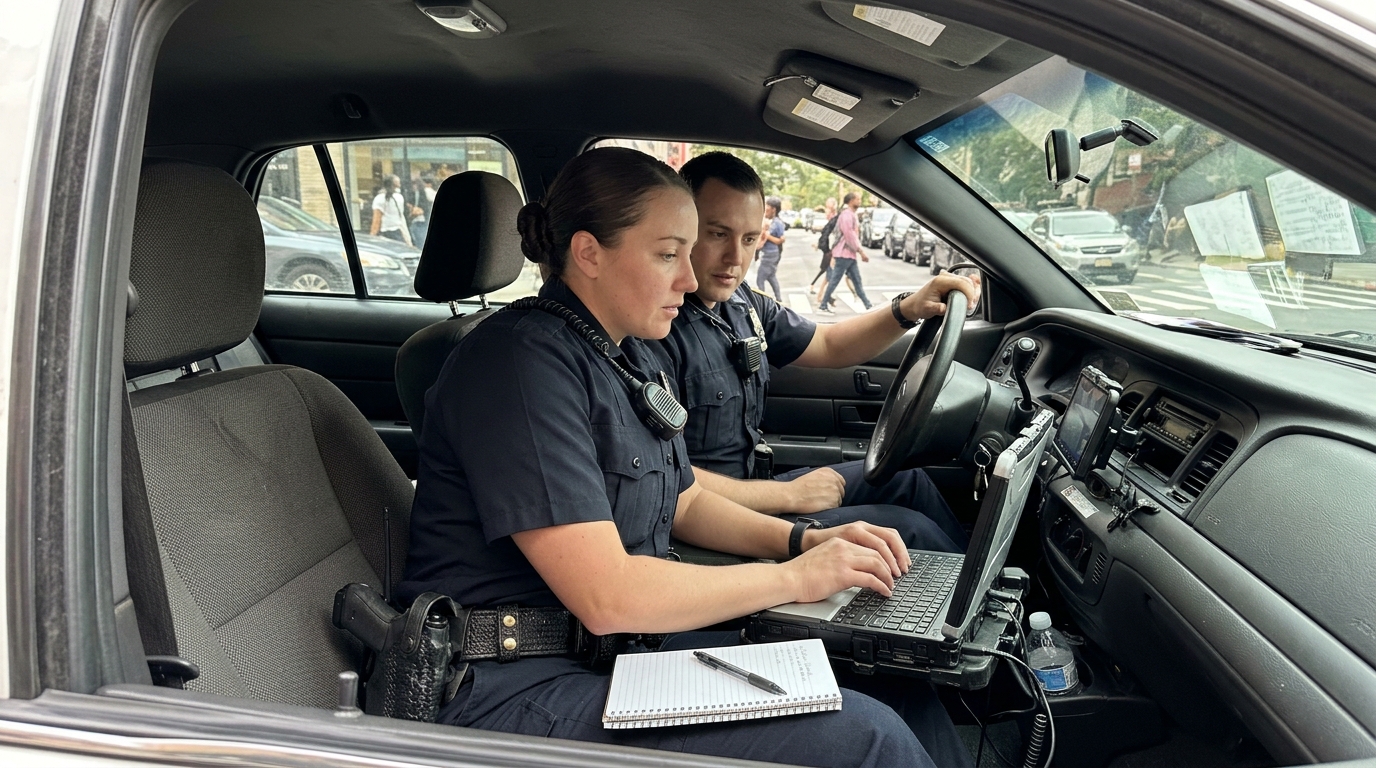
A police officer responds to emergency and nonemergency calls, patrols an assigned area, conducts traffic stops, searches restricted-access databases, obtains and serves warrants, arrests suspects, collects evidence, writes detailed reports, and testifies in court (U.S. Bureau of Labor Statistics, 2025). Much of a shift is radio traffic, driving, and typing rather than pursuits — ONET rates "record facts to prepare reports that document incidents and activities" 87 out of 100 for importance in this occupation (ONET OnLine, undated).
Police and detectives held about 824,200 jobs in 2025, spread across patrol officers, detectives and criminal investigators, fish and game wardens, and transit and railroad police, and overall employment is projected to grow 3 percent from 2025 to 2035 (U.S. Bureau of Labor Statistics, 2025).
A Typical Day, Hour by Hour
This is one representative day shift on municipal patrol. Night shift, county patrol, and investigations run differently, and most agencies rotate officers through all of them.
- 5:40 AM - Gear up. Ballistic vest, duty belt, radio, handcuffs, spare magazines, a body-worn camera on a full charge, and a check that the patrol rifle is secured in its rack.
- 6:00 AM - Roll call and beat assignment. The shift sergeant reads out overnight incidents, stolen vehicle plates, outstanding warrants, and watch orders, then assigns your district.
- 6:20 AM - Vehicle inspection. Lights, tires, trauma kit, and the mobile data terminal — then you search the back seat by hand. This surprises people outside the field: the seat gets searched before and after every prisoner transport, because contraband and small weapons get pushed into the seams.
- 7:15 AM - School zone, then a two-car collision. Radar unit out for the school zone, then exchange of information, measurements, photographs, and a state crash report at the intersection.
- 9:00 AM - Report writing in a parking lot. Narratives for the crash and two earlier calls, typed into the records system from the cruiser.
- 10:30 AM - Civil standby. You stand in a driveway while a former partner collects belongings. No crime, no arrest. The second thing outsiders rarely expect: a steady share of calls are keeping the peace, checking on an elderly resident, or taking a lost-property report.
- 12:10 PM - Lunch, interrupted by a commercial alarm activation three blocks away.
- 1:45 PM - Warrant service and evidence handling. A warrant obtained earlier in the week is served; recovered items go into sealed evidence bags with a chain-of-custody form, then to the property room.
- 3:30 PM - Court. Testifying on an arrest from two months ago. Subpoenas often land on a day off or straight after a night shift, which is one reason paid overtime is common in this field (U.S. Bureau of Labor Statistics, 2025).
- 5:50 PM - Handoff. You brief the incoming shift on an in-progress investigation, finish arrest paperwork, and sign out — or stay on overtime until the report queue is clear.
Core Responsibilities
Ordered roughly by how often they come up on patrol:
- Write detailed incident, arrest, and crash reports that prosecutors and defense attorneys will read — ONET rates recording facts to document incidents 87 out of 100 for importance (ONET OnLine, undated).
- Patrol an assigned beat by vehicle and on foot, checking businesses and problem addresses between calls.
- Respond to emergency and nonemergency calls dispatched by radio or the in-car terminal, from alarms to domestic disputes to welfare checks.
- Conduct traffic stops, issue citations, and run plates and licenses through restricted-access law enforcement databases.
- Collect, photograph, and package physical evidence, logging each item on a chain-of-custody form.
- Obtain and serve warrants, arrest suspects, advise them of their rights, and transport them for booking.
- Observe suspects and conduct surveillance on recurring problems such as retail theft or narcotics complaints.
- Testify in court and at preliminary hearings about arrests and evidence you handled (U.S. Bureau of Labor Statistics, 2025).
Where and How the Work Happens
| Setting | Schedule type | Typical pace | Supervision level |
|---|---|---|---|
| City or municipal patrol | Rotating 8, 10, or 12-hour shifts covering nights, weekends, and holidays; 68% of ONET respondents report work weeks over 40 hours (ONET OnLine, undated) | Back-to-back dispatched calls with report writing squeezed between them; 69% of ONET respondents said conflict situations occur every day (ONET OnLine, undated) | Roll call briefing with a shift sergeant, who assigns the beat and reviews reports before filing |
| Rural county or sheriff's patrol | Shift work around the clock, with on-call recalls because the on-duty roster is small (U.S. Bureau of Labor Statistics, 2025) | Long drives between calls, with 20 to 40 minutes of backup response time shaping how you handle a scene alone | Sergeant may be off duty or 30 miles away; you make scene decisions and brief by radio or phone |
| Detective or investigations bureau | Mostly weekday business hours with callouts for major incidents; FBI special agents, for example, must work at least 50 hours a week and are on call 24/7 (U.S. Bureau of Labor Statistics, 2025) | Caseload-driven: interviews, records requests, surveillance, and court appearances scheduled weeks ahead | Assigned cases reviewed by a unit supervisor; detectives typically begin as police officers because the role requires law enforcement experience (U.S. Bureau of Labor Statistics, 2025) |
The Hard Parts and the Good Parts
The hard parts are not mainly dramatic. Police and sheriff's patrol officers have some of the highest rates of injuries and illnesses of all occupations (U.S. Bureau of Labor Statistics, 2025), and much of that comes from routine physical work: wrestling a resisting arrestee onto a sidewalk, lifting someone who has fallen, standing in sleet directing traffic around a downed line for three hours. The schedule grinds too. You can finish a 12-hour night shift at 6:00 AM, sleep four hours, be in a courtroom at noon under subpoena, and be back at roll call that evening. Conflict is constant rather than occasional — 69% of ONET respondents said conflict situations occur every day (ONET OnLine, undated) — and much of it involves people who are frightened, intoxicated, or grieving rather than criminal.
The good parts are equally specific. On a domestic call you may be the person who gets a mother and two children out of a house at 2:00 AM, and that outcome traces to decisions you made in twenty minutes. Casework that closes carries its own satisfaction: a plate you noticed on patrol matches a stolen vehicle from the morning briefing, and three weeks later you are testifying about it. The setting is not a desk — 89% of ONET respondents work in an enclosed vehicle every day and 77% work outdoors in all weather every day (ONET OnLine, undated).
Weigh both before you apply. A felony conviction or drug use may disqualify a candidate outright (U.S. Bureau of Labor Statistics, 2025), so for some people the decision point arrives before the application does.
Frequently asked questions
How long are police shifts, and do you get weekends off?
Most police and detectives work full time, with shift work necessary to protect the public at all times and paid overtime common (U.S. Bureau of Labor Statistics, 2025). Agencies commonly build rotations from 8, 10, or 12-hour shifts that include nights, weekends, and holidays, with seniority usually deciding who gets the preferred rotation. In O*NET's survey, 68% of respondents said the typical work week is more than 40 hours and 31% said 40 hours (O*NET OnLine, undated).
Can any part of this job be done remotely?
No. 89% of O*NET respondents said the job requires working in an enclosed vehicle or operating enclosed equipment every day, and 77% said it requires working outdoors in all weather every day (O*NET OnLine, undated). Reports are typed in the cruiser or at a station terminal because they are filed in the agency's records system. Temporary light-duty or administrative assignments after an injury are the closest thing to desk work.
How physically demanding is patrol work?
Police and detective work can be physically demanding, stressful, and dangerous, and patrol officers have some of the highest rates of injuries and illnesses of all occupations (U.S. Bureau of Labor Statistics, 2025). Candidates usually must meet rigorous physical qualifications before hire, and academies include supervised training in patrol, self-defense, firearm use, first aid, and emergency response (U.S. Bureau of Labor Statistics, 2025). Expect to wear a ballistic vest and duty belt for the full shift.
What are the minimum age and education requirements?
Candidates usually must be at least 21 years old and meet rigorous physical and personal qualifications; a felony conviction or drug use may disqualify a candidate (U.S. Bureau of Labor Statistics, 2025). Some departments run cadet programs for people below the age requirement, with candidates usually needing to be at least 18 with a driver's license (U.S. Bureau of Labor Statistics, 2025). On education, 42% of O*NET respondents said a high school diploma or equivalent is required for a new hire, 33% said an associate's or other 2-year degree, and 18% said a postsecondary certificate (O*NET OnLine, undated).
How long is academy training before you work a beat alone?
Most police and detectives must graduate from their agency's training academy and then complete a period of on-the-job training before working independently (U.S. Bureau of Labor Statistics, 2025). The academy combines classroom instruction in laws, constitutional law, civil rights, and police ethics with supervised training in patrol, traffic control, firearm use, self-defense, first aid, and emergency response (U.S. Bureau of Labor Statistics, 2025). Academy and field training length are set by each state's standards board and the hiring agency, so check that board's published requirements in the state where you plan to apply.
Sources
- U.S. Bureau of Labor Statistics — Police and Detectives : Occupational Outlook Handbook (2025)
- O*NET OnLine (U.S. Department of Labor) — 33-3051.00 - Police and Sheriff's Patrol Officers
Your coach for this guide
Lena builds long-form conversations with workers across industries, chasing the specific texture of a job rather than its title. She's most interested in the gap between what a role is called and what it actually asks of someone.