Is Becoming a Nurse Right for You? 7 Signs to Watch For
What a medication round, a shift handoff and an hour of charting actually feel like — and how registered nursing differs from the nurse practitioner route.

By Lena KowalczykOct 28, 2026 · 9 min read
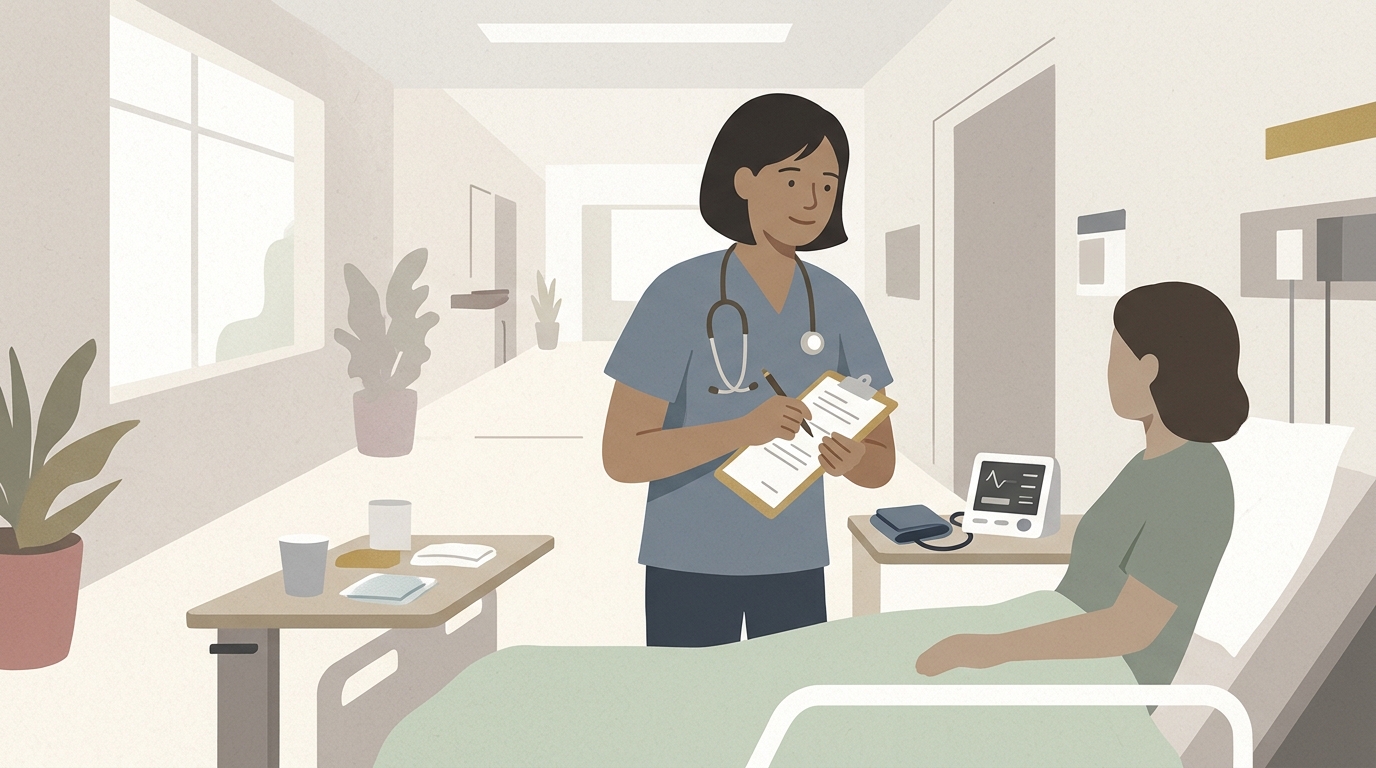
Nursing suits people who can stay organized and kind while being interrupted constantly, and who don't mind that a large slice of the job is documentation rather than bedside time. The work is physical, people-saturated and procedure-driven: medication rounds, assessments, charting in an electronic health record, and passing information to the next shift without losing a detail.
This guide walks through the real task mix, the traits that predict who lasts, how the role compares with being a nurse practitioner, and a yes/no checklist you can answer honestly before you apply to a program.
What This Career Actually Involves
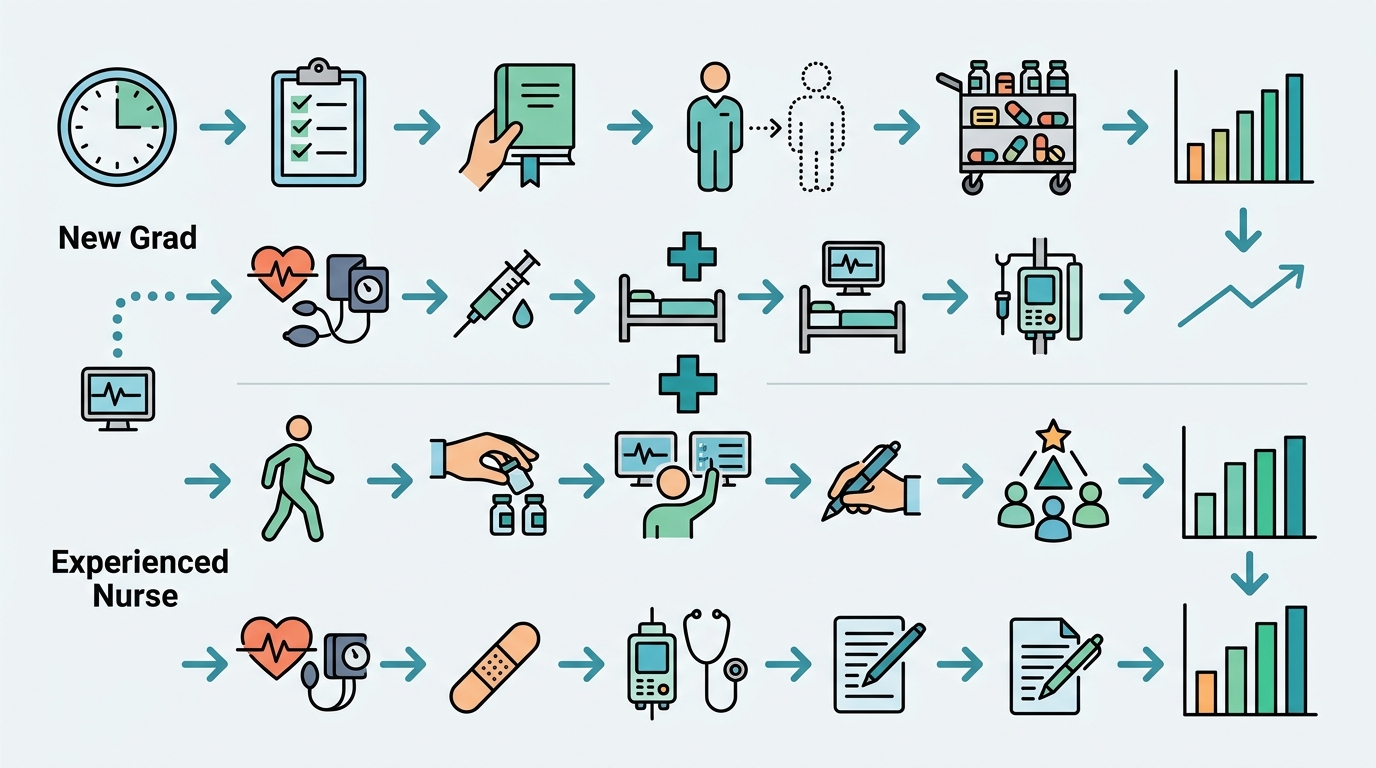
Registered nurses work in hospitals, physicians' offices, home healthcare services, nursing care facilities, outpatient clinics and schools (U.S. Bureau of Labor Statistics, 2025), and the mix changes with the setting. On a typical hospital medical-surgical or telemetry floor, a rough shape of the shift looks like this — it shifts by unit, acuity and how many patients you carry:
- Roughly a third on medication administration and treatments: pulling doses, scanning the barcode on the patient's wristband, programming IV pumps, watching for reactions.
- Roughly a quarter to a third charting in the electronic health record — the medical software ONET lists for this job (ONET OnLine, 2026) — logging vital signs, intake and output, wound descriptions and condition changes.
- Around a fifth on assessment and direct care: listening to lung sounds, checking telemetry rhythms, repositioning patients, answering call lights.
- The remainder on coordination — paging providers, giving an SBAR handoff at shift change, consulting with the care team on the plan of care, teaching a family how to manage a dressing or a new insulin pen at discharge.
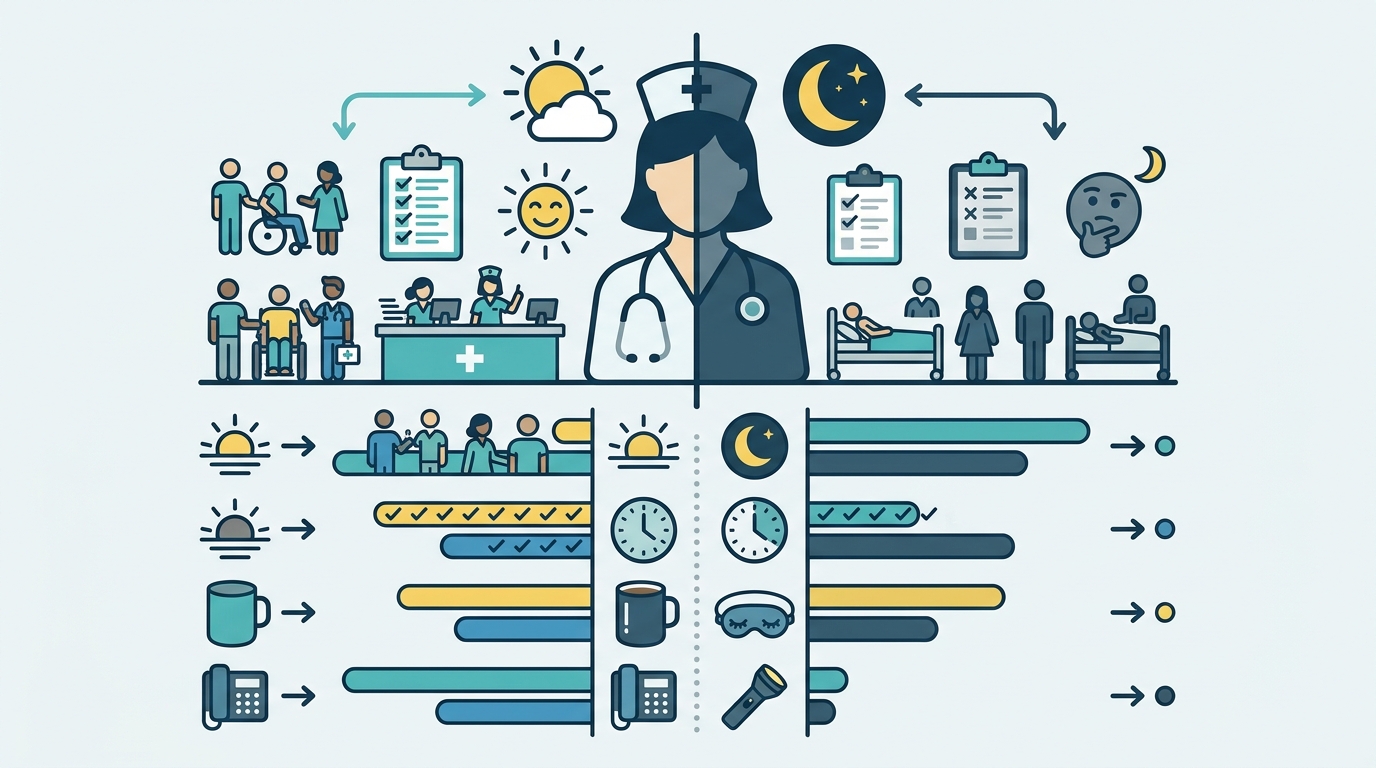
ONET's task list for registered nurses centers on exactly this: recording medical information and vital signs, administering medications and monitoring for reactions, maintaining accurate detailed records, reporting changes in patients' conditions, and consulting with the healthcare team (ONET OnLine, 2026). Many positions also expect CPR, basic life support (BLS) or advanced cardiac life support (ACLS) certification (U.S. Bureau of Labor Statistics, 2025), which means knowing your role in a code before one happens. Hospital work often runs nights, weekends and holidays.
Home health and school nursing trade the code cart for driving, solo judgment and far more phone work.
Specialty units change the ratios: an outpatient clinic skews toward teaching and triage calls, an ICU toward monitoring and drip titration.
Interruptions are the constant — ONET records constant contact with others and daily face-to-face discussions as standard work context for the role (ONET OnLine, 2026).
Traits and Skills That Predict Success
The U.S. Bureau of Labor Statistics (2025) lists critical thinking, communication, compassion, detail orientation, emotional stability, organizational skills and physical stamina as the important qualities for registered nurses. Here is what each one actually looks like on shift:
- Detail orientation under interruption — you'll verify drug, dose, route, time and patient against the order while someone is talking to you, and a missed decimal point matters.
- Critical thinking that acts early — you'll notice a blood pressure drifting down across three sets of vitals and escalate before the patient crashes, rather than waiting for the next scheduled check.
- Emotional stability — you'll finish a death in one room and go straight to discharge teaching in the next, then document both accurately.
- Organizational skill with a running task list — you'll hold four to six patients' medication times, lab draws, dressing changes and discharge paperwork in a workable order and rebuild that order when an admission lands.
- Communication that survives handoff — you'll give a structured report at shift change and call a provider at 3 a.m. with a clear, short summary of what changed.
- Compassion that shows in small acts — you'll explain a procedure to a frightened patient who has already been told twice, without sounding rushed.
- Physical stamina — you'll stand, walk and help reposition or transfer adults for the length of a long shift, often with limited breaks.
- Tolerance for documentation — you'll close the shift writing records that another nurse, an auditor or a court could read, after the clinical work is done.
- Steadiness when blamed — you'll absorb a family member's anger about a delayed test result and keep providing care to that patient.
This Career vs. a Common Alternative
The role people most often confuse with registered nursing is the nurse practitioner (NP). An NP is a nurse who has gone further; the day-to-day jobs are genuinely different.
| Difference | Registered nurse (RN) | Nurse practitioner (NP) |
|---|---|---|
| Entry credential | One of 3 routes — bachelor's, associate's or diploma; BSN programs typically take 4 years and diploma programs 2 to 3 years (U.S. Bureau of Labor Statistics, 2025) | At least a master's degree in one of the APRN roles, on top of an undergraduate nursing degree (U.S. Bureau of Labor Statistics, 2025) |
| Exams and licensure | The NCLEX-RN, taken after graduating from an approved nursing program, with licensure through your state's Nursing Regulatory Body | State APRN licensure plus 1 national certification exam in the chosen role (U.S. Bureau of Labor Statistics, 2025) |
| Daily task split | Weighted toward medication administration, assessment, monitoring and charting; care is carried out and escalated | Weighted toward diagnosing, ordering and interpreting tests, and prescribing within the scope your state allows |
| Pay structure | Usually an hourly base with shift, weekend and overtime differentials; BLS publishes a median annual wage for registered nurses (2025) | Usually salaried, sometimes with productivity components; BLS lists a median annual pay for nurse practitioners separately on its fastest-growing occupations table (2025) |
| Outlook | BLS projects employment growth for registered nurses and a large number of annual openings over 2025-35 (2025) | BLS projects a growth rate for nurse practitioners over the same 2025-35 decade (2025) |
Look up both current pay figures and both growth rates side by side in the BLS Occupational Outlook Handbook before you choose — they are updated and they differ by state and setting.
The practical point: you cannot start as an NP. You become an RN first, so the question is whether the RN work itself suits you for the years it takes to decide about graduate school.
Signs This Career Fits You
Answer each of these yes or no. Count your yeses honestly rather than aspirationally.
- You've stayed calm while someone yelled at you about something that wasn't your fault.
- You've worked a job where you were on your feet for most of a shift and finished it without resenting the whole day.
- You've handled someone else's vomit, blood or incontinence without needing to leave the room.
- You've kept an accurate written record — a log, a chart, a till count, a checklist — when nobody was watching you do it.
- You've been interrupted mid-task five times and still finished the original task correctly.
- You've explained something technical to a confused person twice in a row without changing your tone.
- You've worked nights, weekends or holidays before and know how your body and your relationships handled it.
- You've noticed something small was off — a number, a color, someone's breathing — and spoken up when it would have been easier to say nothing.
- You've been part of a team where you had to tell someone senior that you disagreed, and did it.
- You've read a description of medication rounds, charting and discharge teaching and felt interested rather than bored.
Seven or more yeses is a strong signal. Fewer than five usually means spend time in the setting first — as a nursing assistant, unit clerk, home health aide or volunteer — before you pay for a program.
Frequently asked questions
How long does it take to become a registered nurse?
It depends on which of the three education routes you take. The U.S. Bureau of Labor Statistics (2025) states that registered nurses usually enter through a bachelor's degree, an associate's degree or a diploma program, with BSN programs typically taking 4 years and diploma programs typically taking 2 to 3 years. Add time after graduation for licensure paperwork and for scheduling and sitting the NCLEX-RN.
What do I have to do to sit the NCLEX-RN?
You must graduate from an approved or accredited nursing program first. You then apply for licensure or registration with your state's Nursing Regulatory Body, register and pay the exam fee with Pearson VUE, and wait for your Authorization to Test before you can book a seat. Because the Nursing Regulatory Body is state-based, the application steps and timing vary by state, so work from your own board's instructions.
What is on the NCLEX-RN, and how is it scored?
The NCLEX-RN Test Plan effective April 2023 (National Council of State Boards of Nursing) weights Management of Care at 15-21% and Safety and Infection Control at 10-16% within Safe and Effective Care Environment, with Health Promotion and Maintenance at 6-12% and Psychosocial Integrity at 6-12%. It is not scored as a simple raw pass mark: a computerized adaptive algorithm stops the exam once it is 95% certain your ability is clearly above or below the passing standard. That is why two candidates can answer very different numbers of questions and both pass.
How is nurse pay structured, and where do I check current rates?
Hospital registered nursing is usually paid as an hourly base rate with differentials added for nights, weekends and holidays, plus overtime; clinic, school and some home health roles are more often salaried. The U.S. Bureau of Labor Statistics publishes a median annual wage for registered nurses in its Occupational Outlook Handbook (2025), and that is the figure to look up rather than relying on averages quoted elsewhere. Rates vary by state, by employer and by whether the unit is unionized, so also compare current postings in the metro area where you intend to work.
Do I need certifications beyond my RN license?
Often, yes. The U.S. Bureau of Labor Statistics (2025) notes that registered nursing positions may require CPR, basic life support (BLS) or advanced cardiac life support (ACLS) certification, and emergency and critical care units are the most likely to insist on ACLS. Beyond that, you can certify through professional associations in areas such as ambulatory care, gerontology or pediatrics; these are usually voluntary, though some employers require them for specific posts.
Is demand for nurses actually growing?
The U.S. Bureau of Labor Statistics (2025) projects employment growth for registered nurses over the 2025-35 decade and a substantial number of projected annual openings across that period, many of them from workers leaving the occupation. Demand is uneven, though — openings concentrate in hospitals, nursing care facilities and home healthcare services, and a rural clinic and a large metro hospital will not have the same hiring picture. Check the current growth figure and openings number in the Occupational Outlook Handbook, then look at live postings in your own state.
Sources
- U.S. Bureau of Labor Statistics — Registered Nurses : Occupational Outlook Handbook (2025)
- U.S. Bureau of Labor Statistics — Nurse Anesthetists, Nurse Midwives, and Nurse Practitioners : Occupational Outlook Handbook (2025)
Your coach for this guide
Lena builds long-form conversations with workers across industries, chasing the specific texture of a job rather than its title. She's most interested in the gap between what a role is called and what it actually asks of someone.