Is a Career in Cybersecurity Right for You?
A look at the monitoring, patching and incident write-ups behind the job, plus how it differs from network administration and who tends to last in it.

By Marcus BellweatherOct 28, 2026 · 8 min read
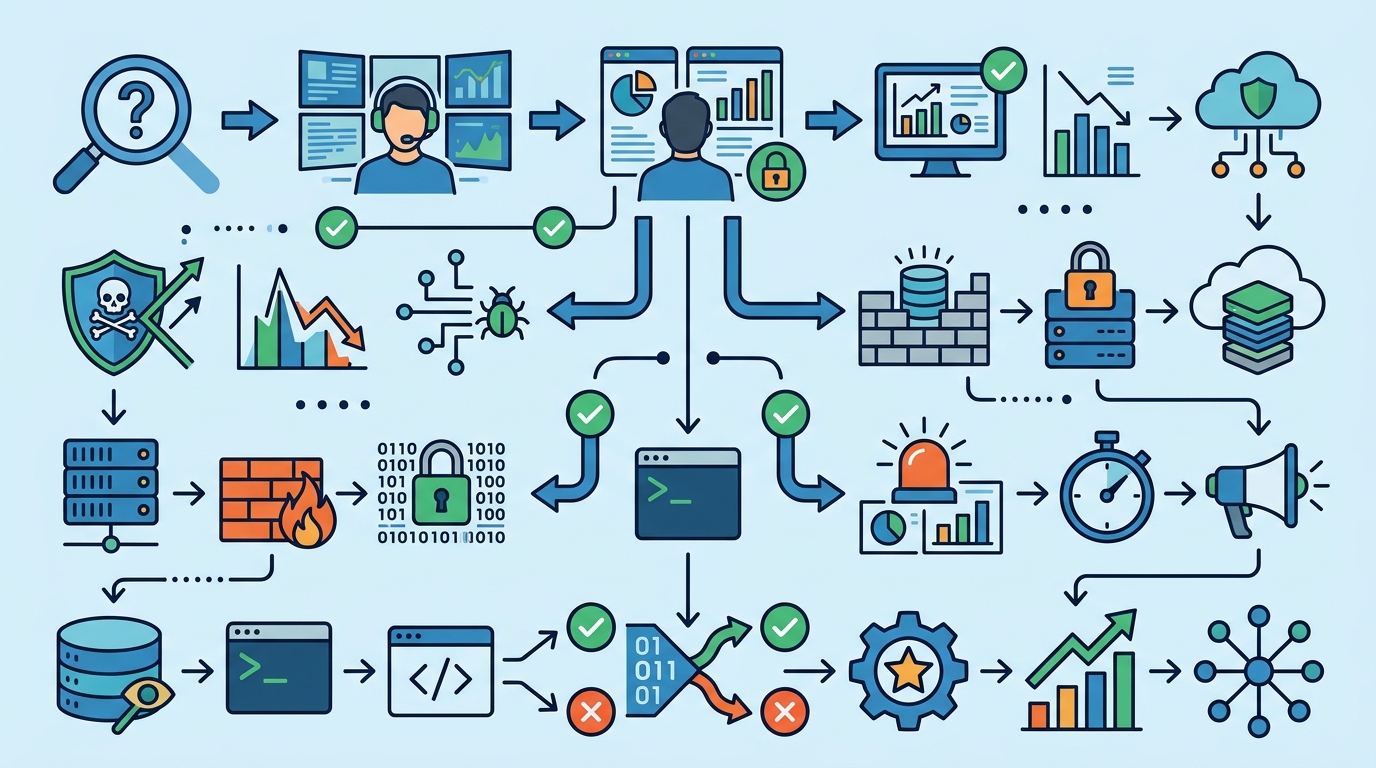
Cybersecurity suits you if you like noticing small inconsistencies in data, you can keep working a problem after the obvious answer fails, and you don't mind being the person who says no to a convenient shortcut. Most of the work is monitoring networks for breaches, maintaining firewalls and encryption tools, and hunting for vulnerabilities before someone else finds them (U.S. Bureau of Labor Statistics, 2025).
It is a growing field — employment of information security analysts is projected to grow 21 percent from 2025 to 2035, much faster than average (U.S. Bureau of Labor Statistics, 2025) — but it is not an easy entry. Most employers expect a bachelor's degree, some prior IT experience, and often a security certification.
What This Career Actually Involves
The core of an information security analyst's week is watching and checking. Roughly 35 to 45 percent of the time goes to monitoring the organization's networks for security breaches and working alerts — pulling logs in a SIEM console, chasing a flagged login from an unexpected country, deciding whether an endpoint detection alert is a real intrusion or a developer running a scanning tool they forgot to announce.
Another 20 to 25 percent is tool work: using and maintaining software such as firewalls and data encryption programs, encrypting data transmissions, and monitoring current reports of computer viruses to decide when virus protection systems need updating (U.S. Bureau of Labor Statistics, 2025; O*NET).
About 15 to 20 percent goes to vulnerability work — running scans against servers and web applications, reading the output, and arguing with system owners about patch windows. Vulnerability scanners, ticketing systems like a service desk queue, and cloud consoles are where this happens.
The rest is writing and planning. Analysts are heavily involved in creating the organization's disaster recovery plan and continually testing its steps (U.S. Bureau of Labor Statistics, 2025), plus developing plans to safeguard computer files against accidental or unauthorized modification, destruction, or disclosure (O*NET). That means tabletop exercises, incident reports, risk write-ups and briefings for people who do not want to hear them.
Settings vary. Computer systems design and related services is the largest employer category (U.S. Bureau of Labor Statistics, 2025), where you may rotate across client environments; in-house teams at a hospital or bank go deeper on one estate. On-call rotations are common but not universal.
Traits and Skills That Predict Success
- Tolerance for routine detail work — people drawn to this occupation tend to like activities involving data, detail and regular routines (O*NET), and that is what triaging a daily alert queue feels like.
- Perseverance — O*NET lists it for this role, and you'll need it the fourth time you re-trace an intrusion timeline because the log timestamps are in three different time zones.
- Intellectual curiosity — also listed by O*NET; it shows up as reading vulnerability advisories and deciding whether your own systems are exposed before anyone asks.
- Willingness to deliver unwelcome news — you'll tell a project team their launch date slips because a scan found an unauthenticated admin interface.
- Precise writing — incident reports and risk findings get read by auditors, lawyers and executives who were not in the room.
- Comfort with ambiguity — half of alerts are neither clearly benign nor clearly malicious, and you still have to make a call and record why.
- Adaptability — O*NET names it, and it matters when a vendor patch breaks a production service at 2am and you're on the bridge call.
- Initiative — nobody will assign you the task of testing the disaster recovery plan steps; analysts are expected to drive that testing themselves (U.S. Bureau of Labor Statistics, 2025).
- Basic systems fluency — you need to read a firewall rule and a server configuration without a translator, because that is the raw material of the job.
This Career vs. a Common Alternative
The job readers most often confuse with security analyst is network and computer systems administrator. They sit next to each other, share tools, and sometimes share a person — but the pay, the trajectory and the hours differ.
| Factor | Information security analyst | Network and computer systems administrator |
|---|---|---|
| Median annual wage | $129,180 in May 2025 (U.S. Bureau of Labor Statistics, 2025) | $99,130 in May 2025 (U.S. Bureau of Labor Statistics, 2025) |
| Entry education | Bachelor's degree typically (U.S. Bureau of Labor Statistics, 2025); O*NET rates education 3 of 4, a bachelor's or post-college certificate | Bachelor's degree typically (U.S. Bureau of Labor Statistics, 2025) |
| Prior experience expected | Less than 5 years in a related occupation typically needed (U.S. Bureau of Labor Statistics, 2025) | No related work experience typically required (U.S. Bureau of Labor Statistics, 2025) |
| Credentials employers look for | Many employers prefer an information security certification, including specialized ones such as systems auditing (U.S. Bureau of Labor Statistics, 2025) | Vendor and networking credentials are common, but not described as a typical preference |
| Daily task split | Breach monitoring, firewall and encryption software upkeep, vulnerability checks, disaster recovery plan testing (U.S. Bureau of Labor Statistics, 2025) | Installing, configuring and maintaining LANs, WANs, data communication networks, operating systems and servers (U.S. Bureau of Labor Statistics, 2025) |
| Job counts, 2025 | About 192,900 jobs (U.S. Bureau of Labor Statistics, 2025) | About 323,600 jobs (U.S. Bureau of Labor Statistics, 2025) |
| Outlook, 2025-35 | Projected to grow 21 percent, about 40,600 added jobs (U.S. Bureau of Labor Statistics, 2025) | Projected to decline 4 percent (U.S. Bureau of Labor Statistics, 2025) |
The practical read: administration is the easier door to walk through with no experience, and it is a legitimate route into security later. Security pays more and is growing while administration shrinks, but it expects you to arrive with something already on your record.
Signs This Career Fits You
Answer each of these yes or no. Six or more yeses is a good sign.
- You've spent an evening chasing down why a system behaved oddly, even though nobody asked you to.
- You've kept a written record of steps you took to fix something, so you could repeat it later.
- You've told someone their plan had a flaw, in writing, and held the position when they pushed back.
- You've worked a queue of repetitive items — tickets, orders, claims, lab samples — without losing attention by item forty.
- You've read technical documentation end to end rather than searching for the one line you hoped would fix it.
- You've been reachable out of hours for work, and did not resent the call.
- You've had to say the same cautious thing three times to three audiences, and adjusted the wording each time instead of repeating yourself.
- You've already worked in IT support, systems, networking or software — or you have a concrete plan to, given that less than 5 years of related experience is typically needed before a security analyst role (U.S. Bureau of Labor Statistics, 2025).
- You've finished a certification, course or qualification that nobody made you take.
- You've been wrong in public about a technical call and corrected the record yourself.
Frequently asked questions
Do I need a degree to work in cybersecurity?
Typical entry-level education for information security analysts is a bachelor's degree (U.S. Bureau of Labor Statistics, 2025), and O*NET rates education for the role 3 of 4, describing a bachelor's degree or a certificate after college as usually needed. Some employers substitute demonstrated experience plus certification, but that varies by employer and by sector — government and regulated industries tend to be stricter. Check the actual postings for the employers you want before deciding a degree is optional.
How much do cybersecurity jobs pay?
The median annual wage for information security analysts was $129,180 in May 2025 (U.S. Bureau of Labor Statistics, 2025). My Next Move shows a sample range from $75,090 to $199,850 around that same median (O*NET). Pay varies by state, industry and your years of experience, so look up the current figures for your state on the Bureau of Labor Statistics occupational pages rather than relying on a national median.
Is cybersecurity a growing field?
Yes. Employment of information security analysts is projected to grow 21 percent from 2025 to 2035, much faster than the average for all occupations, adding about 40,600 jobs (U.S. Bureau of Labor Statistics, 2025). That works out to roughly 14,100 openings a year on average across the decade, counting replacements as well as new positions.
Can I get into cybersecurity with no IT experience?
It is harder than most adverts suggest. Work experience in a related occupation is typically needed, listed as less than 5 years (U.S. Bureau of Labor Statistics, 2025), which usually means help desk, systems or network work first. By contrast, network and computer systems administrator roles typically require no related work experience at entry (U.S. Bureau of Labor Statistics, 2025), which is why many people start there.
Which certification should I get first?
Many employers prefer candidates who hold an information security certification, and the Bureau of Labor Statistics notes that some certifications target entry-level workers while others, including specialized ones such as systems auditing, target experienced workers (U.S. Bureau of Labor Statistics, 2025). Pick based on the certifications named in job postings in your area and sector, not on general popularity. Confirm current exam requirements and fees directly with the certifying body before you pay for training.
What kind of employers hire security analysts?
Computer systems design and related services was the largest employer category for information security analysts (U.S. Bureau of Labor Statistics, 2025), which includes consultancies and managed service providers working across multiple client networks. Finance, healthcare, government and large retailers also staff in-house teams. The work differs: consultancy means more client variety and travel, in-house means one environment you learn deeply over several years.
Sources
- U.S. Bureau of Labor Statistics — Information Security Analysts : Occupational Outlook Handbook (2025)
- U.S. Bureau of Labor Statistics — Network and Computer Systems Administrators : Occupational Outlook Handbook (2025)
Your coach for this guide
Marcus writes a running column on the economics of work, from gig platforms to apprenticeships. He's skeptical of easy career advice and prefers questions to conclusions.