How to Become a Real Estate Agent: A Step-by-Step Guide
Licensing hours, exam rules, background checks and broker sponsorship, laid out in the order a new agent actually has to tackle them.

By Yuki Tanaka-ReevesOct 28, 2026 · 11 min read
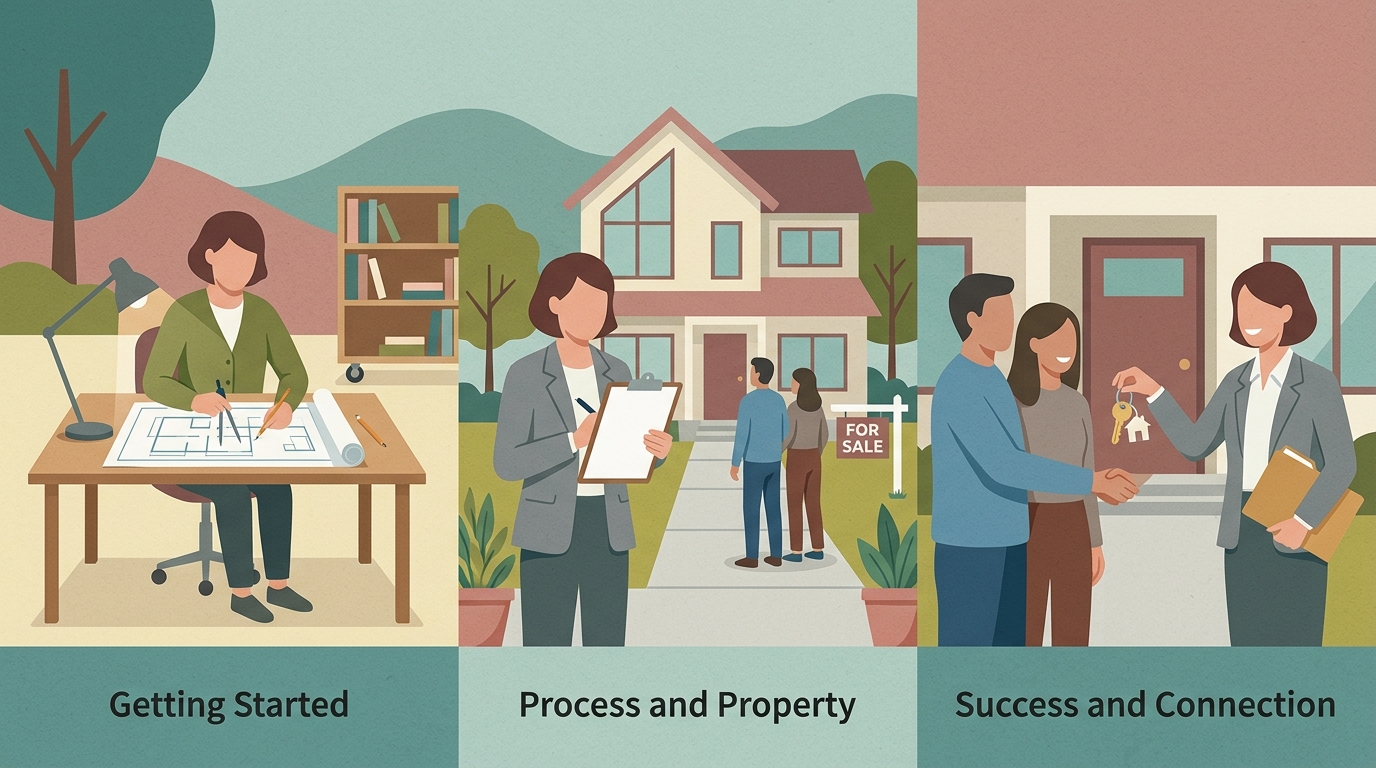
Becoming a real estate agent means getting a state license, and every state requires one (U.S. Bureau of Labor Statistics, undated). The usual sequence is: meet your state's age and education minimum, finish an approved prelicensing course, pass a licensing exam, clear a background check, and hang your license with a sponsoring broker. Most people get through it in four to six months, and a focused candidate can finish in eight to ten weeks (Opendoor, undated).
The academic bar is low — a high school diploma or equivalent is the typical entry-level education (U.S. Bureau of Labor Statistics, 2025) — but the coursework hours, fees and exam rules are set state by state and differ a lot. Before you commit, note that income arrives as commission splits rather than a wage (RealEstateU, summarizing the BLS Occupational Outlook Handbook, undated), so your first months are paid work only if you can tolerate calling a lead back a fourth time and sitting Saturday open houses with no guaranteed closing.
Step-by-Step Path to Entry
- Confirm your state's age, education and background rules — one evening on your state commission's website. States generally require candidates to be at least 18, complete a set number of real estate or college course hours, and pass a licensing exam (U.S. Bureau of Labor Statistics, undated). Alabama sets the floor higher at 19 years of age, with a high school diploma or equivalent, U.S. citizenship or lawful presence, and no felony or crime-of-moral-turpitude conviction (CareerOneStop, undated). Write down three numbers before you spend anything: the age minimum, the course hours and the exam fee.
- Enroll in a state-approved prelicensing course — the longest single block inside the 4-to-6-month typical timeline (Opendoor, undated). Hours vary sharply: Michigan 40, Florida 63, New York 75, California 135, Colorado 168 and Texas 180 (Opendoor, undated; 360training, undated). Washington State requires 60 clock hours completed within the 5 years before the exam (North Seattle College, undated). Texas's 180 hours are six 30-hour courses — Principles of Real Estate I and II, Law of Agency, Law of Contracts, Promulgated Contract Forms and Real Estate Finance (The CE Shop, undated) — and TREC caps instruction at 12 hours per day, so even full-time study cannot finish it in under 15 days (360training, undated).
- Start the background check during your first week of coursework. Kansas requires a background check as part of its agent and broker licensing, alongside a specific pre-license course and a third-party administered exam (CareerOneStop, 5 September 2024). Book fingerprinting early so the results are not the item holding up your application file.
- Book your exam date the week you finish your course hours. California's salesperson exam is 150 multiple-choice questions in 3 hours, passing at 70%, which is 105 correct answers (US Realty Training, undated). Nevada applicants sit both state and national examinations (CareerOneStop, undated). Budget for the attempt fee: $15 in New York, $36.75 in Florida, $58 in Texas, $100 in California, $175 in Georgia and $210 in Washington (RealEstateU, undated).
- Submit the license application and fees the same week you pass. Georgia's salesperson license carries a $170.00 application fee and a $91.00 testing fee (CareerOneStop, 10 September 2024). Keep your course completion certificate, exam score report and background check receipt in one folder; a missing certificate is the most common reason an otherwise complete file sits unprocessed.
- Interview brokerages and affiliate your license as soon as your license number issues. Ask each office what the commission split is, who pays for signage and lockboxes, and whether new agents get floor time. Plan on a learning curve: agents starting with no prior work experience typically need 1 to 12 months of on-the-job training (CareerOneStop, undated), and ONET rates Real Estate Sales Agents as Job Zone 1-2, 'Very Little to Some Preparation Needed', with training from a few days to one year (ONET OnLine, U.S. Department of Labor, undated).
- Decide about REALTOR® membership in your first month at a brokerage. A licensed agent becomes a REALTOR® by joining a local REALTOR® association, which also enrolls them in the state association and the National Association of REALTORS®, and by agreeing to NAR's Code of Ethics (National Association of REALTORS®, undated). National dues were $150 annually in 2023 and $156 annually in 2024, plus a $45 special assessment in both years for a consumer advertising campaign, and dues can change year to year (National Association of REALTORS®, 2024). Local and state dues are charged on top.
- Put continuing education and renewal on the calendar from day one. Kansas requires continuing education to maintain the license (CareerOneStop, 5 September 2024), and Georgia renewal costs $100.00 online or $125.00 by mail or walk-in (CareerOneStop, 10 September 2024). If you later want your own shop, most states require one to three years' experience as a licensed sales agent before a broker's license (CareerOneStop, undated).
Entry Requirements at a Glance
- Age: at least 18 in most states (U.S. Bureau of Labor Statistics, undated); Alabama requires 19 (CareerOneStop, undated). Washington State and Georgia both set 18 (North Seattle College, undated; CareerOneStop, 10 September 2024).
- Education: a high school diploma or equivalent is the typical entry-level requirement (U.S. Bureau of Labor Statistics, 2025), and Georgia and Alabama both name it explicitly in their license rules (CareerOneStop, 10 September 2024; CareerOneStop, undated).
- Prelicensing hours: a state-approved course of at least 40 hours (Michigan) up to 180 hours (Texas), with New York at 75, California at 135 and Colorado at 168 (Opendoor, undated), Florida at 63 (360training, undated) and Washington at 60 clock hours taken within the 5 years before the exam (North Seattle College, undated).
- College alternative where offered: Georgia accepts 10 quarter hours (6 semester hours) of accredited college real estate courses in place of the 75-hour course (CareerOneStop, 10 September 2024); Nevada requires 64 college semester units combining real estate, business, economics and other college-level coursework (CareerOneStop, undated).
- Licensing exam: a pass on your state's exam — for example California's 150-question, 3-hour salesperson exam at a 70% (105 correct) pass mark (US Realty Training, undated), or Nevada's separate state and national examinations (CareerOneStop, undated).
- Background check: required in states such as Kansas (CareerOneStop, 5 September 2024). Alabama additionally bars applicants convicted of a felony or a crime of moral turpitude (CareerOneStop, undated).
- Legal status: Alabama requires applicants to be a U.S. citizen or lawfully present (CareerOneStop, undated); confirm your own state's wording with its real estate commission.
- Sponsoring broker: a new licensee practices under a brokerage, and expects 1 to 12 months of on-the-job training with no prior work experience required (CareerOneStop, undated).
- Money up front: course tuition, an exam attempt fee from $15 in New York to $210 in Washington (RealEstateU, undated), and an application fee such as Georgia's $170.00 (CareerOneStop, 10 September 2024) — all payable before you can earn a commission.
Comparing Entry Routes
| Route | Time to entry | Approximate cost | How earnings start |
|---|---|---|---|
| State-approved prelicensing course (online or classroom), then the state exam | 8 to 10 weeks if focused; 4 to 6 months typical (Opendoor, undated). Florida's 63 hours plus a first-attempt exam pass is described as a realistic twelve weeks (360training, undated); Texas's 180 hours cannot be done in under 15 days under TREC's 12-hour daily cap (360training, undated) | Course tuition, plus an exam fee of $15 (New York) to $210 (Washington) (RealEstateU, undated), plus an application fee such as Georgia's $170.00 and testing fee of $91.00 (CareerOneStop, 10 September 2024) | No fixed wage: income comes from commissions split among the buying agent, selling agent, brokers and firms (RealEstateU, summarizing the BLS Occupational Outlook Handbook, undated). Ask each brokerage for its current split and check your state REALTOR® association for local norms |
| Accredited college real estate coursework used in place of the prelicensing course | Set by your college's term calendar — Georgia accepts 10 quarter hours (6 semester hours) instead of its 75-hour course (CareerOneStop, 10 September 2024), so longer than the 4-to-6-month course route (Opendoor, undated) | Per-credit college tuition for 6 semester hours, plus the same state fees — in Georgia, $170.00 application and $91.00 testing (CareerOneStop, 10 September 2024) | Identical commission structure; college credit does not change how you are paid, only how you met the education requirement |
| Degree-level coursework in a state that counts college units | Nevada requires 64 college semester units across real estate, business, economics and other college-level subjects (CareerOneStop, undated) — measured in college terms, against 135 course hours in California (US Realty Training, undated) | Tuition for 64 semester units, plus both the state and national examination fees (CareerOneStop, undated) | Same commission basis. The coursework can shorten the step to a broker's license, which in Nevada also needs at least 2 of the prior 4 years as a full-time licensed salesperson (CareerOneStop, undated) |
If speed matters most, the prelicensing course route is the shortest in nearly every state: 63 hours in Florida (360training, undated) against 64 semester units in Nevada (CareerOneStop, undated) is not a close contest. The college route is worth it mainly if you already hold credits, your state counts them, or you intend to move up to a broker's license, which in most states requires one to three years as a licensed sales agent anyway (CareerOneStop, undated).
Frequently asked questions
How much does it cost to get a real estate license?
Expect three separate bills: course tuition, the exam fee and the state application fee. Exam attempts run from $15 in New York to $36.75 in Florida, $58 in Texas, $100 in California, $175 in Georgia and $210 in Washington (RealEstateU, undated), and Georgia adds a $170.00 application fee and a $91.00 testing fee (CareerOneStop, 10 September 2024). Course prices are set by approved schools, so get quotes from two or three providers on your state commission's approved list before paying.
How old do I have to be, and do I need a degree?
Most states set the minimum at 18 and require a set number of course hours plus a licensing exam (U.S. Bureau of Labor Statistics, undated); Alabama requires 19 (CareerOneStop, undated). No degree is needed — the typical entry-level education for brokers and sales agents is a high school diploma or equivalent with short-term on-the-job training (U.S. Bureau of Labor Statistics, 2025). Nevada is the exception to watch, requiring 64 college semester units of real estate, business, economics and related coursework (CareerOneStop, undated).
Can I move my license to another state?
A license is issued by one state's commission and is not automatically good elsewhere, because each state sets its own course hours and exam — Washington wants 60 clock hours completed within the 5 years before the exam (North Seattle College, undated), while Texas requires 180 hours in six named 30-hour courses (The CE Shop, undated). Contact the real estate commission in the state you are moving to and ask what it will credit from the coursework you already completed. Expect at minimum a new background check, as Kansas requires of all applicants (CareerOneStop, 5 September 2024), and a state-specific exam section.
How long does the whole process take, realistically?
Most agents earn a license in 4 to 6 months, and a focused candidate can finish in 8 to 10 weeks (Opendoor, undated). Florida's 63 hours plus a first-attempt exam pass makes roughly twelve weeks realistic (360training, undated), while Texas's 180 hours cannot legally be compressed below 15 days because TREC caps instruction at 12 hours per day (360training, undated). Add the background check and application processing on top, and ask your state commission for its current processing window.
Do I have to become a REALTOR®?
No — REALTOR® is a membership status, not a license. A licensed agent becomes one by joining a local REALTOR® association, which also enrolls them in the state association and the National Association of REALTORS®, and by agreeing to NAR's Code of Ethics (National Association of REALTORS®, undated). National dues were $150 annually in 2023 and $156 annually in 2024, plus a $45 special assessment in both years, and dues can change year to year (National Association of REALTORS®, 2024); local and state dues are extra. Some brokerages require membership as a condition of affiliation, so ask during interviews.
How soon will I actually be paid?
Real estate agents earn most income through commissions split among the buying agent, selling agent, brokers and firms, not a fixed wage (RealEstateU, summarizing the BLS Occupational Outlook Handbook, undated), so payment follows a closing rather than a pay period. Plan for the training ramp too: agents with no prior work experience typically need 1 to 12 months of on-the-job training (CareerOneStop, undated), and O*NET puts the occupation in Job Zone 1-2, with training from a few days to one year (O*NET OnLine, U.S. Department of Labor, undated). Ask prospective brokerages for their current split and whether they offer a draw against commission.
Sources
- U.S. Bureau of Labor Statistics — Real Estate Brokers and Sales Agents : Occupational Outlook Handbook (2025)
- U.S. Bureau of Labor Statistics — Real Estate Brokers and Sales Agents : Occupational Outlook Handbook (print version)
Your coach for this guide
Yuki covers early-career life, internships, and the strange first years of figuring out what work is for. She writes with the fresh impatience of someone still sorting out her own path.