What It's Really Like to Work as an Elementary School Teacher
A composite look at the bell schedule, the small-group reading table, the dismissal walkie-talkie and the evening grading in an elementary teacher's week.

By Yuki Tanaka-ReevesOct 28, 2026 · 9 min read
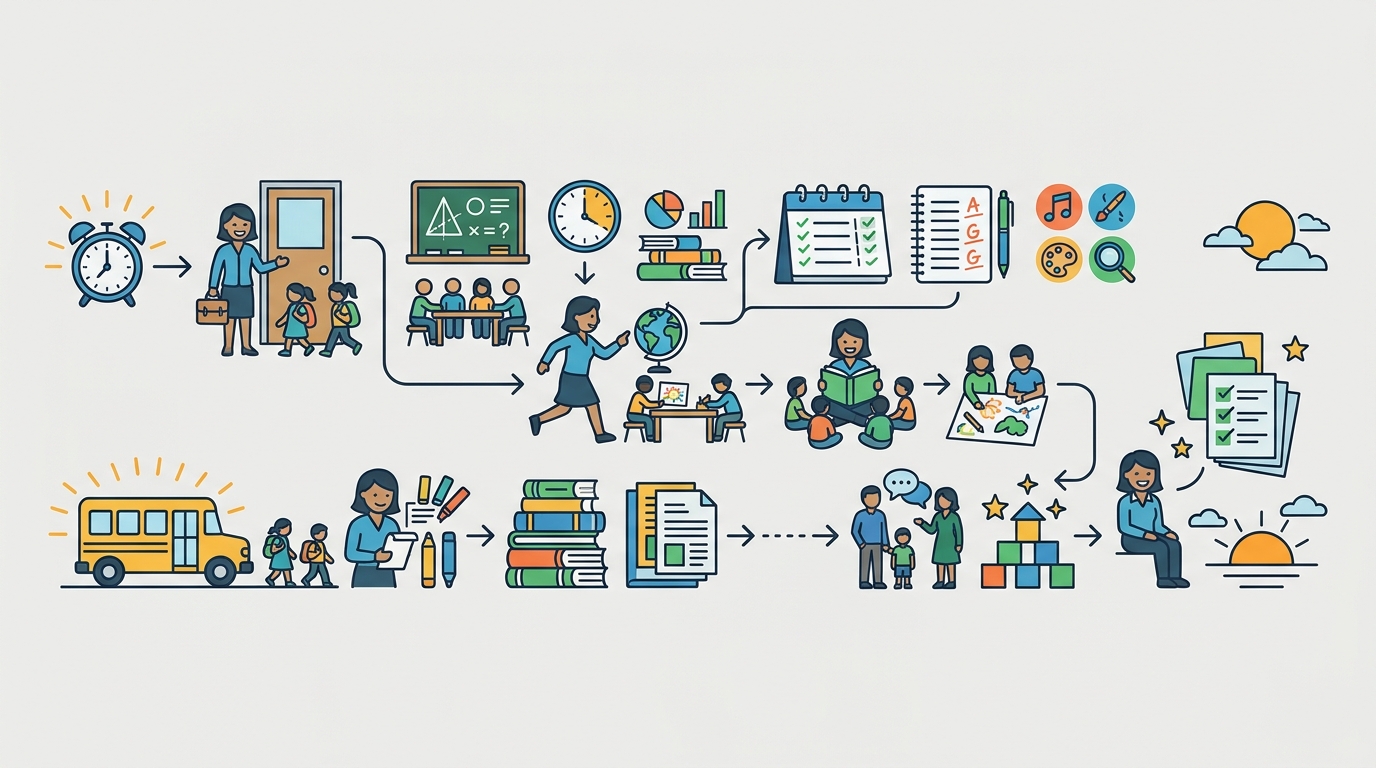
Working as an elementary school teacher means running a tightly timed day for a room of children — around 19 of them, based on the average self-contained elementary class size of 19.1 students in 2020-21 (National Center for Education Statistics). The instructional day ends when the buses pull out, but the job does not: teachers generally work school hours when students are present and use nights and weekends to prepare lessons and grade papers (U.S. Bureau of Labor Statistics, 2025).
This guide walks through a composite day, the duties that stack up weekly and seasonally, who tends to last in the role, and the licensing steps that apply in US public schools.
Hour-by-Hour: A Typical Shift
This is a composite day, assembled from duties the U.S. Bureau of Labor Statistics and O*NET list for the occupation. Bell times, duty rotations and planning periods vary by district and state, and a kindergarten day looks different from a fifth-grade day.
7:00 a.m.-7:30 a.m. — Set-up and inbox. You unlock the room, pull up district email and the student information system, and run copies of the day's math exit tickets at the workroom copier. You check with your grade-level teammate about which small group the reading interventionist is pulling.
7:30 a.m.-7:55 a.m. — Arrival duty. You work the car line with a walkie-talkie alongside the assistant principal, opening doors, sending students to breakfast, and taking a parent's question about a missed field-trip form.
7:55 a.m.-8:20 a.m. — Morning meeting. Students sit on the carpet for greeting and the schedule on the whiteboard. You enter attendance and the lunch count in the student information system while the class does a partner share — part of teaching students to interact with others, a listed duty (U.S. Bureau of Labor Statistics).
8:20 a.m.-9:45 a.m. — Literacy block. A whole-group mini-lesson from the district reading curriculum, then three rotations at the kidney table: guided reading with leveled texts, a running-records clipboard for one student's fluency check, and a quick conference with the paraprofessional about a child who needs decodable text.
9:45 a.m.-10:30 a.m. — Specials and planning. While students are at art, music or P.E., you grade writing samples against the rubric, log two behavior notes in the tracking system, and email a parent about a reading goal.
10:30 a.m.-11:45 a.m. — Math block. A number talk on the document camera, hands-on work with base-ten blocks, then a five-question exit ticket you sort into three piles for tomorrow's groups. You adapt the task sheet for two students with IEP accommodations.
11:45 a.m.-12:25 p.m. — Lunch and recess. You walk the class to the cafeteria, eat at your desk, and take your turn on the recess rotation with a first-aid pouch and the same walkie-talkie.
12:30 p.m.-1:30 p.m. — Science or social studies. A hands-on investigation with lab trays, student science notebooks and a shared anchor chart. The special education teacher co-teaches part of the block.
1:30 p.m.-2:35 p.m. — Conferences, read-aloud, dismissal. You sit beside individual students with their drafts and a conferring notebook, close with a chapter of the read-aloud on the carpet, then pack folders and radio the office when your last car rider leaves.
2:45 p.m.-3:45 p.m. — Meetings. Depending on the day: a grade-level data meeting, an IEP meeting with the special education teacher, school psychologist and a parent, or professional development on the reading program.
7:30 p.m.-9:00 p.m. — At home. Tomorrow's plans, grading and two parent emails. Teachers generally use nights and weekends for this work (U.S. Bureau of Labor Statistics, 2025).
Core Responsibilities Beyond the Clock
- Weekly lesson planning (2-6 hours, usually Sunday or a weeknight): a filed set of plans for every subject block, aligned to state standards, with materials copied and centers prepped. Creating lesson plans is a core listed duty (U.S. Bureau of Labor Statistics).
- Weekly grade-level team meeting: a shared pacing decision and a list of students pulled for intervention, agreed with teammates and often an instructional coach.
- Every two to three weeks — running records or benchmark checks: an updated reading level for each student in the assessment platform, used to regroup your guided reading table.
- Monthly parent communication: a class newsletter plus individual calls for students whose grades or behavior have shifted. Conferring with parents, counselors and administrators about academic and behavioral problems is a standard task (O*NET OnLine, 2026).
- Twice-yearly conferences: a 15-minute meeting per family with a work-sample folder and a written goal sheet, often held over two evenings.
- IEP and 504 cycles (usually annually per student): written input on progress toward goals, recorded in the district's special education system.
- Spring testing season (several weeks): students prepared for state-required standardized tests, security protocols followed, your room reconfigured as a testing site (U.S. Bureau of Labor Statistics).
- End-of-year close-out (1-2 weeks): report cards submitted, cumulative files passed on, inventory returned, room packed.
- Annual professional development and license renewal: continuing education hours logged with your state education agency on a cycle that varies by state.
Who Tends to Thrive in This Role
People who last in elementary classrooms are comfortable being switched on continuously. The schedule above has no gap longer than 45 minutes between arrival duty at the car line and the last bus, and 89% of respondents report constant contact with others in this occupation (O*NET OnLine, 2026). If talking to a parent at 7:35 a.m. and then leading a carpet greeting at 7:55 a.m. sounds draining rather than energizing, that is useful information.
Physical closeness is part of the work: 95% of respondents report very close physical proximity, near touching (O*NET OnLine, 2026). That shows up at the kidney table in the 8:20 a.m. literacy block, where you lean over to point at a word, and again at the afternoon read-aloud with 19 children at your feet.
The role suits people who sort evidence quickly. The 10:30 a.m. exit ticket gets split into three piles in a few minutes, and the running record taken during guided reading changes which book a child holds the next morning — observing students to evaluate strengths and weaknesses is a listed duty (U.S. Bureau of Labor Statistics).
You also need to be genuinely collaborative. The paraprofessional conference mid-literacy block and the 2:45 p.m. IEP meeting with the school psychologist and a parent both require you to explain a child's performance to adults who may push back.
The demanding part is the back end: with 97% of respondents reporting weeks over 40 hours (O*NET OnLine, 2026) and a survey median of 54 hours (Education Week, April 2022), the 7:30 p.m. planning session is not optional. The satisfying part is concrete — the week a struggling reader's running record moves up a level, you can see which small group and which decodable text did it.
How to Get Started
Requirements are set state by state. Check your own state's education agency before paying for anything.
- Earn a bachelor's degree (about 4 years, roughly 120 semester credit hours). Elementary education degrees typically require around 120 credits including general education, subject-area and student-teaching credits (Learn.org). A bachelor's is the typical entry-level education for the occupation (U.S. Bureau of Labor Statistics, 2025); 78% of respondents said a bachelor's is required for new hires, 22% a master's (O*NET OnLine, 2026).
- Pass any program-admission test (a few weeks of prep; one sitting). Many states and preparation programs use the Praxis Core Academic Skills for Educators — Reading, Writing and Mathematics subtests — for admission into educator preparation programs (ETS / Study.com Teaching License Study).
- Complete an approved educator preparation program (concurrent with your degree, or 1-2 years after). With a bachelor's in a non-education field, an alternative certification pathway generally takes one to two years depending on state and subject (Chron).
- Do your student teaching (most commonly 12-16 weeks, one academic semester). This is usually the final step before licensure (ExplainThat). Expect a full school-day schedule under a mentor teacher, unpaid in many programs.
- Pass your state's content exam (study over 2-3 months). Most states require a Praxis Elementary Education subject exam, such as Elementary Education: Multiple Subjects, test code 5001 — four subtests, 245 questions, 4 hours 35 minutes, $180 (Study.com Teaching License Study).
- Clear additional state-specific requirements (weeks to months). North Carolina requires all licensure candidates to pass the Praxis Performance Assessment for Teachers or an approved alternative, and Connecticut requires a Foundations of Reading Test, a Pearson exam, for elementary, early childhood and special education licensure (Study.com Teaching License Study; We Are Teachers).
- Apply for your state license and start job hunting (1-3 months). Public school teachers must hold a state-issued certification or license (U.S. Bureau of Labor Statistics, 2025). Private schools set their own rules.
Frequently asked questions
Do elementary school teachers really get the summer off?
Most do not work during the summer (U.S. Bureau of Labor Statistics, 2025). In practice many use part of the break for curriculum work, district training, license renewal coursework, classroom setup or a second job. Contracts are typically written for a set number of duty days rather than year-round, and pay may be spread across 12 months even though the work is not.
How is elementary teacher pay structured?
Most US public districts pay from a published salary schedule, with steps for years of experience and lanes for degrees or credits earned, plus stipends for coaching or extra duties. Schedules are usually posted on district or state websites. For national figures, check the current median annual wage for kindergarten and elementary school teachers in the U.S. Bureau of Labor Statistics Occupational Outlook Handbook (2025).
Do I need a master's degree to teach elementary school?
Usually not to start: 78% of respondents said a bachelor's degree is required for new hires, while 22% said a master's (O*NET OnLine, 2026). Some states require a graduate degree or additional credits within a set period after initial licensure, and many salary schedules pay more for one. Confirm with your state education agency.
Is it hard to find an elementary teaching job?
The outlook for 2025-35 is little or no change in employment, with about 99,400 openings projected each year on average, mostly from workers transferring occupations or leaving the labor force (U.S. Bureau of Labor Statistics, 2025). Demand varies sharply by region, grade level and endorsement, so check hiring pages for the districts you would commute to.
Can I switch into teaching from another career?
Yes. With a bachelor's degree in a non-education field, alternative certification pathways generally take one to two years depending on state and subject (Chron). These routes often let you teach on a provisional license while completing coursework and assessments. Your state education agency lists approved providers; requirements do not transfer automatically between states.
Sources
- U.S. Bureau of Labor Statistics — Kindergarten and Elementary School Teachers : Occupational Outlook Handbook (2025)
- U.S. Bureau of Labor Statistics — Kindergarten and Elementary School Teachers : Occupational Outlook Handbook (print/archive version)
Your coach for this guide
Yuki covers early-career life, internships, and the strange first years of figuring out what work is for. She writes with the fresh impatience of someone still sorting out her own path.