What It's Really Like to Work as a Paramedic
A composite 24-hour tour on an ambulance, from the morning narcotics count to the chart you finish long after the patient has been handed off.

By Marcus BellweatherOct 28, 2026 · 9 min read
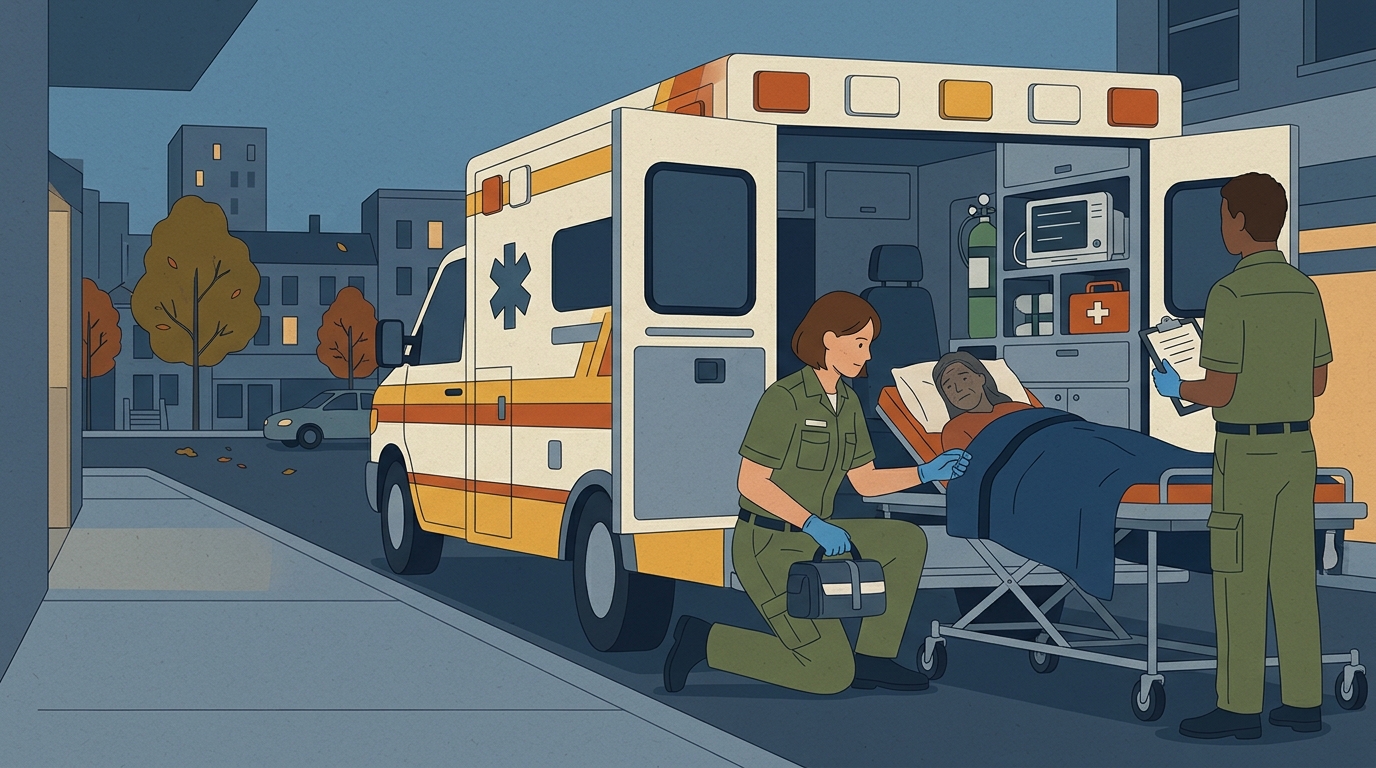
Working as a paramedic means long shifts of waiting broken by short bursts of high-stakes work: you respond to 911 calls, assess patients, deliver advanced prehospital care, transport them, and hand off a verbal and written report to hospital staff (U.S. Bureau of Labor Statistics, 2025). Paramedics go beyond the EMT scope — a wider range of intravenous medications, advanced airway management and EKG interpretation (U.S. Bureau of Labor Statistics, 2025).
The schedule is unusual and the body pays for it. Shifts can run 12, 18 or 24 hours, most paramedics work full time and some exceed 40 hours a week including nights, weekends and holidays, and the occupation has one of the highest rates of injuries and illnesses of all occupations (U.S. Bureau of Labor Statistics, 2025).
Hour-by-Hour: A Typical Shift
The day below is a composite 24-hour shift on a 911 ambulance, assembled to show the usual rhythm of the work rather than one real crew's log. Call volume, call types and downtime vary widely by service, county and season.
6:45 a.m. – 7:30 a.m. — Shift change and rig check. You take report from the off-going paramedic, then walk the ambulance with your EMT partner: oxygen pressure, cardiac monitor battery and 12-lead cable, airway kit, suction unit, drug box seals. The controlled-substance count is witnessed on the narcotics log, often with the shift supervisor present.
7:40 a.m. – 9:05 a.m. — Chest pain call. The 911 dispatcher tones you out to a residence (U.S. Bureau of Labor Statistics, 2025). You acquire and interpret a 12-lead EKG on the monitor, establish IV access, give medication per your medical director's protocols, and transmit findings to the receiving facility while your partner and an engine crew carry the patient out on the stair chair.
9:05 a.m. – 9:40 a.m. — Hospital handoff and charting. Verbal report to the charge nurse and emergency physician, then the electronic patient care report (ePCR) on a tablet: times, vitals, drug doses, ECG strips attached. Documenting and reporting treatment to physicians or nurses is core to the job (U.S. Bureau of Labor Statistics, 2025).
9:40 a.m. – 10:30 a.m. — Decontamination and restock. You wipe down the stretcher and monitor cables, bag linens, and replace supplies from the hospital EMS room, signing out controlled drug replacements with a supervisor (U.S. Bureau of Labor Statistics, 2025).
11:00 a.m. – 1:30 p.m. — Posting and standby. You park at an assigned post, monitor the radio and mobile data terminal, eat when you can, and work through online continuing education modules.
1:45 p.m. – 3:30 p.m. — Motor vehicle collision. You arrive alongside police and firefighters, who handle traffic and extrication while you triage at the car (U.S. Bureau of Labor Statistics, 2025). You coordinate transport decisions with the fire captain and a second ambulance crew, apply spinal motion restriction, and call a trauma alert by radio.
4:15 p.m. – 5:30 p.m. — Lower-acuity transport. A nursing facility requests transport for a resident with a fever. You review the transfer paperwork and medication list with the floor nurse, take vitals, and move a patient who cannot bear weight down a narrow hallway on the stretcher.
6:00 p.m. – 8:30 p.m. — Station time. Dinner with the crew, an oxygen cylinder swap, generator and tire checks on the rig, and a protocol update emailed by the medical director.
9:10 p.m. – 11:00 p.m. — Cardiac arrest. Dispatch sends you to an unresponsive patient with CPR in progress by the first-arriving engine company. You run the code — manual defibrillation, advanced airway, IV or IO medications — coordinating compression cycles with the fire crew, then speak with the family.
1:40 a.m. – 3:00 a.m. — Overnight call. A behavioral health call or an interfacility transfer. You de-escalate by talking, document consent carefully in the ePCR, and hand off to the receiving nurse.
3:00 a.m. – 6:30 a.m. — Broken sleep. You lie down in the bunk room between tones. Some nights you get four hours, some nights none.
6:45 a.m. — Clock-out. You close open charts, repeat the narcotics count with the oncoming medic, and hand over the radio.
Core Responsibilities Beyond the Clock
- Controlled substance and supply audits (monthly, plus every shift change): a signed narcotics log with no unexplained discrepancies and a restocked drug box for the next crew.
- QA chart review (monthly or quarterly, depending on service): flagged ePCRs reviewed with a field training officer or medical director, producing documented corrections on protocol deviations or missing vitals.
- Skills verification (quarterly or annually): signed competency check-offs on advanced airway placement, manual defibrillation and cardioversion, and medication calculation.
- CPR-BLS for Healthcare Provider credential (renewal cycle set by the issuing organization): a current card on file, required by the National Registry of Emergency Medical Technicians for Paramedic certification (NREMT, 2019).
- Continuing education toward recertification (ongoing, hours logged each cycle): a completed education record submitted to the National Registry and your state EMS office, which licenses you to work in that state — requirements vary by state (U.S. Bureau of Labor Statistics, 2025).
- Out-of-service reporting (weekly, or immediately on failure): a maintenance ticket and documented swap so no rig runs with a dead monitor battery or failed suction unit.
- Precepting students (seasonal, tied to program cohorts): signed field internship evaluations for paramedic students, whose programs include supervised field experience (U.S. Bureau of Labor Statistics, 2025).
- Event standby and surge coverage (seasonal, plus variable overtime): a patient log for races and holiday events, and filled schedule holes — one reason some paramedics exceed 40 hours a week (U.S. Bureau of Labor Statistics, 2025).
Who Tends to Thrive in This Role
Self-control is rated an important work style for paramedics (O*NET OnLine, U.S. Department of Labor, 2025), and the 9:10 p.m. cardiac arrest is where you find out whether you have it: you sequence defibrillation, airway and drugs while a family watches from the doorway. The same trait carries the 1:40 a.m. behavioral health call, where talking someone down is the intervention.
Attention to detail shows up in quieter places. The 6:45 a.m. narcotics count and the 9:05 a.m. ePCR are both jobs where one wrong number matters — a dose recorded incorrectly follows the patient into the hospital record, and a drug log discrepancy becomes a supervisor's problem and then yours.
Cooperation is not optional when the 1:45 p.m. collision puts you on a roadway with police managing traffic, a fire crew cutting a door and a second crew waiting on your triage decision (U.S. Bureau of Labor Statistics, 2025). The same skill gets the 4:15 p.m. nursing facility handoff done, because you need the floor nurse's medication list to write an accurate chart.
Physical strength is a stated requirement (U.S. Bureau of Labor Statistics, 2025), and the demand is concrete: the stair chair carry at 7:40 a.m. and the non-weight-bearing patient at 4:15 p.m. are where backs get hurt, part of why this occupation has one of the highest injury rates of all occupations (U.S. Bureau of Labor Statistics, 2025).
The hardest parts are specific: fragmented sleep between 3 a.m. and 6:30 a.m., and the conversation with a family after a code that did not work. So is the reward — interpreting a 12-lead at 7:40 a.m., transmitting it ahead, and finding the cath lab team waiting when you roll through the doors.
How to Get Started
Requirements vary by state, so confirm each step with your state EMS office before you pay for anything.
- Finish high school or equivalent and get a CPR-BLS for Healthcare Provider credential (days to a few weeks). The National Registry requires a current CPR-BLS for Healthcare Provider credential for Paramedic certification (NREMT, 2019).
- Complete an EMT-Basic program (typically less than 1 year) (U.S. Bureau of Labor Statistics, 2025). These run at community colleges, technical schools, hospitals and fire academies, full time or on nights and weekends.
- Certify and get licensed at the EMT level (weeks, depending on exam scheduling and state processing). All states require EMTs and paramedics to be licensed where they work, and requirements vary by state (U.S. Bureau of Labor Statistics, 2025).
- Work on an ambulance as an EMT (commonly 6 months to 2 years). At this level you care for patients at the scene and in the ambulance, managing respiratory, cardiac and trauma emergencies (U.S. Bureau of Labor Statistics, 2025) — and learn whether 24-hour shifts suit you.
- Complete EMT-Intermediate training (up to 2 years) (U.S. Bureau of Labor Statistics, 2025). Paramedic programs require applicants to hold EMT-Intermediate certification (U.S. Bureau of Labor Statistics, 2025), and the National Registry requires a current certification or state license at the EMT level or higher (NREMT, 2019).
- Complete a paramedic program (1 to 2 years at most community colleges; longer for a bachelor's). Most community college programs lead to a nondegree award or associate's degree, some universities offer a bachelor's, and programs include supervised field experience (U.S. Bureau of Labor Statistics, 2025). For National Registry certification the program must be CAAHEP-accredited or hold a CoAEMSP Letter of Review, completed within the past two years (NREMT, 2019).
- Pass the National Registry cognitive and psychomotor exams (weeks to a few months). Your Authorization to Test is valid for 90 days, psychomotor results post within four weeks, and passed results remain valid for 24 months (NREMT, 2019).
- Apply for your state paramedic license, then for jobs (weeks to months). Fire-based services usually add their own academy, physical ability test and hiring cycle.
Frequently asked questions
How is paramedic pay usually structured?
Most paramedic jobs pay an hourly rate with overtime past your employer's threshold, plus differentials for nights, weekends and holidays, and sometimes extra for certifications such as critical care or flight. Fire-based, hospital-based, municipal and private employers structure this differently, and rates vary by state and metro area. Check the U.S. Bureau of Labor Statistics Occupational Employment and Wage Statistics data for paramedics and current local job postings before committing to training.
Can I go straight into paramedic school without working as an EMT?
Paramedic postsecondary programs require applicants to hold EMT-Intermediate certification (U.S. Bureau of Labor Statistics, 2025), and National Registry Paramedic certification requires a current National Registry certification or state license at the EMT level or higher (NREMT, 2019). There is no route that skips the EMT level. Individual programs and states may add prerequisites, including a minimum period of field experience, so ask the program directly.
Is there demand for paramedics?
Paramedics held about 102,200 jobs in 2025, and employment of EMTs and paramedics overall is projected to grow 6 percent from 2025 to 2035 — faster than the average for all occupations — with about 18,200 openings projected each year on average (U.S. Bureau of Labor Statistics, 2025). Demand still varies locally by service model and funding, so check openings in the counties you would actually work in.
What roles can paramedics move into?
Reported job titles include Critical Care Paramedic, Firefighter Paramedic, First Responder and Flight Paramedic (O*NET OnLine, U.S. Department of Labor, 2025). Many paramedics also move into field training, quality assurance, dispatch supervision or EMS education, and some use the clinical hours toward nursing or physician assistant programs. Entry requirements differ, so confirm prerequisites with the specific employer or school.
Sources
- U.S. Bureau of Labor Statistics — EMTs and Paramedics : Occupational Outlook Handbook (2025)
- O*NET OnLine (U.S. Department of Labor) — 29-2043.00 - Paramedics : O*NET OnLine (2025)
Your coach for this guide
Marcus writes a running column on the economics of work, from gig platforms to apprenticeships. He's skeptical of easy career advice and prefers questions to conclusions.