Warehouse Worker Schedules Compared: What Each Shift Really Looks Like
Pickers, loaders and stockers cover the same concrete floor, but the roster size, the trailer volume and who you answer to all change after dark.

By Priya NatarajanOct 28, 2026 · 8 min read
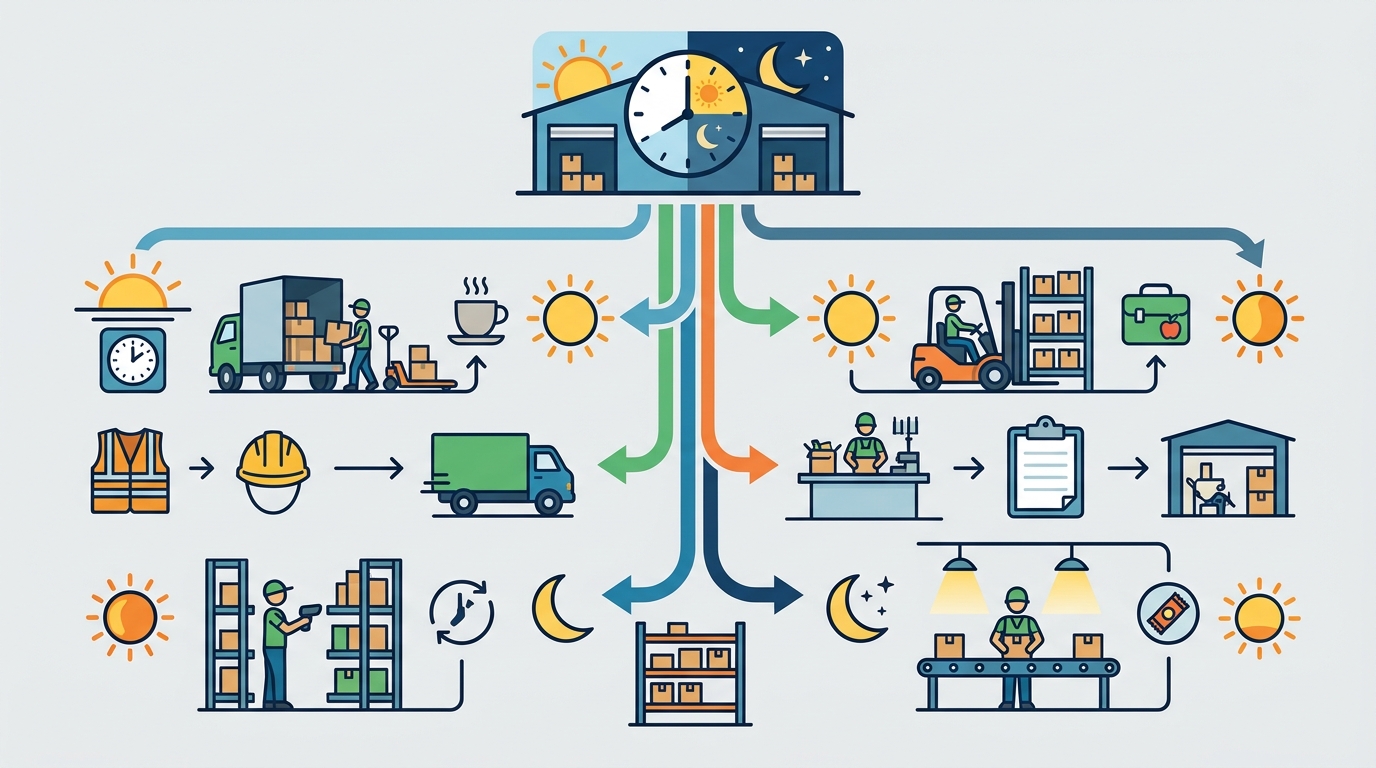
Warehouse work runs on shifts because freight does. Day shift is busier with people — more leads, more live dock doors, more interruptions — while night shift usually means a thinner crew, longer uninterrupted picking runs, and tasks like cycle counting and conveyor cleaning that are easier with empty aisles. Because materials are shipped around the clock, overnight work is common in warehousing specifically (U.S. Bureau of Labor Statistics, 2025).
Both hour-by-hour runs below are composite days, built from tasks typical of picking, loading and stocking roles rather than one real person's timesheet. Volume, automation and roster pattern change the details building to building.
Day Shift vs. Night Shift at a Glance
| Dimension | Day shift | Night shift |
|---|---|---|
| Staffing on the floor | Multiple zone leads, an on-site maintenance tech, HR and a safety coordinator reachable in the office | Often one supervisor for the whole building; maintenance and HR on call rather than on site |
| Pace and volume | Live dock doors most of the shift, drivers arriving against appointment windows | Front half heavy on container unloading, then a quiet stretch in the small hours |
| Typical tasks | Receiving, picking to an RF scanner, pack-out, loading outbound trailers, signing bills of lading with drivers | Unloading to the sorter, picking a wider zone solo, cycle counting clear aisles, staging freight for morning drivers |
| Pay structure | Hourly base, overtime past 40 hours in most US jobs | Same base plus a shift differential at most employers; the amount varies by employer and state, so confirm it in writing and use the U.S. Bureau of Labor Statistics (2025) pay data for hand laborers and material movers as your baseline |
| Interruption frequency | High: driver check-ins, pick corrections from the lead, audits and visitors | Low mid-shift; interruptions cluster at handover and conveyor jam call-outs |
| Equipment and training support | Forklifts and reach trucks in constant use, so you may queue for one; trainers nearby, and most of these roles need under a month of on-the-job training from a supervisor or experienced worker (U.S. Bureau of Labor Statistics, 2020) | Easier access to powered equipment, but fewer certified operators on site and fewer people to ask mid-task |
A Typical Day Shift Hour by Hour
A composite 6:00 a.m.–2:30 p.m. picker/loader shift in a mid-sized distribution center.
- 5:45 a.m.–6:00 a.m. Badge in, draw an RF handheld scanner and box cutter from the equipment cage, join the stretch-and-flex run by the zone lead.
- 6:00 a.m.–6:15 a.m. Stand-up at the production whiteboard: order count, which doors have live appointments, any near-miss from the previous shift. These safety briefings track rules standardized through the Occupational Safety and Health Administration (U.S. Bureau of Labor Statistics, 2020).
- 6:15 a.m.–8:00 a.m. Unload the first inbound at door 12 — cases hand-stacked off the trailer floor onto pallets, shrink-wrapped, moved with an electric pallet jack. The physically hardest block: bending at floor level in an unrefrigerated trailer for 90 minutes.
- 8:00 a.m.–9:30 a.m. Picking to the scanner. You scan each location and package number so the item lands on the right order — the reason pickers track package numbers with a hand-held scanner (U.S. Bureau of Labor Statistics, 2025).
- 9:30 a.m.–9:45 a.m. Break. The lead stops you twice on the way back with short-picks to re-scan.
- 9:45 a.m.–11:00 a.m. Replenishment with a reach truck operator: you call down pallets from upper racks, they drop them to pick faces. Forklift and conveyor operators work closely with hand laborers like this (U.S. Bureau of Labor Statistics, undated).
- 11:00 a.m.–11:30 a.m. Lunch.
- 11:30 a.m.–1:00 p.m. Pack-out station: wrap, label and stage orders, moving stock from storage to the loading dock by hand and powered jack (O*NET OnLine, 2026).
- 1:00 p.m.–2:00 p.m. Load two outbound trailers, count pallets against the bill of lading, walk the driver through the seal number.
- 2:00 p.m.–2:30 p.m. Sweep the aisle, dock the pallet jack on charge, hand open counts to the swing-shift lead at the whiteboard.
A Typical Night Shift Hour by Hour
A composite 10:00 p.m.–6:30 a.m. shift in the same building.
- 9:45 p.m.–10:00 p.m. Badge in and walk from the lit section of the lot with a coworker — a safety protocol difference from days: many sites ask night staff to park in a designated area and walk in pairs.
- 10:00 p.m.–10:15 p.m. Handover from the evening lead instead of a full huddle. Staffing difference: one supervisor covers the whole floor, so jam calls, injury reports and equipment faults all route through one phone.
- 10:15 p.m.–12:00 a.m. Devan a container onto the conveyor, scanning cartons as they feed the sorter.
- 12:00 a.m.–12:30 a.m. Lunch from the vending bank — no staffed break room, so most people bring food.
- 12:30 a.m.–2:00 a.m. Pick a double-width zone alone with the handheld because the crew is smaller. No replenishment partner, so you queue requests in the warehouse management system.
- 2:00 a.m.–3:00 a.m. Conveyor shutdown window with the on-call maintenance tech: belts cleared, photo eyes wiped, jams logged. Quiet-period difference: no live drivers, so this hour exists at all.
- 3:00 a.m.–3:30 a.m. Break. The mental low point — alertness and scan accuracy sag between 3 a.m. and 5 a.m.
- 3:30 a.m.–5:00 a.m. Cycle counting empty aisles against system quantities and correcting stockroom locations — receiving, storing and issuing items to fill racks and pick faces (CareerOneStop, My Next Move, undated).
- 5:00 a.m.–6:00 a.m. Stage, wrap and label outbound pallets at doors 1–6 for the first drivers.
- 6:00 a.m.–6:30 a.m. Write exception notes on the whiteboard for the day lead and return the scanner to the cage.
Which Schedule Fits Which Person
Day shift suits you if you want people around while you learn. Most of these roles need less than a month of on-the-job training, usually from a supervisor or a more experienced worker (U.S. Bureau of Labor Statistics, 2020) — and on days that trainer is standing in your aisle, not on call. It also suits anyone who likes the 1:00 p.m.–2:00 p.m. dock block: counting pallets against a bill of lading with a driver waiting is social, deadline-driven and has a clear finish.
Night shift suits you if the 12:30 a.m.–2:00 a.m. solo picking block reads as relief rather than isolation. Covering a double-width zone with only the handheld and the warehouse management system means you set your own pace, but nobody catches a mis-scan for you. The 2:00 a.m.–3:00 a.m. conveyor window and the 3:30 a.m.–5:00 a.m. cycle count reward people who like fixing and reconciling rather than racing a clock.
Be honest about the demands. Hand-unloading a floor-stacked trailer, as in the 6:15 a.m. block, is hard on back and knees on either schedule; nights add the 3 a.m.–5 a.m. alertness dip and sleeping through daylight. The satisfying part is concrete: closing the last outbound door with the count matching the bill of lading, or clearing a cycle-count variance that had been throwing off a pick face for weeks. Schedules here vary and may include nights and weekends, and while most workers are full time, part-time work is common (U.S. Bureau of Labor Statistics, 2025) — so ask which pattern the site runs before you accept.
Frequently asked questions
Does night shift in a warehouse pay more?
Most warehouse employers add a shift differential to the hourly base for overnight work, but the amount is set by the employer and varies by state and by whether the site is unionized. The base matters more than the differential, so compare current pay for hand laborers and material movers in U.S. Bureau of Labor Statistics figures (2025, and its 2022 hourly percentile estimates) before accepting an offer.
Can I transfer from nights to days later?
Usually yes, but through an internal posting or seniority bid rather than a request, and day slots open less often because more people want them. At interview, ask how transfers are handled, whether peak season freezes shift changes, and how long you must stay in your starting shift before bidding.
Do I need forklift certification to work either shift?
Not to start as a picker or loader, but powered-equipment work requires it. Employers must ensure each powered industrial truck operator is trained and evaluated, certify that training, and re-evaluate performance at least every three years, with refresher training after any unsafe-operation deficiency (Occupational Safety and Health Administration, undated). Operators must be at least 18 (OSHA Education Center, undated), and there is no OSHA-issued license — certification is the employer's written record (EHS Insight, undated).
Are weekends part of the schedule?
Often. Work schedules in this occupation vary and may include nights and weekends (U.S. Bureau of Labor Statistics, 2025). Some sites run fixed weekend crews on compressed four-day or three-day patterns, which suits people who want weekdays free. Ask which pattern the specific shift runs and whether it rotates.
Sources
- U.S. Bureau of Labor Statistics — Hand Laborers and Material Movers : Occupational Outlook Handbook (2025)
- U.S. Bureau of Labor Statistics — Hand Laborers and Material Movers : Occupational Outlook Handbook (2020)
Your coach for this guide
Priya shapes the publication's coverage of job transitions, writing often about the messy middle between leaving one role and starting another. She's drawn to the quiet negotiations people have with themselves before a resignation letter gets written.