UX Design vs. Graphic Design: Which Career Change Is Right for You
One is built around visual systems and brand assets, the other around research and testing, so the switch into each demands different proof.

By Desmond OkaforOct 28, 2026 · 9 min read
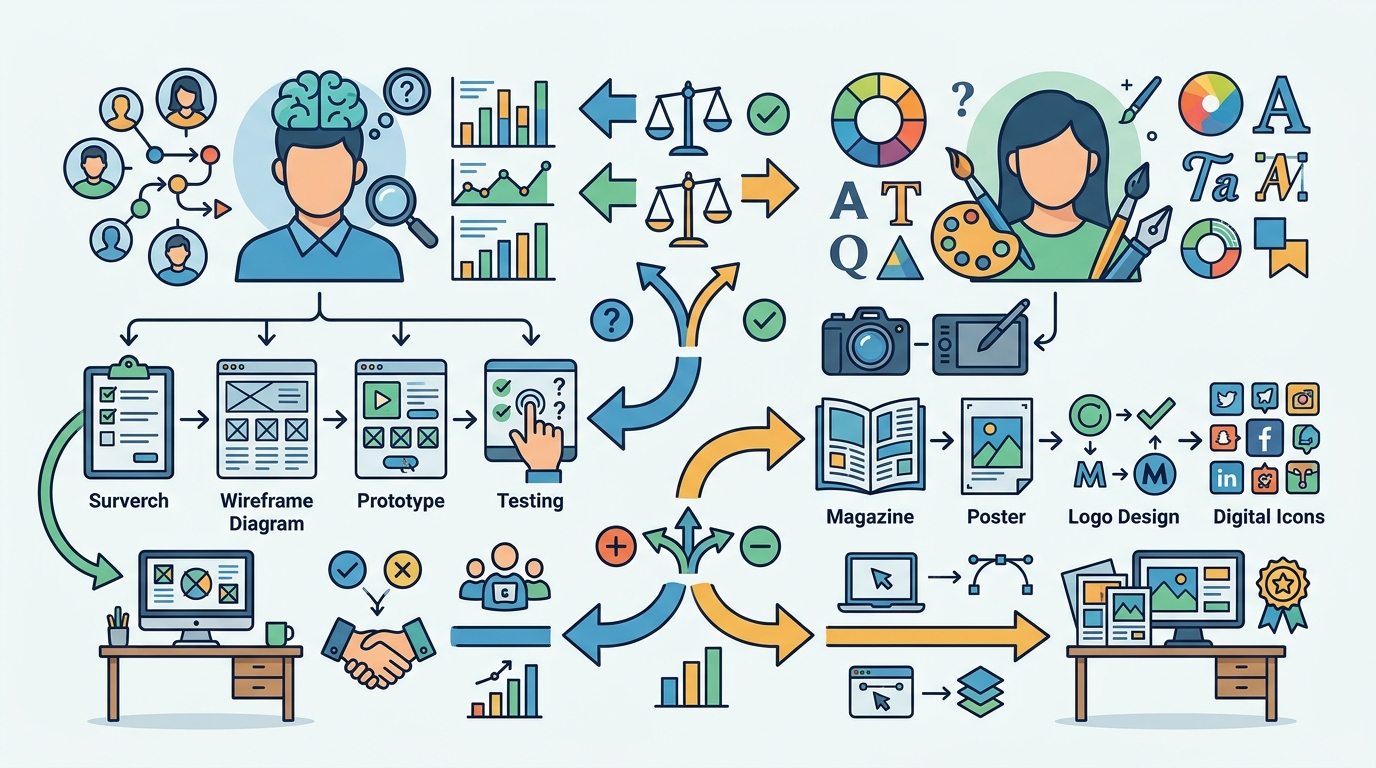
Both careers sit at a desk, use overlapping software, and ask for a portfolio — but they are measured differently. Graphic design is judged on visual craft and originality, and the U.S. Bureau of Labor Statistics (2025) lists a bachelor's degree as the typical entry-level education. UX design sits inside the occupation the Bureau calls web and digital interface designers, where it says education ranges from a high school diploma to a bachelor's degree (2025), and where structured beginner credentials such as the Google UX Design Professional Certificate — eight courses designed for about six months at 10 hours a week (Coursera and Google) — give a career changer a defined starting path.
If you are employed now and choosing between them, the practical question is not which is more creative. It is which evidence you can assemble around your current job: a visual portfolio, or a set of research-and-testing case studies.
UX Design vs. Graphic Design at a Glance
Pay for both is published as a median annual figure by named government sources rather than as a fixed rate, so the cells below point you to the exact occupation title to look up. Check the current numbers yourself before you decide — both are updated.
| Dimension | UX design | Graphic design |
|---|---|---|
| Where median pay is published | U.S. Bureau of Labor Statistics publishes a median annual wage for Web and Digital Interface Designers, separate from Web Developers (2025); O*NET OnLine publishes median wages for the same occupation (2025) | U.S. Bureau of Labor Statistics publishes median annual pay for Graphic Designers (2025); O*NET OnLine publishes median wages for Graphic Designers (2025) |
| Typical schedule | Most web developers and digital designers work full time (BLS, 2025) | Schedules shift with workloads and deadlines; self-employed designers may adjust the workday to meet clients evenings or weekends (BLS, 2025) |
| Typical entry education | Ranges from a high school diploma to a bachelor's degree (BLS, 2025) | Bachelor's degree is the typical entry-level education (BLS, 2025) |
| Named entry credential route | Google UX Design Professional Certificate: 8 courses, beginner level, designed for about 6 months at 10 hours a week (Coursera and Google); Nielsen Norman Group offers an exam-based UX Certificate for practitioners | No single named beginner certificate; BLS (2025) states candidates should have a portfolio demonstrating creativity and originality |
| Employment size | BLS publishes a job count for web developers and digital designers as a combined occupation (2025) | BLS publishes a separate job count for graphic designers (2025) |
| Published outlook | BLS publishes a 2025–35 job outlook for web developers and digital designers | BLS publishes a 2025–35 job outlook for graphic designers |
| Physical demands | Seated screen work, plus moderating usability sessions in person or on video calls | Seated screen work, plus handling printed proofs and colour checks on print jobs |
| Upward path | Those with a bachelor's degree may advance to project manager (BLS, 2025) | Experienced designers may advance to chief designer, art director, or other supervisory roles (BLS, 2025) |
Day-to-Day Differences
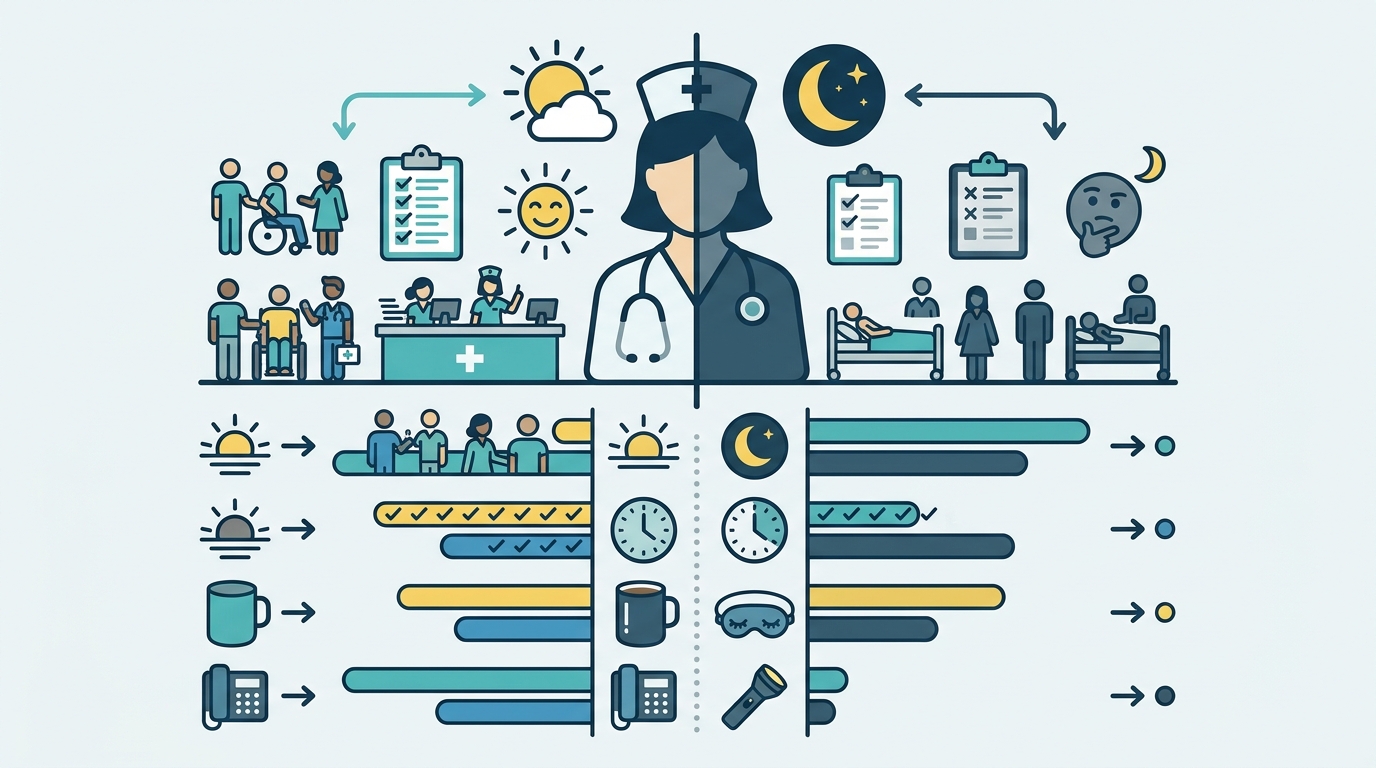
Here is a Wednesday in each, hour by hour, as the work is usually structured on a product or studio team.
A UX designer's Wednesday. 9:00–9:15 is the team stand-up, where you say which screens you are taking to engineering this week. 9:15–10:30 you moderate two 30-minute usability sessions on a prototype — you read a script, watch the participant try to complete a checkout, and note where they stop. 10:30–11:30 you tag those recordings and write up the three friction points you saw. 11:30–1:00 you redraw the flow in Figma, updating components from the shared design system so the buttons and form fields match what is already shipped. After lunch, 2:00–3:00 is a handoff call with two engineers about edge cases: what the screen shows when the address lookup fails. 3:00–4:30 you write acceptance notes in the ticketing tool and attach the redlined frames. 4:30–5:30 you draft next week's research plan and the screening questions for participants. The day is dominated by evidence and specification: you spend as much time explaining why a screen is shaped that way as drawing it.
A graphic designer's Wednesday. 9:00–9:30 you review marked-up proofs returned by a client overnight. 9:30–11:30 you build out a campaign in Illustrator and InDesign — a poster, three social sizes, and an email header — keeping type scale and brand colours consistent across all five assets. 11:30–12:30 you retouch and mask product photography in Photoshop. 1:30–2:30 is a presentation where you show two logo directions and explain the construction of each. 2:30–4:00 you apply the chosen direction across stationery and prepare print-ready files: bleeds, crop marks, CMYK conversion, and a packaged folder of fonts and links. 4:00–5:00 you check a colour proof against the brand swatch. Work tends to cluster around deadlines rather than sprint cycles, and the Bureau of Labor Statistics notes (2025) that schedules depend on workloads and deadlines, with self-employed designers sometimes meeting clients in the evening or at weekends.
The practical difference is the deliverable. UX work ends in a specified flow that engineers build and that research can be used to justify. Graphic design work ends in a produced asset — printed, posted, or packaged — judged on craft. If you prefer finishing something visible by 5pm, that leans graphic. If you prefer arguing a design decision from session notes, that leans UX.
Pay, Hours, and Entry Requirements Compared
Where a figure below is my estimate rather than a published number, it is labelled and the reasoning is given.
| Factor | UX design | Graphic design |
|---|---|---|
| Median pay | Published by the U.S. Bureau of Labor Statistics as the median annual wage for Web and Digital Interface Designers (2025), and separately by O*NET OnLine (2025); note that BLS also publishes a combined median for web developers and digital designers together, and a separate one for web developers alone — look up the designer line, not the combined one | Published by the U.S. Bureau of Labor Statistics as median annual pay for Graphic Designers (2025), and separately by O*NET OnLine (2025) |
| Typical weekly hours | Most web developers and digital designers work full time (BLS, 2025) — treat 40 hours as the baseline | Writer's estimate: a 40-hour baseline with peaks before deadlines, because BLS (2025) states schedules vary with workloads and deadlines and that self-employed designers may work evenings or weekends to meet clients |
| Required credential | Education ranges from a high school diploma to a bachelor's degree (BLS, 2025); the Google UX Design Professional Certificate is an 8-course beginner series aimed at preparing learners for an entry-level job (Coursera and Google), and the Nielsen Norman Group UX Certificate is an exam-based credential for working practitioners | A bachelor's degree is the typical entry-level education (BLS, 2025); in addition, candidates should have a portfolio demonstrating creativity and originality (BLS, 2025) |
| Average time to entry | About 6 months of study at 10 hours a week for the Google certificate (Coursera and Google), roughly 240 hours; writer's estimate of 9–15 months total for an employed career changer, adding time to produce three end-to-end case studies after coursework | Four years if you take the typical bachelor's route (BLS, 2025); writer's estimate of 12–24 months if you already hold any bachelor's degree and are building a portfolio part-time, since portfolio depth, not coursework, is the stated hiring filter |
| Advancement milestone | Project manager, for those with a bachelor's degree (BLS, 2025) | Chief designer, art director, or other supervisory position, with experience (BLS, 2025) |
On course costs, prices change and differ by provider, subscription term, and whether your employer reimburses tuition. Open the provider's own pricing page, note the monthly or one-off price and the number of months you expect to take, and multiply — then compare that to any tuition benefit in your current staff handbook. Google states that most graduates of its certificates report a positive career outcome within six months of completing them; that is the company's own reported figure from its graduates, not an independent measure, and it is not a guarantee of a job.
Questions to Ask Yourself Before Choosing
Answer each with yes, no, or a number from your own life. Write the answers down before you spend money.
- Can you block 10 hours a week for 6 months — the pace the Google UX Design Professional Certificate is designed for — and name the specific days and times in your calendar right now?
- Do you already hold a bachelor's degree in any subject? The Bureau of Labor Statistics (2025) lists a bachelor's as the typical entry-level education for graphic designers, so a yes removes a four-year obstacle on that side.
- How many finished design pieces could you put in front of a hiring manager today? Count them. BLS (2025) says graphic design candidates should have a portfolio demonstrating creativity and originality.
- How many months of expenses do you have saved, and does that cover at least three months if you start in a junior role at lower pay than your current job? Write the dollar figure.
- Are you willing to recruit and moderate at least five usability sessions with strangers in the next three months? That task is routine in UX work and absent from most graphic design roles.
- Do you want the full-time employment pattern BLS (2025) reports for most web developers and digital designers, or are you prepared for the client-driven evenings and weekends it describes for self-employed graphic designers?
- Have you looked up both median wage figures — Graphic Designers and Web and Digital Interface Designers on the BLS and O*NET sites (2025) — and written both numbers, plus your current salary, on the same sheet of paper?
Frequently asked questions
Is UX design or graphic design easier to switch into without a degree?
UX has the shorter formal path: the Bureau of Labor Statistics (2025) says education for web and digital interface designers ranges from a high school diploma to a bachelor's, and the Google UX Design Professional Certificate covers 8 courses in about 6 months. For graphic designers, BLS (2025) lists a bachelor's as typical entry-level education.
Which pays more, UX design or graphic design?
Check two published figures side by side: the median annual wage for Web and Digital Interface Designers and median annual pay for Graphic Designers, both published by the U.S. Bureau of Labor Statistics (2025) and by O*NET OnLine (2025). Use the designer line, not the combined web developer and digital designer median.
Can I use my graphic design portfolio to get a UX job?
Partly. Visual craft transfers, but UX hiring asks for end-to-end case studies showing research and testing. Plan on adding three, which is why my estimate for an employed career changer is 9–15 months total, including the roughly 240 hours of study the Google certificate assumes at 10 hours a week.
Sources
- U.S. Bureau of Labor Statistics — Graphic Designers : Occupational Outlook Handbook (2025)
- U.S. Bureau of Labor Statistics — Web Developers and Digital Designers : Occupational Outlook Handbook (2025)
Your coach for this guide
Desmond covers workplace culture and the unwritten rules that shape who gets ahead. He likes talking to people mid-career, after the certainty has worn off and the real questions start.