Thinking About Becoming a UX Designer? Ask Yourself These Questions First
The questions that separate people who enjoy this work from people who like the idea of it, plus the tools, tasks and training timelines involved.

By Lena KowalczykOct 28, 2026 · 9 min read
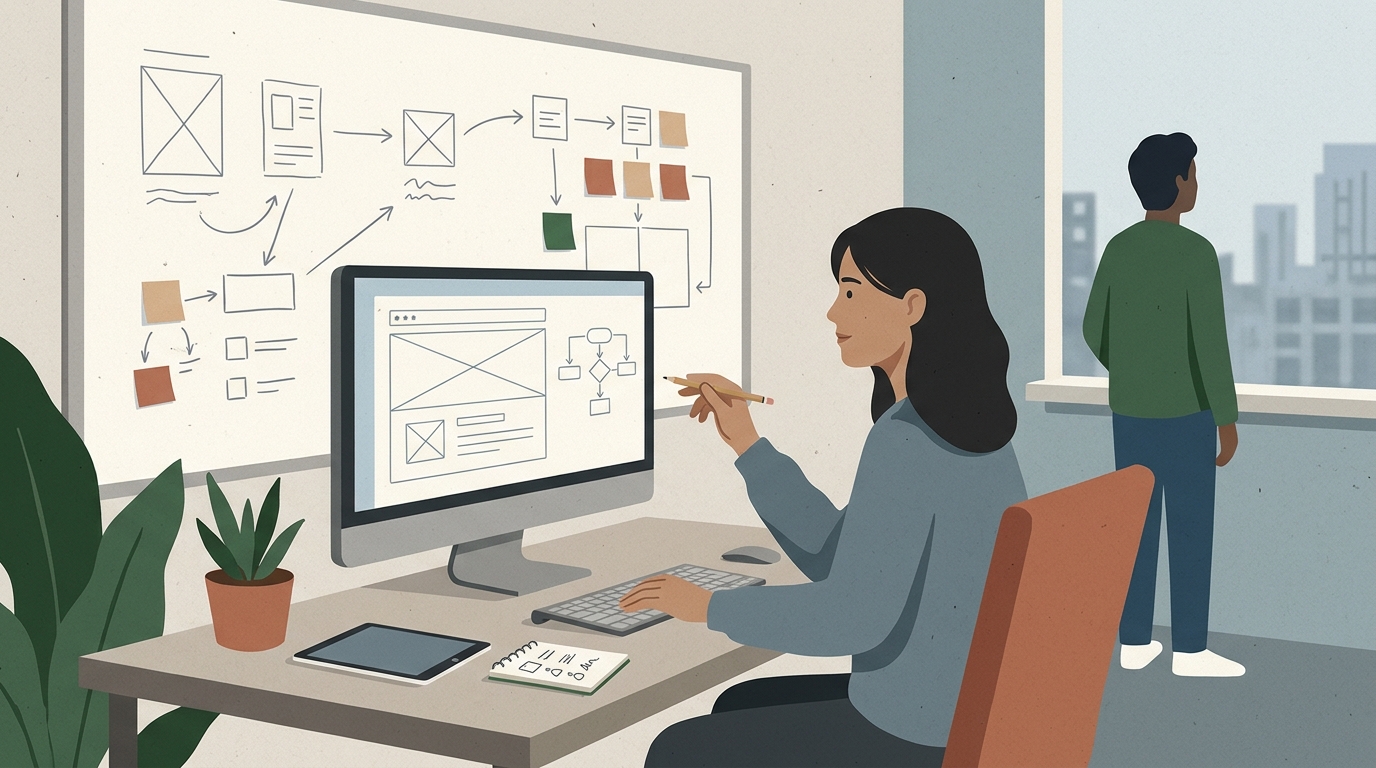
UX design is not a single job title. ONET lists "UX Designer," "UX Researcher" and "UI/UX Designer" as alternate search titles for SOC 15-1255.00, Web and Digital Interface Designers (ONET OnLine, U.S. Department of Labor), and the day-to-day work sits somewhere between interviewing users, drawing screens in Figma, and absorbing stakeholder feedback.
Before you pay for anything, the useful questions are about the work itself: do you like having your drawings redlined by six people, can you sit with research notes for two days without producing a visible deliverable, and will you give up roughly 10 hours a week for about six months to learn the method? Employment for web developers and digital designers is projected to grow faster than the average for all occupations from 2025 to 2035 (U.S. Bureau of Labor Statistics, 2025), but growth tells you nothing about whether the daily tasks suit you.
What the Job Actually Involves Day to Day
The two tasks ONET lists for this occupation describe most of the job: "Conduct user research to determine design requirements and analyze user feedback to improve design quality," and "Develop new visual design concepts and modify concepts based on stakeholder feedback" (ONET OnLine, U.S. Department of Labor). In practice that breaks into a repeating set of jobs:
- Running user interviews and usability sessions, usually over Zoom or Teams, with a written script and a recording you then watch back. Sessions typically run 30 to 60 minutes each, and a round of five to eight of them eats most of a week.
- Synthesising those recordings into themes — sticky notes in FigJam or Miro, quotes in a spreadsheet, and a short findings document that names the top problems in order.
- Drawing and redrawing screens in Figma, which O*NET lists as a Hot Technology for this occupation. You will maintain components, keep a shared library tidy, and version files so a developer can tell which frame is current.
- Walking stakeholders through work and changing it afterwards — design critiques, sprint reviews, and comment threads left on your Figma file by product managers, engineers and legal.
- Writing tickets and acceptance notes, commonly in Jira or Linear, so an engineer knows what the hover state does and what happens when the form fails.
- Answering questions in Slack about spacing, copy and edge cases while someone builds the thing you drew last month.
The meeting load depends heavily on employer type. In-house product roles at larger organisations tend to be calendar-heavy — standups, refinement, critique, one-to-ones — and design work gets squeezed into whatever blocks survive. Agency and contract work usually flips that: fewer internal rituals, more concentrated solo production, and client presentations clustered at the end of a phase. Ask about this directly in interviews; the answer differs between two companies in the same city, let alone between a startup and a bank.
Signs This Career Fits You
- You have already redesigned something at work nobody asked you to redesign — an intake form, a shift rota, a spreadsheet — and you can describe the before and after.
- You have come off a complaint call and written down why the customer got confused, not just how you fixed it for them.
- You have had a piece of your work pulled apart in front of other people and changed it afterwards without relitigating it.
- You can go three days producing only notes and a document, with no finished artefact, and not feel like the week was wasted.
- You are comfortable asking a stranger the same question four different ways for 45 minutes while a recorder runs.
- You have sat between two teams that wanted opposite things and written the summary everyone then worked from.
- You poke at software for fun — you have mapped out a tool's settings menu or explained to a colleague why an app's checkout is confusing.
Signs It Might Not Be a Fit
- You want your output to be final. One of the two core tasks for this occupation is modifying concepts based on stakeholder feedback (O*NET OnLine), which means work you considered finished gets reopened routinely.
- You dislike ending a day with nothing shippable. Research weeks produce documents, not screens.
- Talking to strangers drains you. Moderated interviews and usability tests are a recurring, scheduled part of the job, not an occasional extra.
- You need a predictable, posted pay figure. Compensation is typically a base salary plus any bonus or equity in product roles, or hourly and project rates in contract work, and it moves with state, employer size and seniority — the BLS Occupational Outlook Handbook publishes a 2025 median annual wage for web developers and digital designers, and CareerOneStop publishes a median hourly wage for Web and Digital Interface Designers; look both up for your state before you commit.
- You cannot give up roughly 10 hours a week for about six months of evenings and weekends, which is the recommended pace for the Google UX Design Professional Certificate (shortcoursesportal).
- You would rather not write. Findings documents, ticket descriptions and rationale notes are a large share of the output.
Skills You Already Have vs. Skills You'll Need to Build
| Skill you likely already have | Gap skill, and how to close it |
|---|---|
| Interviewing customers, taking support calls, running intake | Moderated usability testing — write one script and run five 30-minute sessions with friends on a live website, recording each. About one week of evenings. |
| Building slide decks and formatting reports | High-fidelity screen design in Figma, listed as a Hot Technology for this occupation (O*NET). Rebuild three screens of an app you use daily on Figma's free tier: 8-12 hours over two weekends. |
| Spreadsheet analysis and reporting | Synthesising qualitative notes into ranked themes — affinity-map 20 interview quotes into five problem statements. 3-4 hours per project. |
| Project coordination and stakeholder updates | Presenting and defending design decisions. Join or watch a weekly public design critique and submit your own work twice. 8 weeks, one hour a week. |
| Writing procedures, scripts or knowledge-base articles | UX writing — rewrite every error message and empty state in one app you use, side by side with the original. About 2 hours. |
| Training or onboarding colleagues | Formal UX method vocabulary. The Google UX Design Professional Certificate is 7 courses at 10 hours a week, roughly 6 months (shortcoursesportal); the NN/g UX Certification requires passing 5 courses and their exams, and the UX Master Certification requires 15 (Nielsen Norman Group). |
| Deep knowledge of one industry or customer group | Accessibility fundamentals — audit one page of your employer's public site against the WCAG success criteria and list every failure. 4-6 hours. |
How to Test the Waters Before You Commit
- Read the occupation entry and score the tasks. Open O*NET OnLine's page for 15-1255.00, Web and Digital Interface Designers — the one that lists UX Designer as an alternate title — and mark each listed task as "would do willingly," "tolerable," or "no." 30 minutes, free. Outcome: a one-page list you can show to someone already in the job.
- Look up the pay yourself, for your state. Check the BLS Occupational Outlook Handbook 2025 median pay for web developers and digital designers and the CareerOneStop median hourly wage for this occupation, filtered to your state. 20 minutes, free. Outcome: two numbers written down, not a vague impression.
- Build one Figma rebuild project. Pick three screens from an app you use and redraw them, then write 200 words on what you changed and why. Figma has a free tier; budget 8-12 hours across two weekends. Outcome: a shareable file and a short rationale note.
- Run three informational interviews. Ask each person how many hours a day they spend in meetings and how often finished work gets reopened. 30 minutes each, two to three weeks to schedule, free. Outcome: three sets of notes and a clearer picture of the meeting load at different employer sizes.
- Use a free trial before paying for a certificate. The Google UX Design Professional Certificate is priced as a flat monthly Coursera subscription after a free trial period (Designlab); finish the first of its 7 courses inside the trial and check the current monthly price before continuing. Outcome: a completed first course and a decision based on the real syllabus.
- Do one volunteer usability review. Offer a local nonprofit or community group a written review of a single page — donation form, signup, contact page. 6-8 hours total, free. Outcome: a findings document listing five problems ranked by severity, which is also your first portfolio piece.
Frequently asked questions
Do I need a degree to become a UX designer?
It depends which source you read, and that inconsistency is real. The U.S. Bureau of Labor Statistics (2025) says educational requirements for web developers and digital designers range from a high school diploma to a bachelor's degree, while CareerOneStop lists typical entry requirements for Web and Digital Interface Designers as a bachelor's degree, no work experience and no on-the-job training. Job postings in your state are the tiebreaker.
How long does it take to switch into UX design from another job?
Plan in months, not weeks. The Google UX Design Professional Certificate is 7 courses at a recommended 10 hours a week, roughly 6 months (shortcoursesportal). The NN/g UX Certification requires passing 5 courses and their exams, and the UX Master Certification 15 courses (Nielsen Norman Group). Portfolio projects and job searching sit on top of that.
How much does a UX design certificate cost?
Pricing models differ, so check current rates directly. The Google UX Design Professional Certificate is billed as a flat monthly Coursera subscription after a free trial period (Designlab), meaning your total depends on how fast you finish its 7 courses. Nielsen Norman Group prices its UX Certification pathway as a package of 5 courses and exams; see its site for the current figure.
Is UX design a growing field?
Overall employment of web developers and digital designers — the group that includes UX designers, UX researchers and UI/UX designers under SOC 15-1255.00 — is projected to grow from 2025 to 2035 faster than the average for all occupations (U.S. Bureau of Labor Statistics, 2025). The same source publishes average annual projected openings for the occupation over that decade.
What software do UX designers use?
Figma is listed as a "Hot Technology" under graphical user interface development software for this occupation (O*NET OnLine), and it is the first tool to learn — the free tier is enough for a portfolio project. Expect to also use a whiteboard tool such as FigJam or Miro, a ticketing system like Jira, and video calls for interviews.
Sources
- U.S. Bureau of Labor Statistics — Web Developers and Digital Designers : Occupational Outlook Handbook (2025)
- O*NET OnLine (U.S. Dept. of Labor) — How do they match: 15-1255.00 - Web and Digital Interface Designers
Your coach for this guide
Lena builds long-form conversations with workers across industries, chasing the specific texture of a job rather than its title. She's most interested in the gap between what a role is called and what it actually asks of someone.