Remote Jobs vs In-Office Jobs: How Pay Really Compares
Remote work carried a measured hourly wage premium in 2021, but the gap comes mostly from who holds those jobs rather than from where the work gets done.

By Marcus BellweatherOct 28, 2026 · 7 min read
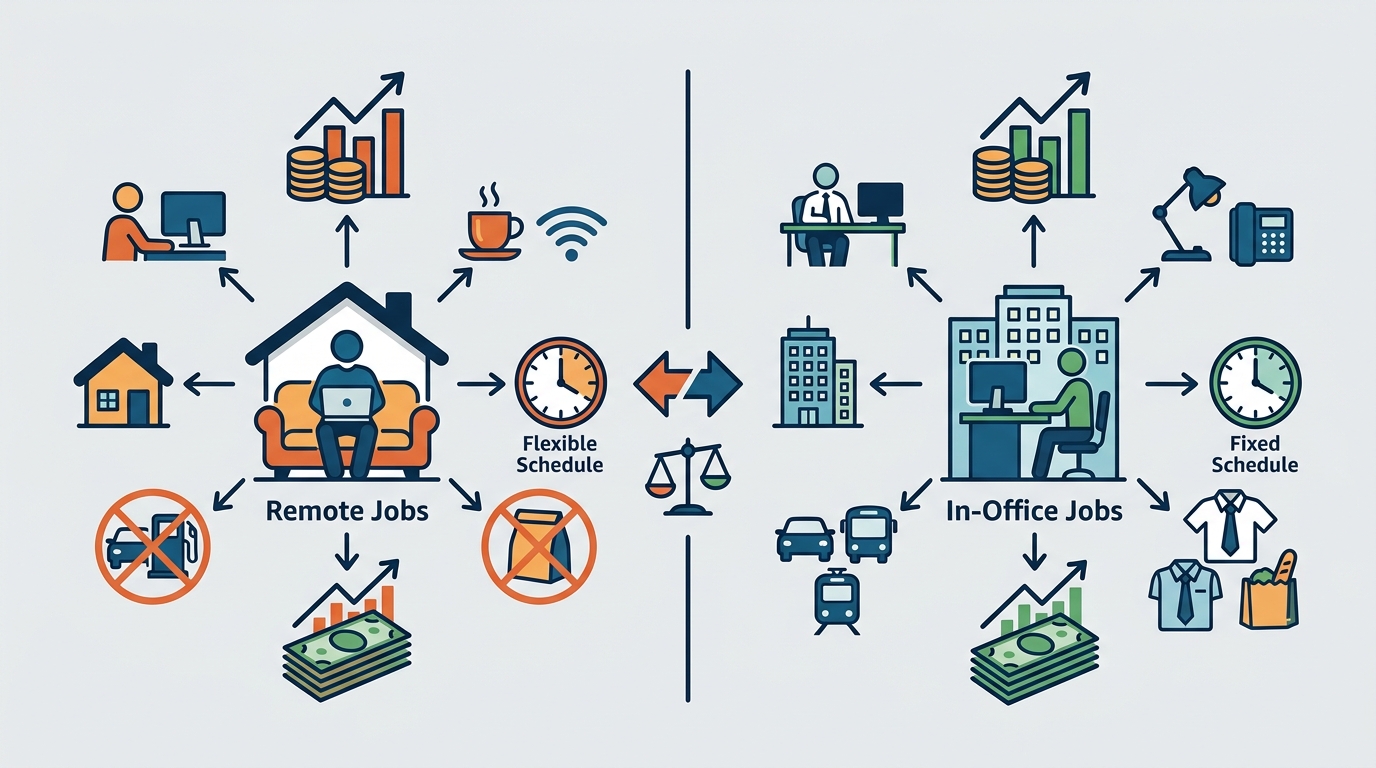
On average, people working primarily from home earned more per hour than on-site workers: a 13.3 percent average per-hour premium for 2021 after controlling for demographics and industry (Congressional Research Service, 2024), and 13.4 percent before those controls (American Economic Association conference presentation authored by BLS staff, 2024). That gap mostly reflects which jobs can go remote at all, because remote-capable work clusters in higher-paid occupations.
In some jobs the order reverses. Health care support workers who worked remotely took a 5.5 percent per-hour wage penalty in 2021 (Congressional Research Service, 2024).
Side-by-Side Pay Comparison
No agency publishes a separate national median salary for "remote jobs" and "in-office jobs" — wages are reported by occupation, not by work location. What is measured is the per-hour gap between remote and on-site workers doing comparable work. Every figure below is an average per-hour difference for 2021 unless noted, with on-site as the baseline.
| Measure | Remote (primarily home-based) | In-office (on-site) |
|---|---|---|
| Average per-hour wage, controlled for demographics and industry, 2021 | +13.3% (Congressional Research Service, 2024) | 0% (baseline) |
| Average per-hour wage, uncontrolled, 2021 | +13.4% (American Economic Association conference presentation authored by BLS staff, 2024) | 0% (baseline) |
| Median annual or hourly dollar figure published by work location | None — wages are published by occupation only | None |
| Highest-premium occupation group | Sales and related, +20.8% per hour (Congressional Research Service, 2024) | 0% (baseline) |
| Lowest-premium occupation group | Health care support, −5.5% per hour (Congressional Research Service, 2024) | 0% (baseline) |
| White-collar / blue-collar averages, 2021 | At least +5% / +3.6% per hour (Congressional Research Service, 2024) | 0% (baseline) |
| Overtime | 1.5× the regular hourly rate over 40 hours for covered nonexempt staff (Congressional Research Service, 2022) | 1.5× the regular hourly rate over 40 hours (Congressional Research Service, 2022) |
| Exemption salary floor | $684 per week, $35,568 per year, from 15 November 2024 (ADP, 2024) | $684 per week, $35,568 per year (ADP, 2024) |
| Guaranteed bonus tied to work location | None | None |
| Extra weekly hours vs the other group, 2021 | None — hours were similar by 2021 (U.S. Bureau of Labor Statistics, 2023) | None |
For dollar amounts, use the BLS Occupational Employment and Wage Statistics tables, which publish median and mean hourly and annual wages by occupation for every state and most metro areas, then apply the percentages above to your own occupation rather than to a national all-jobs average.
Why the Gap Exists
Occupational composition does most of the work. Remote-capable jobs sit where pay was already higher. In November 2023, computer and mathematical occupations teleworked at 64.9 percent and healthcare practitioner and technical occupations at 10.1 percent (U.S. Bureau of Labor Statistics, 2023). Across major groups, management and professional occupations were at 34.8 percent against 4.0 percent in service and 2.3 percent in construction and maintenance (U.S. Bureau of Labor Statistics, 2023). One paper cited by the Congressional Research Service estimated 37 percent of U.S. jobs could be done entirely remotely, and that those jobs were generally higher-paying (Congressional Research Service, 2024). The headline 13.3 percent is partly a measure of which jobs can go remote at all.
Education sorts the same way. Advanced-degree holders teleworked at 43.6 percent in the first quarter of 2024, against 8.5 percent for high school graduates and 3.5 percent below that (U.S. Bureau of Labor Statistics, 2024).
Industry demand splits the market. In August 2023 the highest telework rates were information at 47.5 percent, financial activities at 46.0 percent and professional and business services at 41.5 percent, against construction at 6.3 percent and leisure and hospitality at 6.0 percent (U.S. Bureau of Labor Statistics, 2023). The 20.8 percent sales premium and 16.8 percent management premium sit inside those high-telework industries.
Exemption structure limits who benefits. Salaried staff above $684 per week ($35,568 per year) are generally exempt from overtime, so extra hours do not convert to pay (ADP, 2024; Congressional Research Service, 2022). Hourly on-site roles keep the 1.5× route to higher weekly earnings. Pre-pandemic, remote employees worked substantially longer hours, though by 2021 hours were similar (U.S. Bureau of Labor Statistics, 2023).
The premium may not hold. Wages in teleworkable jobs grew more slowly than other jobs from 2019 to 2023, and employers report that remote work restrains wage growth (U.S. Bureau of Labor Statistics, 2026).
Where Each Role Pays Best
The remote premium is published by occupation, industry and sector rather than by state, so that is how it breaks down. Each figure is an average per-hour difference from on-site workers in 2021.
| Group | Remote difference | Notes |
|---|---|---|
| Sales and related | +20.8% per hour (Congressional Research Service, 2024) | Largest measured premium of any group |
| Management | +16.8% per hour (Congressional Research Service, 2024) | Among the larger premia in uncontrolled data too |
| Business operations | +14.0% per hour (Congressional Research Service, 2024) | Close to the 13.3% all-occupation average |
| Blue-collar overall | +3.6% per hour (Congressional Research Service, 2024) | Narrow; these roles carried a penalty pre-pandemic |
| Health care support — order reverses | −5.5% per hour (Congressional Research Service, 2024) | On-site pays more here |
| Mothers working from home most days in high-telework fields — order reverses | Wage penalty vs office-based mothers (U.S. Bureau of Labor Statistics, 2022) | Yet remote mothers of young children in white-collar fields earned 13.0% more, and remote fathers 14.7% more (American Economic Association conference presentation authored by BLS staff, 2024) |
Sector matters too: in August 2023, federal government workers teleworked at 28.6 percent, state government at 20.7 percent and local government at 8.8 percent (U.S. Bureau of Labor Statistics, 2023). For state and metro dollar figures, pull your occupation from the BLS Occupational Employment and Wage Statistics tables and check whether your state sets a salary threshold above the federal $35,568 per year.
Which Path Fits You
- You want the largest measured upside and work in sales or management. Go remote: 20.8 percent and 16.8 percent per-hour premia for 2021 (Congressional Research Service, 2024).
- You work in health care support. Take the on-site role. Remote work there carried a 5.5 percent per-hour penalty (Congressional Research Service, 2024), and healthcare practitioner and technical occupations teleworked at only 10.1 percent in November 2023 (U.S. Bureau of Labor Statistics, 2023).
- You want overtime to lift weekly pay. On-site hourly work usually gives more of it: 1.5× the regular hourly rate over 40 hours for covered nonexempt staff (Congressional Research Service, 2022), while salaried staff above $684 per week are generally exempt (ADP, 2024).
- You want faster entry without a degree. Plan for on-site first. Telework rates in early 2024 were 8.5 percent for high school graduates against 43.6 percent for advanced-degree holders (U.S. Bureau of Labor Statistics, 2024).
- You want a middle option. Hybrid is the norm: 52 percent of employees with remote-capable jobs work hybrid, 26 percent fully remote, 22 percent fully on-site (Gallup, 2025), with about 2.3 office days a week (HR Dive reporting on Gallup research, 2025).
- You are weighing long-run growth. Lean on-site or negotiate hard: wages in teleworkable jobs grew more slowly than other jobs from 2019 to 2023 (U.S. Bureau of Labor Statistics, 2026).
Frequently asked questions
Do remote jobs actually pay more than in-office jobs?
On average, yes for 2021: 13.3 percent more per hour after controls for demographics and industry (Congressional Research Service, 2024). The named exception is health care support, where remote work carried a 5.5 percent per-hour penalty.
Will a remote job cost me overtime pay?
Location does not change the rule. Covered nonexempt staff must be paid 1.5× their regular hourly rate over 40 hours a week at home or on-site (Congressional Research Service, 2022), and anyone paid below $684 per week is non-exempt regardless of job title (ADP, 2024).
Is the remote premium shrinking?
Mixed. Home-based teleworkers were paid a penalty pre-pandemic, which became a small premium by 2014 and grew during COVID-19, yet wages in teleworkable jobs grew more slowly than other jobs from 2019 to 2023 (U.S. Bureau of Labor Statistics, 2026). Treat 13.3 percent as a 2021 snapshot.
Does the premium apply equally to men and women?
No. Using 2017-2018 American Time Use Survey data, male home-based teleworkers earned an 8 to 15 percent premium over male office workers, while female home-based teleworkers on average earned none, though female occasional teleworkers earned 7 to 16 percent more (U.S. Bureau of Labor Statistics, 2022).
Sources
- U.S. Bureau of Labor Statistics — About 1 in 3 workers in management, professional, and related occupations teleworked, November 2023 (2023)
- U.S. Bureau of Labor Statistics — Telework highlights, August 2023 (2023-08)
Your coach for this guide
Marcus writes a running column on the economics of work, from gig platforms to apprenticeships. He's skeptical of easy career advice and prefers questions to conclusions.