Police Officer: Day Shift vs. Night Shift
A patrol officer's work changes with the clock — fewer units on the road after midnight, more paperwork and court runs before lunch, and different pay rules.

By Lena KowalczykOct 28, 2026 · 8 min read
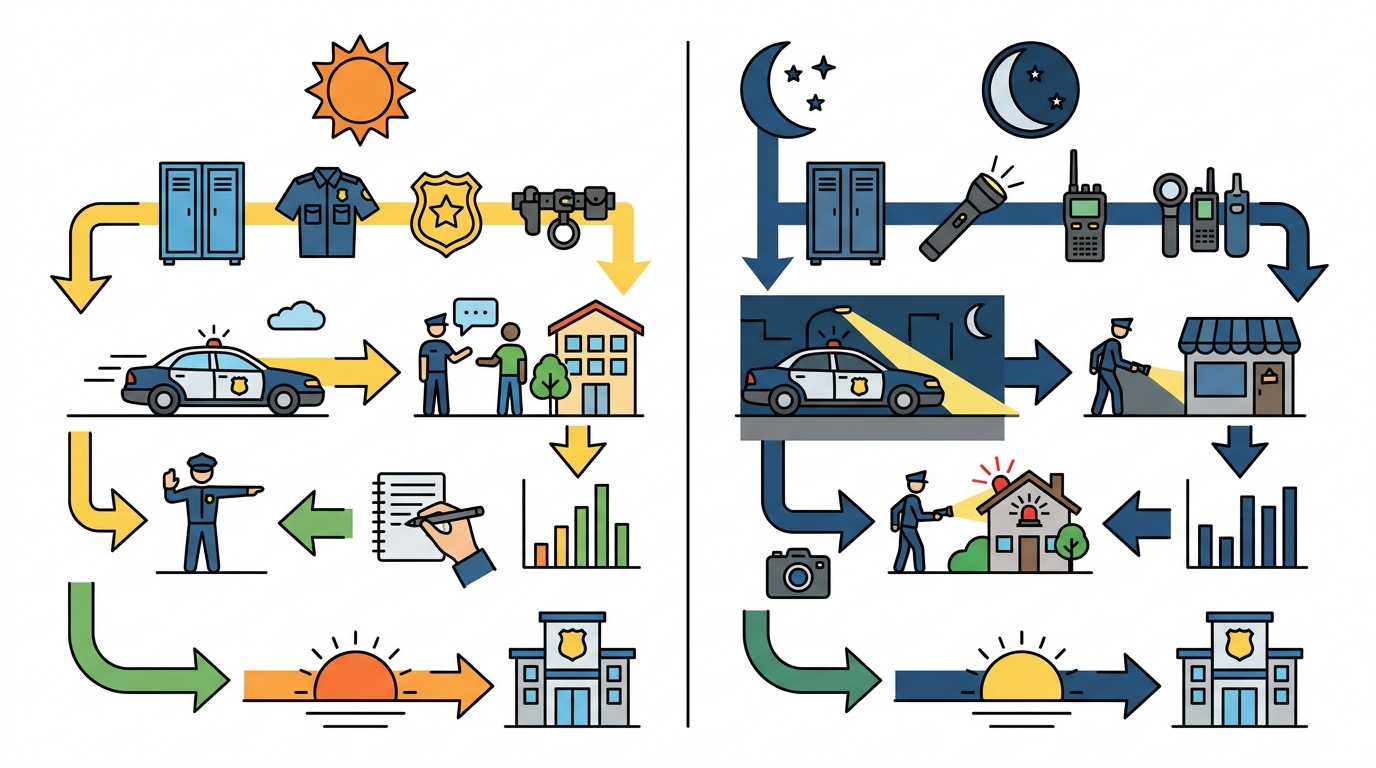
Patrol work runs around the clock because the public has to be protected at all times, and shift work plus paid overtime is standard in the job (U.S. Bureau of Labor Statistics, 2025). The core tasks stay the same on both shifts — patrolling for violators, investigating suspicious activity, deciding whether a crime occurred (O*NET OnLine, 2026) — but staffing, interruptions and shift differential pay all change.
Days put you near courts, detectives and evidence staff. Nights give you fewer units, longer quiet stretches, and in many cities extra pay for the hours after midnight.
Day Shift vs. Night Shift at a Glance
Exact hours, staffing and differentials are set by each agency and, for pay, by city ordinance or union contract — check your department's bid sheet and your municipal code.
| Dimension | Day shift (about 8 a.m.–4 p.m.) | Night shift (about midnight–8 a.m.) |
|---|---|---|
| Officers deployed | One department's plan staffed 0800–1600 with 6 officers (Falmouth Police Department, 2025) | The same plan staffed 0000–0800 with 5 (Falmouth Police Department, 2025); another study set a floor of four personnel in the field at midnights against six on days (Matrix Consulting Group, 2011) |
| Pace and call mix | Steady citizen-generated calls, school-zone traffic stops, walk-in follow-ups at the front desk | Long gaps broken by bar-closing patrol, audible alarms and impaired drivers |
| Typical tasks | Testifying at legal proceedings and relaying case updates to detectives (CareerOneStop) | Maintaining surveillance of establishments and reporting suspicious persons in the patrol area (O*NET OnLine, 2026) |
| Shift differential | One ordinance pays none when most hours fall between 8:00 a.m. and 4:00 p.m. (City of Palmer, Alaska) | The same ordinance adds 6% for midnight to 8:00 a.m.; another city pays 5% for midnight to 6:00 a.m. and 3% for 4:00 p.m. to midnight (City of Fort Worth, Texas) |
| Interruptions | Reports stop for radio traffic, subpoenas, training and meals; practice reviews note about 25% of officers assigned to a shift are unavailable for patrol at any moment (ICMA Center for Public Safety Management) | Few scheduled interruptions; the 3–4 a.m. window is often long enough to clear a report backlog |
| Backup | Sergeant, detectives, records and evidence staff are in the building | Officers self-dispatch to a call for assistance — a graveyard sergeant called that the shift's culture (Police Magazine, 2015); two-officer car policy persists for officer safety (Police Magazine, 2015) |
A Typical Day Shift Hour by Hour
A composite day built from tasks federal occupation sources list for patrol officers — illustrative, not one real officer's diary.
- 7:30–7:55 a.m. Briefing with the day-shift sergeant: overnight BOLOs, the graveyard incident log, beat assignment.
- 7:55–8:15 a.m. Car inspection — rifle lock, AED, first-aid kit, body camera battery — then log on to the mobile data terminal and radio-check with the dispatcher.
- 8:15–9:00 a.m. School-zone traffic enforcement; run plates on the terminal and issue citations for violations detected on patrol (O*NET OnLine, 2026).
- 9:00–9:45 a.m. Burglary report at a business: photograph the forced door, review the facts to determine whether a crime occurred (O*NET OnLine, 2026), collect the owner's camera footage.
- 9:45–10:40 a.m. Write both reports in the records management system and hand the footage to evidence staff while they are on duty.
- 10:40–11:30 a.m. Courthouse on a subpoena, then testify at a preliminary hearing (CareerOneStop).
- 11:30 a.m.–12:15 p.m. Meal break, cut short by a radio call.
- 12:15–1:45 p.m. Collision: administer first aid to a driver with a facial laceration until the ambulance crew takes over (CareerOneStop), direct traffic, measure and diagram the scene.
- 1:45–2:30 p.m. Follow-up with the assigned detective on a fraud case, then a welfare check requested by a social worker.
- 2:30–3:15 p.m. Visible patrol at school dismissal and foot patrol through a shopping plaza.
- 3:15–4:00 p.m. Finish the crash report, log evidence, brief the incoming 1600–0000 shift (Falmouth Police Department, 2025) on an open suspect description, turn in the keys.
A Typical Night Shift Hour by Hour
Same composite approach, same beat, twelve hours later.
- 11:30–11:55 p.m. Briefing. First difference: the room is smaller — that department's plan put 5 officers on 0000–0800 against 6 on 0800–1600 (Falmouth Police Department, 2025), so one call ties up much of the shift.
- 11:55 p.m.–12:20 a.m. Car check and terminal log-on; add a flashlight and spare batteries, because building searches happen on your light, not daylight.
- 12:20–1:15 a.m. Bar-closing patrol: monitor and report suspicious persons and situations in the patrol area (O*NET OnLine, 2026), break up a parking-lot argument, relay a vehicle description by two-way radio (CareerOneStop).
- 1:15–2:10 a.m. Impaired-driving stop, field sobriety tests, arrest and transport. Second difference: a cover unit arrives without being dispatched, which a graveyard sergeant described as the shift's culture (Police Magazine, 2015).
- 2:10–3:00 a.m. Commercial alarm. You wait for a second unit before clearing the building; the two-officer car policy and training standards are built around having a partner, for officer safety (Police Magazine, 2015).
- 3:00–4:00 a.m. The quiet hour: residential area checks, then reports written in the terminal in one sitting — no court, no walk-ins, no evidence window open.
- 4:00–5:00 a.m. Residential burglary report; photograph the broken window and hold the scene for the evidence technician who starts on day shift.
- 5:00–6:00 a.m. Commuter traffic begins; one stop for a dead headlight, one abandoned vehicle tagged.
- 6:00–7:00 a.m. Welfare check requested by a family member, then a stolen-vehicle entry into the state database.
- 7:00–8:00 a.m. Hand the burglary to day shift, then stay on paid overtime for a 9:00 a.m. court appearance — overtime is common in this occupation (U.S. Bureau of Labor Statistics, 2025). Patrol officers also have some of the highest injury and illness rates of all occupations, with round-the-clock shift work common (U.S. Bureau of Labor Statistics, 2024).
Which Schedule Fits Which Person
Day shift suits you if the 10:40 a.m. courthouse block and the 1:45 p.m. detective call look like the useful part of the job rather than dead time. Those tasks exist only when courts, detectives, evidence staff and social workers are working, and testifying at legal proceedings is a listed task for the occupation (CareerOneStop). If you want to move toward a specialty unit, day shift puts you near the people who run them — and officers in units such as mounted, motorcycle, canine or SWAT typically must first work a required number of years on patrol (U.S. Bureau of Labor Statistics, 2024).
The cost is fragmentation. In the composite day above, report writing was broken up, the meal break was cut short by a collision call, and the 12:15 p.m. first aid happened in front of a crowd and moving traffic.
Night shift suits you if the 2:10 a.m. alarm call reads as manageable rather than alarming — clearing a dark building on a flashlight with one cover unit, when the plan has 5 officers out instead of 6 (Falmouth Police Department, 2025). Officers who do well on graveyards are usually the ones who self-dispatch to another unit's call for assistance (Police Magazine, 2015). The 3:00–4:00 a.m. hour is the draw: one uninterrupted stretch to write up everything from the first half of the shift.
The cost is the tail end. The 7:00 a.m. handoff was followed by paid overtime for a 9:00 a.m. court date, and sleeping through daylight after that is the part people underestimate. The reward on either shift is the same moment — reviewing the facts at 9:45 a.m. or 4:00 a.m., determining a crime occurred (O*NET OnLine, 2026), handing a real description to the next shift, and hearing later that it closed.
Frequently asked questions
Can I pick my shift, or is it assigned?
It depends on the department. One agency's policy requires all patrol shifts to be bid by seniority, with the most senior officer choosing first, and rotates shifts on a defined period — currently three months — letting an officer sign up for the same shift up to three rotations in a row (Cedar City Police Department, 2023). Read your own agency's shift-bid policy before assuming you can stay on days.
Will I ever be forced onto nights?
Possibly. That same policy requires an officer to work both shifts, day and graveyard, during a twelve-month rotation cycle, with no more than three shifts in a row (Cedar City Police Department, 2023). Many departments build rotation in so coverage and experience are spread across all hours. Ask about rotation rules at interview rather than after you are hired.
How much extra do nights pay?
Shift differential is set locally by ordinance or contract, usually as a percentage of your hourly step rate. One city pays 3% when more than half the hours fall between 4:00 p.m. and midnight and 5% for midnight to 6:00 a.m., with none for a mostly daytime shift (City of Fort Worth, Texas). Another pays 6% for midnight to 8:00 a.m. (City of Palmer, Alaska). Check your city's code and current federal wage data.
Can I swap a shift or a day off?
Often yes, within limits. One policy allows employees of the same rank to exchange days off when both officers and their immediate supervisors agree, and asks that requests be made at least five days before the first day of the exchange where practical (Cedar City Police Department, 2023). Same-rank matching and supervisor sign-off are the usual conditions.
Sources
- U.S. Bureau of Labor Statistics — Police and Detectives : Occupational Outlook Handbook (2025)
- O*NET OnLine (U.S. Department of Labor/Employment and Training Administration) — 33-3051.00 - Police and Sheriff's Patrol Officers (2026)
Your coach for this guide
Lena builds long-form conversations with workers across industries, chasing the specific texture of a job rather than its title. She's most interested in the gap between what a role is called and what it actually asks of someone.