Medical Assistant Interview Questions and How to Answer Them
Clinics screen for measurement accuracy, plain-language patient explanations and confidentiality judgment, and most questions trace back to one of those three.

By Priya NatarajanOct 28, 2026 · 8 min read
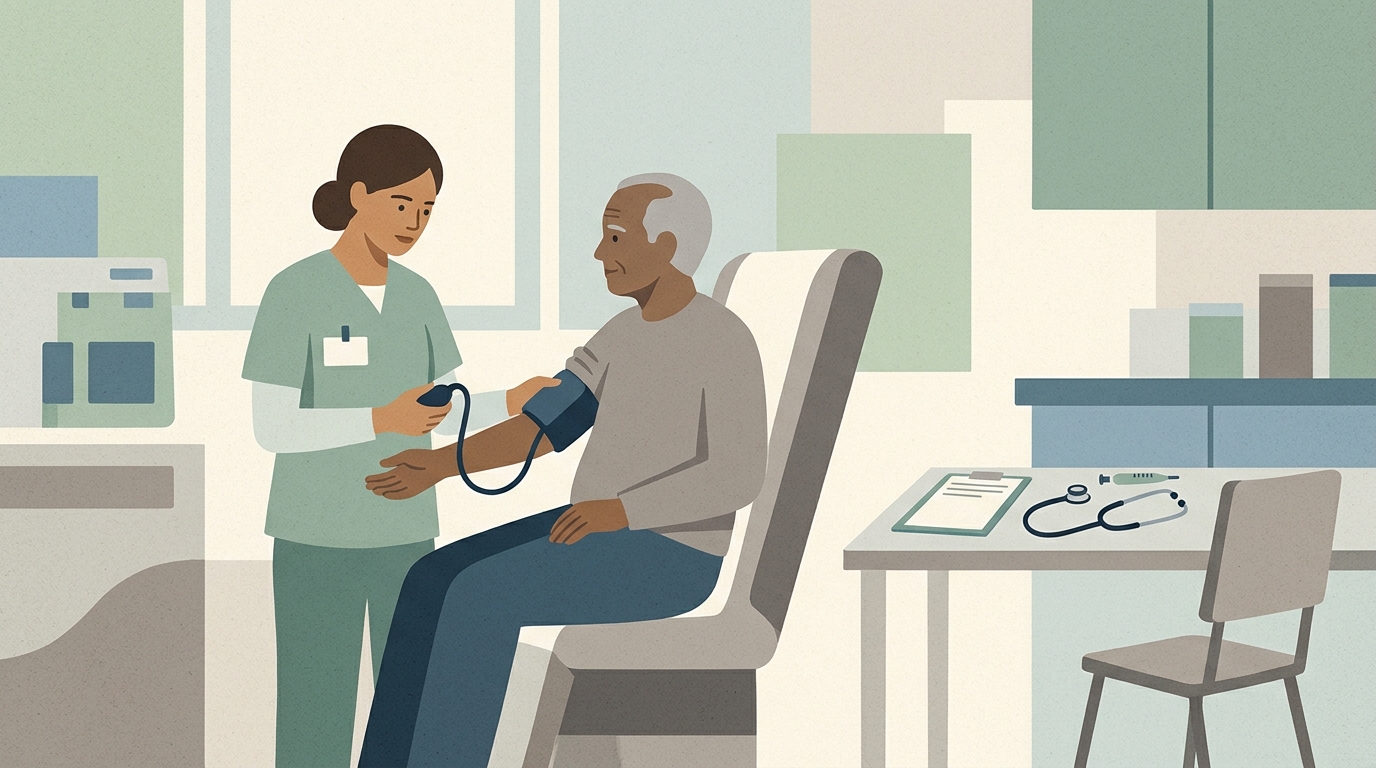
Medical assistant interviews are part behavioral, part practical: the hiring manager wants to know whether you can room patients accurately, talk to anxious people, protect patient information and keep a full schedule moving. Expect questions about vital signs, charting, injections, specimen handling and scope of practice, because those are the tasks the job is built from (U.S. Bureau of Labor Statistics, 2025).
Below: what interviewers screen for, six questions with sample answers, a script for the hardest question, and a day-of checklist.
What This Interview Evaluates
Nearly every question in a medical assistant interview maps back to three or four things.
Precision with measurements and records. The job involves measuring vital signs such as blood pressure and weight, recording medical history and test results, and entering patient data into records (U.S. Bureau of Labor Statistics, 2025), and being detail oriented is named as a core quality for the occupation (U.S. Bureau of Labor Statistics, 2025). Expect questions on how you take a blood pressure and what you do with an abnormal reading.
Patient-facing communication. Medical assistants interview patients to obtain medical information and explain treatment procedures, medications, diets or physicians' instructions (O*NET OnLine). Interviewers listen for plain language and for whether you stay steady with a frightened or angry patient.
Confidentiality and scope judgment. You must adhere to confidentiality standards when working with patients and patient information (U.S. Bureau of Labor Statistics, 2025), and injections and medications are given only as directed and permitted by state law (U.S. Bureau of Labor Statistics, 2025). An answer that oversteps what you are allowed to do reads as a risk.
Clinic flow. Rooming, preparing treatment rooms, sterilizing instruments, collecting and logging specimens, and scheduling all compete for the same hours (O*NET OnLine). Managers want evidence you can triage that list without dropping anything.
Common Questions and Sample Answers
Use these as structure, not scripts. Each moves through situation, task, action and result.
Walk me through how you room a patient and take vital signs.
Sample answer: Situation: at a four-provider clinic I'll call Cedar Hollow Family Medicine, I roomed about 25 patients a day. Task: get accurate vitals and a clean history before the provider walked in. Action: I confirmed two identifiers, asked the reason for the visit in the patient's own words, took height, weight, temperature, pulse and blood pressure, and rechecked any high cuff reading manually on the opposite arm after the patient had been seated a few minutes. I entered medications and allergies before leaving the room. Result: providers stopped re-verifying medication lists, and visits started closer to schedule.
Tell me about a time you caught an error in a chart or an order.
Sample answer: Situation: I was setting up for an injection and the charted dose did not match the strength printed on the vial. Task: resolve it before the patient came back. Action: I did not draw it up. I brought the vial and the chart to the provider, showed her the label and lot number, and waited for a corrected order. Result: the order was amended, the correct dose was given, and the clinic added a label-to-order read-back step to its injection workflow.
How do you handle a patient who refuses an injection?
Sample answer: Situation: a teenage patient started crying when he saw the tray. Task: get cooperation without forcing anything. Action: I moved the tray out of his sight line, told him exactly what he would feel and for how long, let him choose sitting or lying down and which arm, and said he could ask me to stop. Result: he agreed, it took under a minute, and he returned for his second dose without rescheduling.
Give an example of protecting patient information.
Sample answer: Situation: a caller said she was a patient's daughter and asked for lab results. Task: help her without releasing protected information. Action: I explained I could not confirm whether the person was a patient or share results, took her number, and described how an authorization could be added to the record. I also flagged that our check-in monitor was readable from the waiting room. Result: nothing was disclosed, and the screen was repositioned that week.
The provider is 40 minutes behind and three patients are waiting. What do you do?
Sample answer: Situation: a late add-on pushed our afternoon back. Task: keep patients informed and rooms turning over. Action: I told each waiting patient the real delay and offered to reschedule, roomed and vitaled the next two so the provider could go straight in, restocked between visits, and pulled standing orders for the two patients who only needed a blood draw. Result: we finished about 15 minutes behind instead of 40, and nobody left unseen.
How do you handle specimen collection and labeling?
Sample answer: Situation: our clinic sent urine and blood specimens to an outside lab twice daily. Task: make sure nothing was rejected. Action: I labeled at the point of collection, never in advance, read the name and date of birth against the label out loud, logged each specimen with its collection time, then cleaned and sterilized reusable instruments and disposed of contaminated supplies before resetting the room. Result: rejected specimens dropped to effectively none over the next quarter.
Answering the Hardest Question
"A provider asks you to do something you are not permitted to do. What do you say?"
Interviewers ask this because injections and medications are given only as directed and permitted by state law (U.S. Bureau of Labor Statistics, 2025), and an eager "I'd just do it" tells them you are a liability.
Sample answer
At a clinic I'll call Rivergate Urgent Care, a covering provider asked me to change a patient's dosing instructions over the phone while he was with another patient. I knew that sat outside what I could do — I can explain instructions a provider has given, but I can't change them. So I said, "I can put the patient on hold and bring you the chart, or take a message and call back with your answer in a few minutes." He took the chart, made the call himself, and I relayed his exact wording and documented it. I don't treat that as pushing back on a provider; it's the fastest safe route to the same outcome. If I'm unsure where a line sits in this state or this clinic, I ask before, not after.
Day-Of Checklist
- Bring printed copies of your certificate or diploma, any national certification card, and your current Basic Life Support card, since employers may require it (U.S. Bureau of Labor Statistics, 2025).
- Re-read the posting, list every clinical task named in it — injections, phlebotomy, EKG, autoclaving, specimen send-outs — and prepare one example for each.
- Check your state's rules, because some states require graduation from an accredited program, licensure or certification while most do not (U.S. Bureau of Labor Statistics, 2025).
- Write down the electronic health record system you have used and roughly how many patients a day you charted in it.
- Rehearse your blood pressure procedure out loud, including cuff size, arm position and what you do with a high first reading.
- Prepare two questions about the clinical-to-administrative split, since exact duties vary by employer, specialty and practice location or size (CareerOneStop, U.S. Department of Labor).
- Wear clean scrubs or business attire with closed-toe shoes, short nails and no loose jewelry, and expect a possible walk through the clinical area.
- Bring the names, titles and current phone numbers of two supervisors who have watched you room patients.
Frequently asked questions
Will there be a hands-on or technical test?
Often, yes. Clinics may ask you to demonstrate a manual blood pressure, show how you would prepare a treatment room, or talk through sterilization and sharps disposal. Some add a short written test on medical terminology or dosage math. When you confirm the appointment, ask whether to bring scrubs and whether a skills check is part of the visit.
Should I interview differently for a specialty office?
Yes. Exact duties vary by employer, specialty and practice location or size (CareerOneStop, U.S. Department of Labor), and related titles include clinical medical assistant and ophthalmic assistant (O*NET OnLine). Learn the three or four procedures that office performs most often and prepare questions about which of them you would assist with.
When do I bring up pay?
Let the employer raise it, or ask near the end of the first conversation. Pay is usually an hourly rate, sometimes with shift or certification differentials, and most medical assistants work full time in physicians' offices, hospitals and outpatient clinics (U.S. Bureau of Labor Statistics, 2025). Check current wage ranges in the Bureau of Labor Statistics Occupational Outlook Handbook first.
What if I have no certification yet?
Say so plainly and name your plan. Some people enter the occupation with a high school diploma and learn through on-the-job training (U.S. Bureau of Labor Statistics, 2025), though applicants who finish a short-term certificate program and pass a certification exam may have an advantage (CareerOneStop, U.S. Department of Labor). Naming the credential and your target exam window answers the real concern.
Sources
- U.S. Bureau of Labor Statistics — Medical Assistants : Occupational Outlook Handbook (2025)
- O*NET OnLine (U.S. Department of Labor/Employment and Training Administration) — 31-9092.00 - Medical Assistants
Your coach for this guide
Priya shapes the publication's coverage of job transitions, writing often about the messy middle between leaving one role and starting another. She's drawn to the quiet negotiations people have with themselves before a resignation letter gets written.