Inside a Typical Day as a Dental Hygienist
From the 7:40 a.m. operatory setup to the last autoclave cycle, here is how a hygienist's chair time, charting and patient teaching actually fit together.

By Priya NatarajanOct 28, 2026 · 9 min read
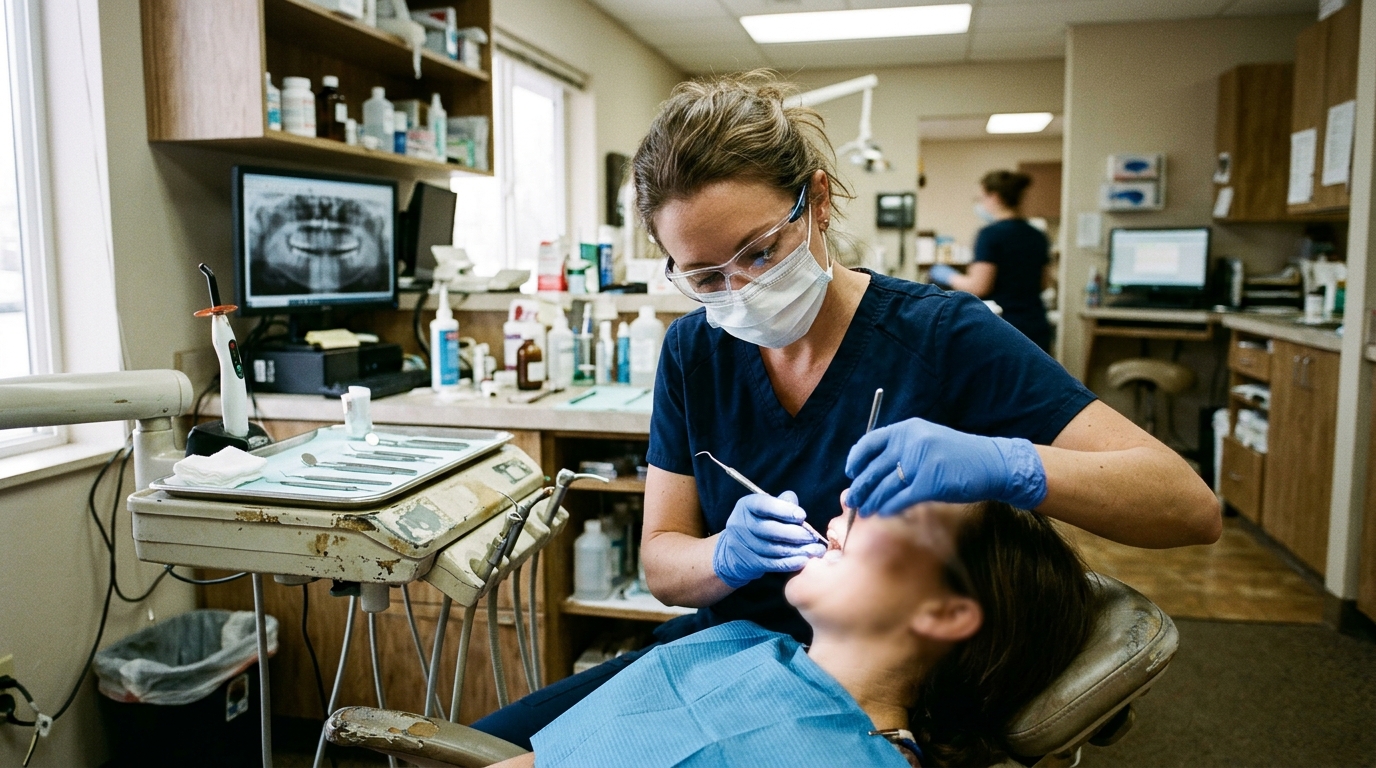
A dental hygienist's day is built around back-to-back appointments in one operatory: assessing gums, scaling away tartar and plaque, taking x-rays, charting findings for the dentist, and teaching patients how to care for their own mouths (U.S. Bureau of Labor Statistics, 2026-08-27). Between appointments sit sterilization cycles, equipment setup and chart notes that must be finished before the next patient sits down.
The day below is a composite of how general dentistry practices typically run. Hours, appointment length and how much you can do without a dentist present vary by state and employer.
Hour-by-Hour: A Typical Shift
This is a composite day in a general dentistry office, not one real person's schedule. Start times, appointment lengths and patient mix change from practice to practice.
7:40 a.m. - 8:00 a.m. — Open the operatory and join the huddle. You flush the waterlines, lay barriers on the chair and light handles, set out a sterilized instrument cassette, and put on safety glasses, a surgical mask and gloves (U.S. Bureau of Labor Statistics, 2026-08-27). You review the day's schedule in the practice management software with the front desk coordinator and the dentist.
8:00 a.m. - 8:50 a.m. — First recall patient. You update the medical history in the chart, ask about new medications, examine the gums visually and by touch for sores and disease, then walk a periodontal probe around each tooth to measure pocket depths and recession (O*NET OnLine, U.S. Department of Labor). You scale with an ultrasonic unit and hand instruments, polish, and apply fluoride. The dentist comes in for the exam and you report bleeding sites.
8:50 a.m. - 9:00 a.m. — Turnover. Instruments go to the ultrasonic bath and autoclave; you disinfect every surface, lay fresh barriers and change gloves. You share the sterilization area with the dental assistant, so you coordinate cycle timing.
9:00 a.m. - 9:50 a.m. — New patient with full radiographs. You place the lead apron and thyroid collar, position a digital sensor and expose a full series, following procedures to protect against radiation (U.S. Bureau of Labor Statistics, 2026-08-27). You chart conditions of decay and disease so the dentist can diagnose, then present findings chairside with the dentist.
9:50 a.m. - 10:40 a.m. — Periodontal maintenance. Heavier deposits, deeper pockets and a patient anxious about sensitivity. You work quadrant by quadrant with ultrasonic and hand instruments and, where your state's scope allows, give local anesthetic first. Depending on the state and treatment, hygienists may work without direct dentist supervision (U.S. Bureau of Labor Statistics, 2026-08-27).
10:40 a.m. - 11:00 a.m. — Charting catch-up. You finish treatment notes on the morning's patients, document home-care instructions, and message the front desk to book a scaling and root planing visit.
11:00 a.m. - 12:00 p.m. — Pediatric appointment. Prophylaxis, sealants on the permanent molars and fluoride, with the parent in the room. You demonstrate brushing and flossing on a model and explain the white-spot lesions you charted.
12:00 p.m. - 1:00 p.m. — Lunch and sterilization. You run a full autoclave load, restock the operatory and eat while a continuing-education webinar plays.
1:00 p.m. - 2:50 p.m. — Two afternoon recalls. Same sequence: history, probing, scaling, polishing, dentist exam. One patient arrives 15 minutes late, so you compress the appointment and warn the front desk the column will run behind.
3:00 p.m. - 4:00 p.m. — Heavy-stain case. You remove stains with an air-polishing device that sprays air, water and baking soda, then polish with a power tool (U.S. Bureau of Labor Statistics, 2026-08-27), talking the patient through the spray and suction.
4:00 p.m. - 4:50 p.m. — Last patient. After the cleaning and the dentist's exam, you hand off to the front desk with the recommended recall interval and any proposed treatment.
4:50 p.m. - 5:15 p.m. — Close down. Final autoclave run, instruments pouched, operatory disinfected, x-ray and sterilization logs initialed, chart notes signed in the software.
Core Responsibilities Beyond the Clock
- Weekly: spore testing the autoclave. You run and log a biological monitor so the practice holds a dated record that the sterilizer works.
- Weekly: instrument sharpening. Dull scalers slow you down and strain your hands, so you sharpen hand instruments or pull them and submit a replacement list.
- Monthly: waterline treatment, equipment checks and supply ordering. You shock or test the dental unit waterlines, check the ultrasonic and air-polishing units, and count prophy angles, fluoride varnish, sealant material and sensor sleeves — producing a completed maintenance log and an order to the office manager.
- Quarterly: recall list review. With the front desk, you pull overdue and lapsed periodontal maintenance patients from the software; the deliverable is a call list that fills open columns.
- Annually: infection control and radiation safety refreshers. The outcome is a signed certificate in your personnel file.
- On your state's renewal cycle: continuing education and license renewal. Continuing education is required to maintain licensure (U.S. Bureau of Labor Statistics, 2026-08-27); you submit course certificates to the board by its deadline. Hours and cycle length vary by state.
- On a certification cycle: CPR recertification. Many hygienist jobs require cardiopulmonary resuscitation certification (U.S. Bureau of Labor Statistics, 2026-08-27), so you keep a current card on file.
- Seasonal: insurance year-end and back-to-school surges. Columns tighten in November and December as patients use remaining benefits, and again in late summer as parents book children's exams.
Who Tends to Thrive in This Role
The U.S. Bureau of Labor Statistics (2026-08-27) lists critical thinking, communication, detail orientation, dexterity, interpersonal skills and problem solving as important for dental hygienists, and each shows up in the day above.
Detail orientation is the 8:00 a.m. probing, where you call out pocket depths one site at a time, and the 9:00 a.m. charting of decay precisely enough that the dentist can diagnose from your notes. If repetitive measurement feels tedious rather than satisfying, that first hour will feel long.
Dexterity and physical stamina are not optional. The 9:50 a.m. periodontal appointment means hand instrumentation in a small field with a sensitive patient, and the 3:00 p.m. stain case means controlling an air-polishing spray without flooding the mouth. Doing that seated and leaned forward for most of eight hours is the most physically demanding part of the job.
Communication decides how the 11:00 a.m. pediatric visit goes — explaining white-spot lesions to a parent while demonstrating flossing to a child — and shapes the 4:00 p.m. handoff, where you restate proposed treatment the patient already heard once from the dentist.
Problem solving covers the 1:00 p.m. late arrival, where you compress an appointment and warn the front desk. Where state law allows hygienists to work without direct dentist supervision, that independence raises the stakes on your judgment, which is part of why demand is expected to grow as states let hygienists work at the top of their training (U.S. Bureau of Labor Statistics, 2026-08-27).
The reward is concrete: at the 8:50 a.m. dentist exam you can show a patient a probing chart where the bleeding sites from six months ago are gone, because they changed how they brush after you taught them.
How to Get Started
- Finish prerequisite coursework (roughly 1 to 2 semesters). Most programs require general education and science courses, often chemistry and anatomy and physiology, before you apply. Admission is competitive.
- Complete an accredited dental hygiene program (usually about 3 years). Hygienists typically need an associate's degree in dental hygiene, and programs usually take 3 years (U.S. Bureau of Labor Statistics, 2026-08-27), combining laboratory, clinical and classroom instruction in areas such as anatomy, medical ethics and periodontics. In O*NET's education survey, a majority of respondents said a new hire needs an associate's or other 2-year degree.
- Pass the required written and clinical examinations (typically 1 to 6 months around graduation). Every state requires licensure, and most require an accredited degree plus passing written and clinical exams (U.S. Bureau of Labor Statistics, 2026-08-27). Scheduling and retake rules differ by state and testing agency.
- Apply for your state license (weeks to a few months). For specific requirements, the BLS directs readers to contact their state's Board of Dental Examiners or use CareerOneStop's licensing finder tool (U.S. Bureau of Labor Statistics, 2026-08-27).
- Get CPR certified (a one-day course, renewed on a cycle). Many hygienist jobs require cardiopulmonary resuscitation certification (U.S. Bureau of Labor Statistics, 2026-08-27); most programs build it in.
- Look for clinical work, including part-time columns (ongoing). Nearly all hygienists work in dentists' offices, many work part time, and because some dentists hire for only a few days a week, some hygienists work for more than one dentist (U.S. Bureau of Labor Statistics, 2026-08-27).
- Maintain continuing education and professional membership (every cycle, indefinitely). O*NET lists the American Dental Association, the American Dental Hygienists' Association and the National Dental Hygienists Association as relevant national associations.
Frequently asked questions
Do you need a bachelor's degree to be a dental hygienist?
Usually not for clinical practice. Hygienists typically need an associate's degree in dental hygiene, with programs usually taking about 3 years (U.S. Bureau of Labor Statistics, 2026-08-27). In O*NET's education survey, most respondents said an associate's or other 2-year degree is what a new hire needs, though smaller shares named higher credentials. Bachelor's and master's degrees exist and are more common for teaching, research or public health work.
Is dental hygiene a growing field?
Employment is projected to grow from 2025 to 2035, much faster than the average for all occupations, with about 15,000 openings projected each year on average over the decade (U.S. Bureau of Labor Statistics, 2026-08-27). Openings come from growth and from workers leaving the occupation. Local conditions still vary, so check hiring in the specific metro area where you plan to work.
How do I check licensing requirements for my state?
Go to the source rather than a summary. The BLS directs readers to contact their state's Board of Dental Examiners or consult CareerOneStop's licensing finder tool (U.S. Bureau of Labor Statistics, 2026-08-27). Boards publish current exam requirements, application steps, fees and continuing education rules, and they handle license transfer if you move between states.
What protective equipment do hygienists wear?
Safety glasses, surgical masks and gloves, to protect themselves and patients from infectious diseases, plus procedures to protect against radiation when taking x-rays (U.S. Bureau of Labor Statistics, 2026-08-27). In practice that also means barriers on equipment and documented annual infection control training at most employers.
Sources
- U.S. Bureau of Labor Statistics — Dental Hygienists : Occupational Outlook Handbook (2026-08-27)
- O*NET OnLine (U.S. Department of Labor) — Summary Report for: 29-1292.00 - Dental Hygienists
Your coach for this guide
Priya shapes the publication's coverage of job transitions, writing often about the messy middle between leaving one role and starting another. She's drawn to the quiet negotiations people have with themselves before a resignation letter gets written.