How Much Does a Truck Driver Make? Pay by Route Type, Experience, and State
Truck pay is usually built from per-mile rates and bonuses, so two drivers holding the same license can end a year with very different totals.

By Yuki Tanaka-ReevesOct 28, 2026 · 8 min read
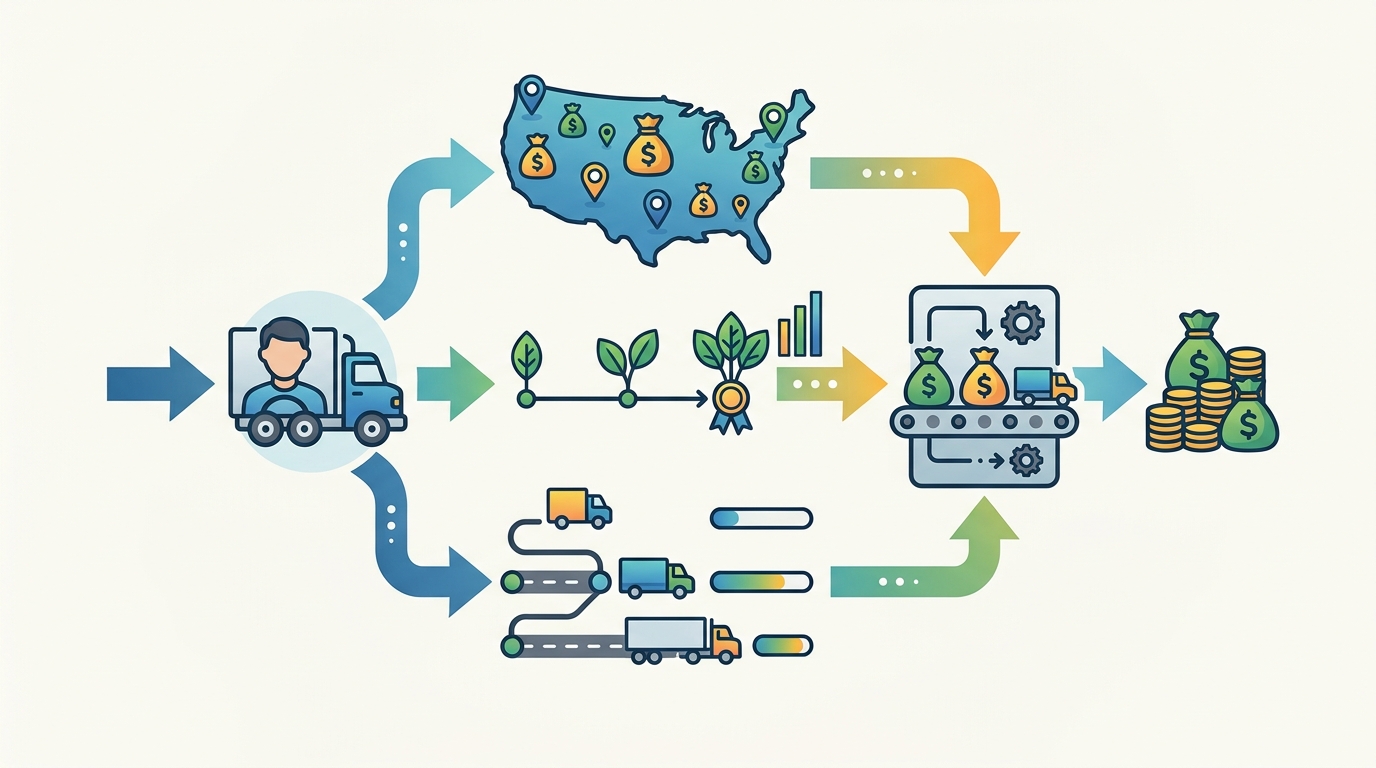
Heavy and tractor-trailer truck drivers earned a median of $58,640 a year, or $28.19 an hour, in May 2025 (U.S. Bureau of Labor Statistics, 2025). The lowest-paid 10 percent earned less than $40,140 and the highest-paid 10 percent earned more than $79,380 in the same month (U.S. Bureau of Labor Statistics, 2025), so the national spread is wide at both ends.
Where you land inside that spread depends mostly on your state, the industry you haul for, how your employer structures pay, and whether you drive local or long-distance. Most over-the-road drivers are paid by the mile plus bonuses rather than by the hour (U.S. Bureau of Labor Statistics, 2025), which is why annual totals move with freight volume as well as with skill.
National Average Salary
The median annual wage for heavy and tractor-trailer truck drivers was $58,640 in May 2025, equal to a median of $28.19 an hour (U.S. Bureau of Labor Statistics, 2025). Half of drivers earned more than that and half earned less. The lowest 10 percent earned less than $40,140 a year, and the highest 10 percent earned more than $79,380 a year in the same reference month (U.S. Bureau of Labor Statistics, 2025).
Two things are worth keeping in mind when you read that median. First, it covers heavy and tractor-trailer drivers only; delivery truck drivers and driver/sales workers are a separate occupation, with a median of $43,950 a year, about $21.13 an hour, in May 2025 (Boostpoint, citing the U.S. Bureau of Labor Statistics Occupational Outlook Handbook, 2025). Second, most long-haul drivers are not paid hourly at all — they are paid by the mile plus bonuses, with the per-mile rate set by each employer (U.S. Bureau of Labor Statistics, 2025), so the hourly figure is a conversion of annual earnings rather than a rate anyone quotes you at hiring.
For current numbers, check the BLS Occupational Employment and Wage Statistics pages for heavy and tractor-trailer truck drivers, and the local wages table on ONET OnLine for code 53-3032.00, which draws on the same BLS May 2025 data and reports 25th and 75th percentile annual wages alongside the median (ONET OnLine, U.S. Department of Labor, 2025).
Salary by Experience Level
BLS does not publish truck driver pay by years of experience, so the table below uses the published national percentiles and industry medians as reference points for each stage. Treat them as the shape of the curve rather than guaranteed steps — a new driver on a strong dedicated account can out-earn a veteran on short local runs.
| Stage | Annual reference figure (May 2025) | What the figure is |
|---|---|---|
| First year after CDL | Around $40,140 or below | 10th percentile, heavy and tractor-trailer drivers (U.S. Bureau of Labor Statistics, 2025) |
| 2-4 years, clean record | Approaching $58,640 | National median (U.S. Bureau of Labor Statistics, 2025) |
| 5-9 years, over-the-road or dedicated freight | About $60,320 | Median for drivers in the truck transportation industry (U.S. Bureau of Labor Statistics, 2025) |
| 10+ years, specialised or owner-operator | Above $79,380 | 90th percentile, heavy and tractor-trailer drivers (U.S. Bureau of Labor Statistics, 2025) |
The per-mile rate itself is where experience usually shows up: employers set that rate, and it may depend on both cargo type and driver experience (U.S. Bureau of Labor Statistics, 2025). Annual totals also swing with how many miles you actually run. If you want the quartile points between these stages, ONET OnLine publishes 25th and 75th percentile annual wages for code 53-3032.00 from the same BLS May 2025 data (ONET OnLine, U.S. Department of Labor, 2025).
Salary by State or Metro
State medians for heavy and tractor-trailer truck drivers are drawn from BLS Occupational Employment and Wage Statistics for May 2025.
| State or district | Median annual wage (May 2025) |
|---|---|
| Alaska | $70,100 |
| Washington | $64,760 |
| District of Columbia | $64,170 |
| New Jersey | $63,570 |
| United States (all states) | $58,640 |
| West Virginia | $49,480 |
| Louisiana | $49,320 |
Alaska reports the highest state median at $70,100 a year, and Louisiana at $49,320 and West Virginia at $49,480 are among the lowest (BLS OEWS May 2025 data, via nuecareer.com, 2025); the national median of $58,640 comes from the U.S. Bureau of Labor Statistics (2025). Before you treat a high-paying state as a plan, price the cost of living there and check whether the work is seasonal. Over-the-road drivers are also a special case: your pay usually follows the terminal or carrier you are domiciled with, not the states you drive through.
What Affects Pay
- State or domicile. Alaska's state median was $70,100 a year against Louisiana's $49,320 and West Virginia's $49,480 (BLS OEWS May 2025 data, via nuecareer.com, 2025) — the single largest published swing in this occupation.
- Industry. Drivers in truck transportation had a median of $60,320 a year in May 2025, while those in construction had $56,080, the lowest of the top industries BLS lists (U.S. Bureau of Labor Statistics, 2025).
- Occupation class. Delivery truck drivers and driver/sales workers had a median of $43,950 a year, about $21.13 an hour, in May 2025 (Boostpoint, citing the BLS Occupational Outlook Handbook, 2025), against $58,640 for heavy and tractor-trailer drivers (U.S. Bureau of Labor Statistics, 2025).
- Pay structure. Most heavy truck drivers are paid per mile plus bonuses, with the rate set by each employer and varying by cargo type and driver experience; some long-distance drivers, especially owner-operators, are instead paid a share of the shipping revenue (U.S. Bureau of Labor Statistics, 2025). Because the rate is employer-set, the national band of $40,140 at the 10th percentile to $79,380 at the 90th is the practical size of what these choices add up to (U.S. Bureau of Labor Statistics, 2025).
- Endorsements. Hauling hazardous materials requires an H endorsement on your CDL, which means an extra knowledge test and a background check (U.S. Bureau of Labor Statistics, 2025). BLS does not publish a separate HAZMAT wage, so ask carriers for the per-mile rate on HAZMAT loads against dry van in writing rather than assuming a premium.
- Miles and hours. Since mileage pay drives annual totals, two drivers at the same cents-per-mile rate can finish the year far apart. Ask any prospective employer for average weekly miles, not just the rate.
How to Increase Your Earnings
- Get the CDL and a clean first year. Drivers typically hold a high school diploma, attend a professional truck driving school lasting 3 to 6 months, and pass a knowledge test and a driving test for the commercial driver's license (U.S. Bureau of Labor Statistics, 2025). Expect first-year earnings to sit nearer the $40,140 10th percentile than the $58,640 median (U.S. Bureau of Labor Statistics, 2025).
- Hold a clean record to the two-year mark, then renegotiate your per-mile rate. Rates vary by employer and may depend on cargo type and driver experience (U.S. Bureau of Labor Statistics, 2025), so this is the point where moving from the bottom decile toward the $58,640 median is most achievable.
- Move into truck transportation rather than construction hauling. The May 2025 industry medians were $60,320 and $56,080 respectively (U.S. Bureau of Labor Statistics, 2025).
- Add a hazardous materials (H) endorsement. It takes an extra knowledge test and a background check, and it opens cargo types whose per-mile rates are set separately (U.S. Bureau of Labor Statistics, 2025). Compare the HAZMAT rate against your current load type before you commit.
- Check whether relocating pays. A domicile in Washington, at a $64,760 state median, or Alaska, at $70,100, sits above the $58,640 national median (BLS OEWS May 2025 data, via nuecareer.com, 2025; national median from the U.S. Bureau of Labor Statistics, 2025) — but net the cost of living before you move.
- Consider owner-operator or percentage-of-revenue work last. Some long-distance drivers, especially owner-operators, are paid a share of shipping revenue rather than per mile (U.S. Bureau of Labor Statistics, 2025). It is the main route toward the top 10 percent above $79,380 (U.S. Bureau of Labor Statistics, 2025), but you take on truck costs and rate risk with it.
Frequently asked questions
Is truck driving a growing field?
Employment of heavy and tractor-trailer truck drivers is projected to grow 4 percent from 2025 to 2035, about as fast as the average for all occupations, with roughly 214,500 openings projected each year (U.S. Bureau of Labor Statistics, 2025). Most of those openings come from replacing drivers who leave the occupation.
What is the hourly equivalent of the median truck driver wage?
The 2025 median pay was $28.19 an hour (U.S. Bureau of Labor Statistics, 2025). That is a conversion of annual earnings — most over-the-road drivers are paid by the mile plus bonuses, not by the hour (U.S. Bureau of Labor Statistics, 2025).
Do local delivery drivers earn the same?
No. Delivery truck drivers and driver/sales workers are a distinct occupation, with a median of $43,950 a year, about $21.13 an hour, in May 2025 (Boostpoint, citing the BLS Occupational Outlook Handbook, 2025).
How long does it take to start earning?
Drivers usually hold a high school diploma and attend a professional truck driving school lasting 3 to 6 months, then pass a knowledge test and a driving test for the CDL (U.S. Bureau of Labor Statistics, 2025).
Where should I check current pay for my area?
Use the BLS Occupational Employment and Wage Statistics tables for heavy and tractor-trailer truck drivers, and the local wages table on O*NET OnLine for code 53-3032.00, which reports 25th and 75th percentile annual wages from the same BLS May 2025 data (O*NET OnLine, U.S. Department of Labor, 2025).
Sources
- U.S. Bureau of Labor Statistics — Heavy and Tractor-Trailer Truck Drivers : Occupational Outlook Handbook (2025)
- O*NET OnLine (U.S. Department of Labor, ETA) — National Wages: 53-3032.00 - Heavy and Tractor-Trailer Truck Drivers (2025)
Your coach for this guide
Yuki covers early-career life, internships, and the strange first years of figuring out what work is for. She writes with the fresh impatience of someone still sorting out her own path.