How a Software Engineer's Day Changes After Five Years on the Job
How code review, on-call duty and design work shift from supervised tickets to owning systems and coaching the newer engineers around you.

By Marcus BellweatherOct 28, 2026 · 9 min read
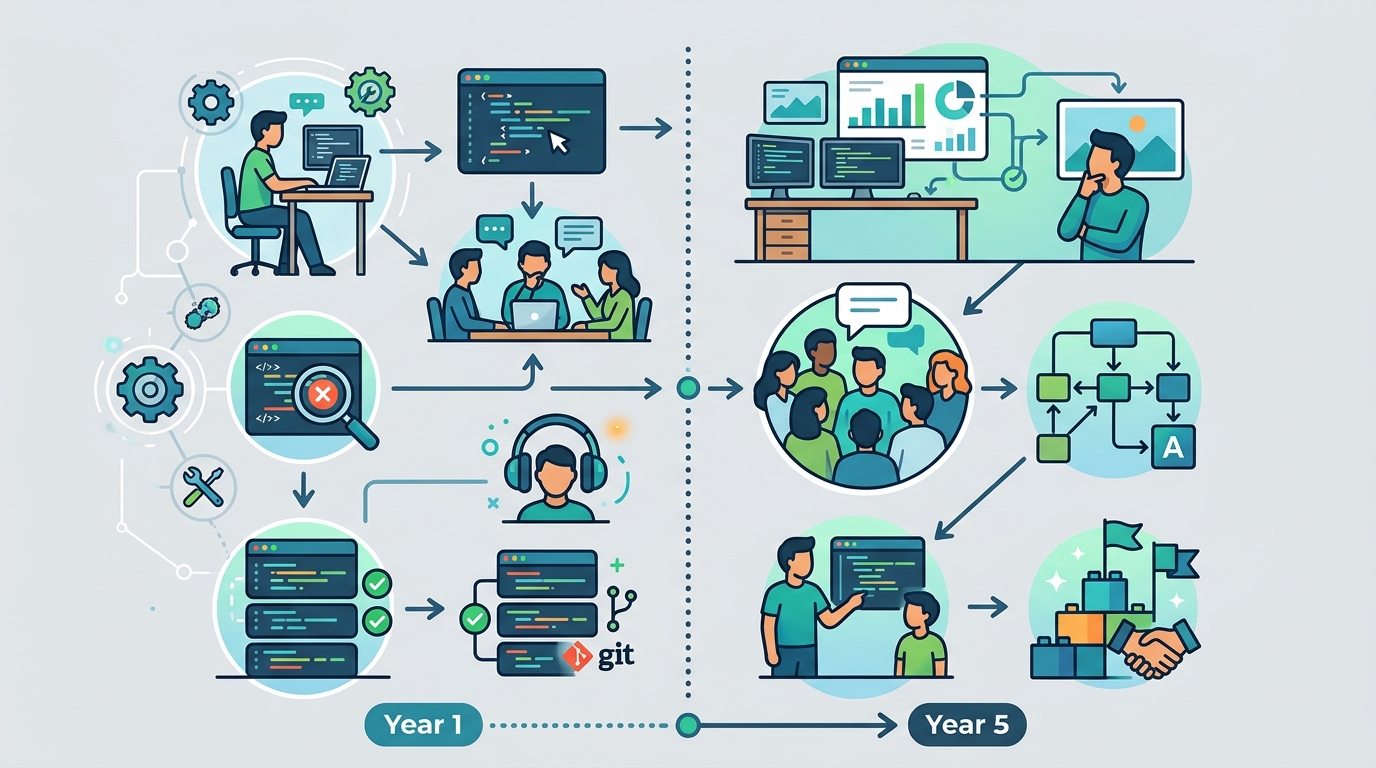
After about five years, the shape of a software engineer's day usually inverts: less time writing code someone else specified, more time deciding what gets built and reviewing other people's work. One career-ladder analysis notes that senior engineers typically need at least five years of industry experience, and that seniority is the first level where responsibilities grow beyond what one person can deliver alone (endoflineblog.com, undated).
The tasks do not disappear — experienced engineers still debug, still write tests, still get paged at night. What changes is who decides, who reviews, and how much of the day goes to writing and conversation rather than an editor.
What Changes With Experience
The comparison below describes common US practice. Titles, band structures and review processes vary a great deal by employer — a 2,000-person product company, a government contractor and a 12-person startup draw these lines differently.
| Dimension | Entry-level (0-2 years) | Experienced (5+ years) |
|---|---|---|
| Autonomy | Works under the guidance of a team lead, developing code from written requirements (Careerflow.ai, undated); picks up tickets someone else scoped | Expected to independently solve complex problems and potentially lead teams of junior engineers after 4-6 years (Careerflow.ai, undated); scopes own work from a problem statement |
| Task types | Modifies existing software to correct errors or improve performance (O*NET OnLine, undated); writes unit tests; updates the team wiki | Analyzes user needs and requirements to determine feasibility of design within time and cost constraints (O*NET OnLine, undated); writes design documents; directs testing and validation procedures |
| Supervision | Every pull request needs a senior reviewer's approval before it merges; the weekly 1:1 covers specific tickets | Approves others' pull requests; the 1:1 with the engineering manager covers delivery risk and roadmap, not individual tasks |
| Decision authority | Chooses test cases and naming; escalates anything touching schema, security or a production rollback | Decides whether to roll back a release, approves a migration plan, and confers with systems analysts and engineers on interfaces and performance requirements (O*NET OnLine, undated) |
| Pay band | Usually the lowest rung of an employer's engineering ladder, set mostly by level and location | Typically one or two bands higher, often with a larger bonus or equity component; ranges vary by state and employer, so check the U.S. Bureau of Labor Statistics Occupational Outlook Handbook for current figures |
| Scope of impact | One service, one feature, one sprint | A system or several services across quarters, often coordinating, supervising, managing or training others, as ONET notes for this job zone (ONET OnLine, 2025) |
A Day as an Entry-Level Software Engineer
A composite day, assembled from common practice on in-house product teams in the US. Hours vary by employer; some teams run core hours, others work asynchronously.
- 8:45 a.m.-9:15 a.m. Open the issue tracker and re-read the acceptance criteria on an assigned bug, plus the comment your team lead left overnight narrowing it to one API endpoint.
- 9:15 a.m.-9:30 a.m. Stand-up on video. You report one blocker — a failing integration test you cannot reproduce locally — and the lead assigns a mid-level engineer to pair with you.
- 9:30 a.m.-11:00 a.m. Write code in your IDE on a feature branch, running the unit suite between changes: modifying existing software to correct errors and improve performance (O*NET OnLine, undated).
- 11:00 a.m.-11:45 a.m. Push; the CI pipeline fails on a lint rule you did not know about. Fix, push again, open a pull request that cannot merge without a senior reviewer's approval.
- 11:45 a.m.-12:15 p.m. Address four review comments, two about test coverage rather than the fix, and ask in the team channel what "make the failure mode explicit" means.
- 12:15 p.m.-1:00 p.m. Lunch.
- 1:00 p.m.-2:15 p.m. Pair session on the flaky test, screen-sharing with the mid-level engineer. They drive first, then hand you the keyboard and talk you through the service logs.
- 2:15 p.m.-3:00 p.m. Reproduce a customer-reported bug from the support queue in a staging account and write the steps into the ticket.
- 3:00 p.m.-3:45 p.m. Add this morning's lint rule to the onboarding page on the team wiki. Your lead reviews the edit before it publishes.
- 3:45 p.m.-4:30 p.m. Listen in, read-only, on an incident call for a service you do not own, following how the on-call engineer narrates the dashboards.
- 4:30 p.m.-5:15 p.m. Rebase on main, resolve one conflict, post a status note on the ticket — the junior version of preparing reports on project activities or status (O*NET OnLine, undated).
The mentally demanding part at this stage is uncertainty: three hours into a bug, you still cannot tell whether you are one line or one architecture away. The satisfying part is concrete — the CI pipeline turning green and your first production fix merging with your name on the commit.
A Day as an Experienced Software Engineer
Also a composite day, drawn from typical senior responsibilities. The balance of coding to coordination varies widely; some employers keep senior engineers hands-on, others push them toward technical leadership.
- 8:15 a.m.-8:45 a.m. Check overnight alerts on the service dashboards. Error rates rose after last night's deploy but stayed inside the agreed threshold, so you decide against a rollback and post your reasoning in the incident channel — your call alone.
- 8:45 a.m.-9:15 a.m. Review three pull requests. You approve two and block the third for adding an unindexed query to a write-heavy table, telling the junior author what to measure first.
- 9:15 a.m.-9:30 a.m. Stand-up. You take the hard half of a ticket off a newer engineer stuck for two days, leaving them the testable half.
- 9:30 a.m.-10:30 a.m. Draft a design document for a queue-based replacement of a batch job with managed-service costs and a two-sprint estimate — determining feasibility of design within time and cost constraints (O*NET OnLine, undated).
- 10:30 a.m.-11:15 a.m. Meet the product manager, a systems analyst and a security reviewer to agree interfaces and performance requirements, the conferring task ONET lists for this role (ONET OnLine, undated).
- 11:15 a.m.-12:00 p.m. Mentoring block: walk a second-year engineer through writing validation procedures for their feature, then hand them ownership of the test plan.
- 12:00 p.m.-12:45 p.m. Lunch away from the desk.
- 12:45 p.m.-1:30 p.m. A 1:1 with that engineer on which new tools and languages to learn next — keeping current is a career-long expectation for developers (U.S. Bureau of Labor Statistics, undated).
- 1:30 p.m.-3:00 p.m. Hands-on coding on the migration script behind a feature flag. You still write code; you write the part nobody else on the team can.
- 3:00 p.m.-3:45 p.m. Read usability feedback showing users cannot find a setting and decide to redesign the flow rather than ship it — when testing shows a design is too hard to use, developers redesign until it works (CareerOneStop, undated).
- 3:45 p.m.-4:30 p.m. Write the weekly status report on project specifications and activities for the engineering manager, flagging a dependency that will slip.
- 4:30 p.m.-5:15 p.m. On-call handoff: update the runbook with this morning's alert reasoning so nobody re-derives it at 3 a.m.
The demanding part is on-call accountability — a page at 2 a.m. for a service you designed, where the rollback decision is yours. The reward is just as specific: the junior whose query you blocked in March shipping a schema change in June with no review comments. Engineers who do well here are the ones who enjoyed the 10:30 a.m. interface meeting and the design document, not only the 1:30 p.m. coding block.
Skills and Credentials That Unlock the Next Level
There is no single gate between levels, and thresholds differ by employer. Treat these as the evidence a promotion committee usually looks for.
- A four-year degree as the common baseline. Software developers typically need a bachelor's degree in computer and information technology or a related field such as engineering or mathematics, and some employers prefer a master's (U.S. Bureau of Labor Statistics, undated). ONET places the occupation in Job Zone Four, where most occupations require a bachelor's degree but some do not (ONET OnLine, 2025).
- Three years for mid-level, five for senior. Career-ladder analysis puts mid-level consideration at a minimum of three years and senior at a minimum of five (endoflineblog.com, undated). Most senior postings list five to eight years, with employers emphasizing demonstrated ownership of systems over tenure (webpeak.org, undated).
- Evidence of leading others. Senior engineers independently solve complex problems and may lead teams of junior engineers after 4-6 years (Careerflow.ai, undated). Keep a record of the design documents you authored and the engineers you onboarded.
- A portable cloud certification. The AWS Certified Solutions Architect - Associate exam runs 130 minutes with 65 multiple-choice or multiple-response questions and costs 150 USD (Amazon Web Services, undated); AWS says candidates with 1-3 years of IT experience have earned it as a starting point (Amazon Web Services, undated).
- Testing and validation leadership. Show that you have developed or directed software system testing or validation procedures and documentation, not only written tests to someone else's plan (O*NET OnLine, undated).
- Accumulated preparation and a current toolkit. Job Zone Four occupations carry a Specific Vocational Preparation range of 7.0 to less than 8.0, and employees usually need several years of work-related experience, on-the-job training or vocational training (O*NET OnLine, 2025). Developers must also keep up to date on new tools and computer languages throughout their careers (U.S. Bureau of Labor Statistics, undated).
Frequently asked questions
How long does it take to go from entry-level to senior?
Career-ladder analysis puts mid-level consideration at a minimum of three years of industry experience and senior at a minimum of five (endoflineblog.com, undated). Most senior postings list five to eight years, though employers emphasize demonstrated ownership of systems over tenure (webpeak.org, undated). Fast-growing teams promote sooner because scope appears sooner; large organizations with formal calibration cycles usually take longer.
What actually triggers a promotion to senior?
A documented shift in scope rather than a date. Promotion packets typically point to design documents you authored, a system you owned through an incident, and juniors you unblocked — the point at which responsibilities grow beyond what one person can deliver alone (endoflineblog.com, undated). Senior engineers are expected to independently solve complex problems and potentially lead teams of junior engineers after 4-6 years (Careerflow.ai, undated).
How much more does an experienced engineer earn?
Pay is usually a base salary plus bonus, with equity added at senior level at many product companies, and bands set by level, employer and location. Differences between US states are substantial. Check the U.S. Bureau of Labor Statistics Occupational Outlook Handbook for current wage data on software developers, then compare it against local postings at the level you are targeting.
Does becoming senior mean I stop writing code?
No, but the proportion drops. In the composite senior day above, about 90 minutes goes to hands-on coding on a migration script while the rest covers design documents, interface meetings with systems analysts and reviewers, pull request reviews and mentoring. If you want to stop coding, the next step is project management specialist or computer and information systems manager (U.S. Bureau of Labor Statistics, undated).
Sources
- U.S. Bureau of Labor Statistics — Software Developers, Quality Assurance Analysts, and Testers : Occupational Outlook Handbook
- O*NET OnLine (U.S. Department of Labor) — 15-1252.00 - Software Developers (2025)
Your coach for this guide
Marcus writes a running column on the economics of work, from gig platforms to apprenticeships. He's skeptical of easy career advice and prefers questions to conclusions.