Electrician: Entry-Level vs. Experienced Day-to-Day
The gap between holding the light and running the job comes down to logged hours, a code exam, and who signs off before a panel gets energized.

By Yuki Tanaka-ReevesOct 28, 2026 · 10 min read
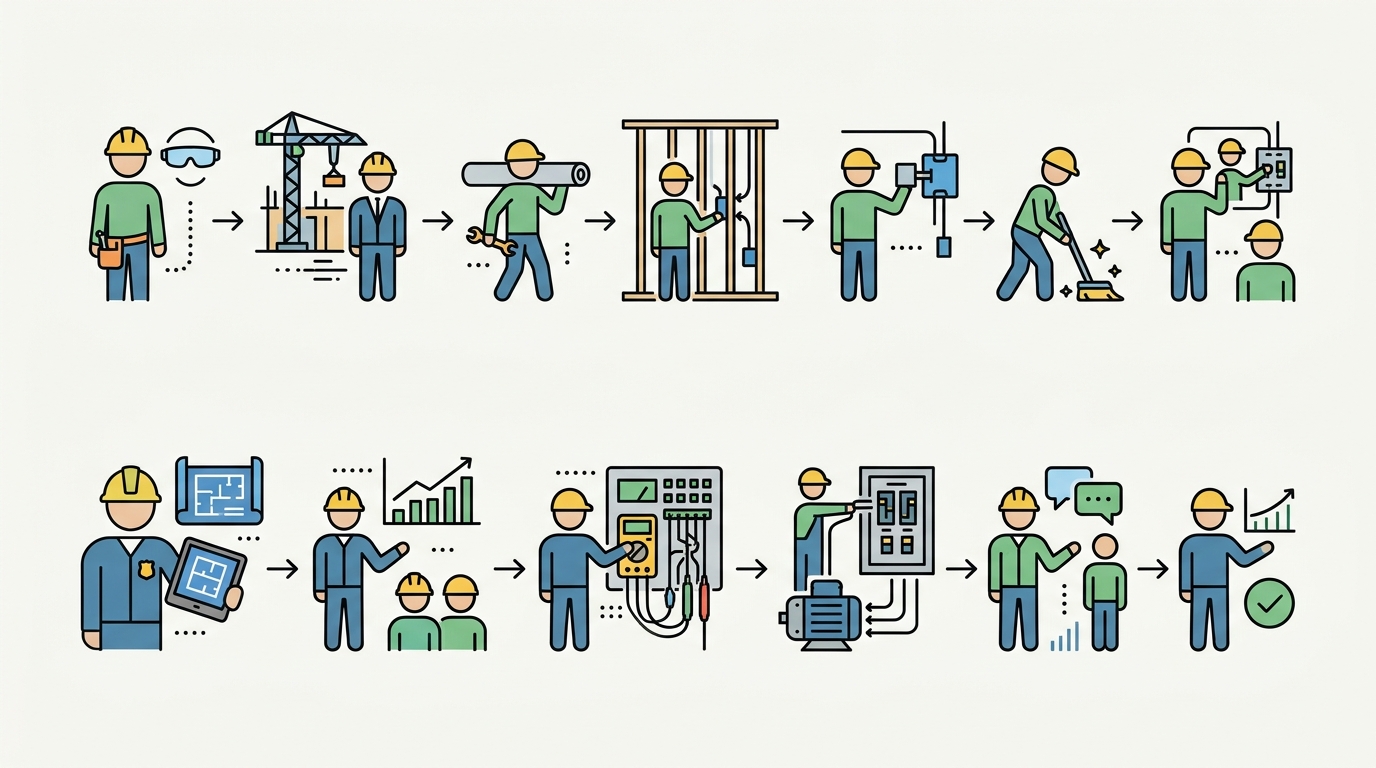
An entry-level electrician spends the shift inside someone else's plan: bending conduit, pulling wire, mounting boxes, and having each termination checked before power goes on. An experienced electrician sets that plan, troubleshoots what nobody else can find, and directs the helpers and apprentices on the crew.
The dividing line in the US is formal. Most electricians learn the trade through a multi-year apprenticeship with paid on-the-job hours plus technical instruction each year, and after finishing it they are considered journey workers who may perform duties on their own, subject to local or state licensing (U.S. Bureau of Labor Statistics, 2025).
What Changes With Experience
Electricians install, maintain, and repair electrical power, communications, lighting, and control systems (U.S. Bureau of Labor Statistics, 2025). Both levels touch all four. What changes is who decides, who checks, and who gets told what to do.
| Dimension | Entry-level (apprentice or helper) | Experienced (journey or master) |
|---|---|---|
| Autonomy | Works within sight of a journey worker; the foreman walks the rough-in before any drywall goes up | May perform duties on their own after completing an apprenticeship, subject to local or state licensing requirements (U.S. Bureau of Labor Statistics, 2025) |
| Task types | Bending EMT to a mark, pulling conductors through conduit, mounting device boxes to layout | Laying out feeder routes from the panel schedule, terminating a distribution panel, tracing an intermittent fault with a clamp meter and insulation tester |
| Supervision | Each shift's hours go in an apprenticeship logbook for a supervising electrician to sign; technical instruction runs alongside the paid work (U.S. Bureau of Labor Statistics, 2025) | Takes a scope and a deadline from the general contractor or service manager, then reports exceptions rather than progress |
| Pay band | Typically a stepped percentage of the journey rate that rises as logged hours accumulate; apprenticeship on-the-job hours are paid (U.S. Bureau of Labor Statistics, 2025) | Full journey or master rate, sometimes with a foreman premium; see the Bureau of Labor Statistics 2025 median and May 2025 percentile wage figures for the current range (U.S. Bureau of Labor Statistics, 2025) |
| Decision-making authority | Stops and asks when the print conflicts with what is in the wall; does not energize anything alone | Advises management on whether continued operation of equipment could be hazardous (O*NET OnLine, U.S. Department of Labor); decides lockout, replacement, and routing on the spot |
| Crew role | One of the workers being directed on a crew at a larger company (U.S. Bureau of Labor Statistics, 2025) | Directs helpers and apprentices, and trains workers to install, maintain, or repair wiring, equipment, or fixtures (U.S. Bureau of Labor Statistics, 2025; O*NET OnLine) |
| Code use | Asks where a National Electrical Code requirement applies to the box fill being installed | Cites the article to the inspector; licensing tests cover the National Electrical Code plus state and local codes (U.S. Bureau of Labor Statistics, 2025) |
A Day as an Entry-Level Electrician
A composite day on a commercial fit-out crew, built from tasks common to apprentice work rather than one real person's shift. Start times vary by employer, trade local, and whether the site is occupied.
- 6:00 a.m.-6:25 a.m. Loads the van from the shop pick list: benders, hole saw kit, mud rings, two spools of THHN. The lead electrician checks the list against the day's prints.
- 6:30 a.m.-6:50 a.m. Toolbox talk with the foreman on lockout/tagout for the floor's existing lighting panel; signs the attendance sheet.
- 6:50 a.m.-9:00 a.m. Rough-in: mounting device boxes to layout marks, working from the electrical sheet on a tablet. The journey worker spot-checks box height and mud ring depth about once an hour.
- 9:00 a.m.-9:15 a.m. Break. Logs the morning's hours and task categories in the apprenticeship logbook the training program requires.
- 9:15 a.m.-11:30 a.m. Bending EMT offsets on a hand bender to clear a duct run. Scraps two bends after the journey worker points out the shrink calculation was off.
- 11:30 a.m.-12:00 p.m. Lunch.
- 12:00 p.m.-2:15 p.m. Pulling conductors with a crew of three: feeding at one end, pulling grips at the other, wrestling the reel stand into place. The hardest stretch of the shift, and the clearest reason the trade calls for strength to move heavy components (U.S. Bureau of Labor Statistics, 2025).
- 2:15 p.m.-3:15 p.m. Tagging home runs and ringing out circuits with the journey worker holding the tester at the panel. The circuit that finally reads correct after an hour of hunting is the satisfying part.
- 3:15 p.m.-3:30 p.m. Sweeps up, returns unused mud rings to the gang box, hands the logbook page to the supervising electrician for signature.
- 5:30 p.m.-8:30 p.m., two evenings a week Technical instruction covering the National Electrical Code chapters in the year's curriculum, alongside the paid on-the-job hours (U.S. Bureau of Labor Statistics, 2025).
A Day as an Experienced Electrician
A composite service-and-construction day for a licensed journey worker running a small crew, not a profile of a real person. Scope and call volume vary by employer and by whether the work is new construction, service, or industrial maintenance.
- 5:45 a.m.-6:15 a.m. Reads the prints and panel schedule in the truck, finds a conflict between the feeder route and a new mechanical duct, and decides to reroute above the corridor rather than wait for a design change.
- 6:15 a.m.-6:45 a.m. Runs the toolbox talk, assigns two apprentices to rough-in and a helper to material staging, then walks the first-year through a four-point saddle at the bender — directing and training workers to install wiring and equipment (O*NET OnLine, U.S. Department of Labor).
- 6:45 a.m.-8:45 a.m. Terminates the distribution panel: torques lugs to the manufacturer's spec with a torque screwdriver, labels circuits against the schedule, leaves the main open pending inspection.
- 8:45 a.m.-10:15 a.m. Service call on an occupied floor. Traces an intermittent trip with a clamp meter and insulation resistance tester, isolates a motor feeder with degraded insulation, locks out the starter, and advises the building manager in writing that continued operation would be hazardous (O*NET OnLine, U.S. Department of Labor).
- 10:15 a.m.-11:00 a.m. Calls the general contractor about the reroute, cites the National Electrical Code article governing the clearance, then writes it up as a change order with labor and material.
- 11:00 a.m.-11:30 a.m. Lunch with the crew; sets the afternoon sequence so the apprentices know which runs must close before the drywall contractor arrives.
- 11:30 a.m.-1:45 p.m. Pulls and terminates the rerouted feeder, letting the apprentices land conductors while checking each termination before the breaker goes in.
- 1:45 p.m.-2:45 p.m. Walks the rough-in with the local inspector, opens the junction boxes requested, and corrects two support spacings on the spot instead of booking a re-inspection. A clean sign-off on a run the crew bent that morning is the payoff for the argument about routing.
- 2:45 p.m.-3:45 p.m. Signs apprentice logbook hours, orders tomorrow's material through the supply house, writes the service report. Workers in the occupation report that the impact of their decisions on co-workers and company results is very important (O*NET OnLine, U.S. Department of Labor).
Skills and Credentials That Unlock the Next Level
These are the gates between apprentice work and journey-level work in the US. Hour counts, exam names, and reciprocity rules are set by each state and sometimes by the city, so confirm yours before you count on anything.
- Baseline education. The Bureau of Labor Statistics publishes a typical entry-level education requirement for electricians; check the current Occupational Outlook Handbook entry rather than assuming (U.S. Bureau of Labor Statistics, 2025).
- A completed apprenticeship. Most electricians learn the trade in a multi-year program with paid on-the-job hours plus technical instruction each year (U.S. Bureau of Labor Statistics, 2025). ONET describes the occupation as requiring three or four years of apprenticeship or several years of vocational training, combining on-the-job experience with informal instruction from experienced workers (ONET OnLine, U.S. Department of Labor).
- Signed, logged hours. A logbook countersigned by a supervising electrician and broken out by task category is the evidence a licensing board accepts. Gaps in it are a common reason a qualified-looking candidate cannot sit the exam.
- The licensing exam. Most states require electricians to pass a test and be licensed, with questions on the National Electrical Code plus state and local codes (U.S. Bureau of Labor Statistics, 2025). Requirements vary by state, and CareerOneStop is the source the Bureau of Labor Statistics points to for checking yours.
- Journey worker status. Once the apprenticeship is complete you are considered a journey worker and may perform duties on your own, subject to local or state licensing requirements (U.S. Bureau of Labor Statistics, 2025).
- Demonstrated troubleshooting. Taking a nuisance-tripping circuit from complaint to isolated cause with a clamp meter and insulation resistance tester, then putting the finding in writing, is what separates someone who installs from someone who diagnoses.
- Crew direction. Electricians at large companies are likely to work as part of a crew, directing helpers and apprentices (U.S. Bureau of Labor Statistics, 2025). Handing a first-year a clear task at the bender and checking the result is a skill supervisors watch for.
- Master or management. After meeting additional requirements and working as a qualified electrician, journey workers may advance to master electrician, supervisor, or project management (U.S. Bureau of Labor Statistics, 2025). Michigan, for example, requires a licensed journeyman to accumulate set hours and hold that license for a minimum period before testing for master, with a higher total of logged hours for the master credential itself (Michigan Department of Licensing and Regulatory Affairs).
Frequently asked questions
How long does it take to go from apprentice to journey worker?
The apprenticeship sets the clock. Most electricians learn through a multi-year program with paid on-the-job hours plus technical instruction each year (U.S. Bureau of Labor Statistics, 2025), and O*NET describes the occupation as needing three or four years of apprenticeship or several years of vocational training (O*NET OnLine, U.S. Department of Labor). Most states then require passing a licensing test before you work on your own.
What actually triggers the move up?
Two things together: completed, signed apprenticeship hours, and a passing score on your state or local licensing exam, which covers the National Electrical Code plus state and local codes (U.S. Bureau of Labor Statistics, 2025). Promotion to foreman is an employer decision on top of that, usually based on whether you can direct helpers and apprentices through a rough-in without the superintendent checking behind you.
What does the pay difference look like?
Apprentice pay is typically a percentage of the journey rate that steps up as logged hours accumulate, so each completed period raises the rate. Journey and master rates sit above that, sometimes with a foreman premium. For current numbers, use the Bureau of Labor Statistics 2025 median pay for electricians and its May 2025 10th and 90th percentile wage figures (U.S. Bureau of Labor Statistics, 2025), then check your state's data.
What comes after journey level?
Master electrician, supervisor, or project management, once you meet additional requirements and have worked as a qualified electrician (U.S. Bureau of Labor Statistics, 2025). The requirements are state-specific: Michigan requires a journeyman to accumulate set hours and hold the license for a minimum period before testing for master, with a higher hour total for the master credential (Michigan Department of Licensing and Regulatory Affairs).
Sources
- U.S. Bureau of Labor Statistics — Electricians : Occupational Outlook Handbook (2025)
- O*NET OnLine (U.S. Department of Labor) — 47-2111.00 - Electricians
Your coach for this guide
Yuki covers early-career life, internships, and the strange first years of figuring out what work is for. She writes with the fresh impatience of someone still sorting out her own path.