Data Analyst vs. Data Scientist: Which Career Change Is Right for You
Both titles sit inside the same federal occupation code, so the real split shows up in daily tasks, entry time, and how deep your statistics need to go.

By Yuki Tanaka-ReevesOct 28, 2026 · 10 min read
If you are employed now and weighing a move into data work, the honest starting point is that "data analyst" and "data scientist" are not separate occupations in federal data. ONET lists Business Intelligence Analysts (15-2051.01) underneath Data Scientists (15-2051.00), and the wage, employment, and industry figures shown on the analyst page belong to the Data Scientists series rather than a separate analyst series (ONET OnLine, undated).
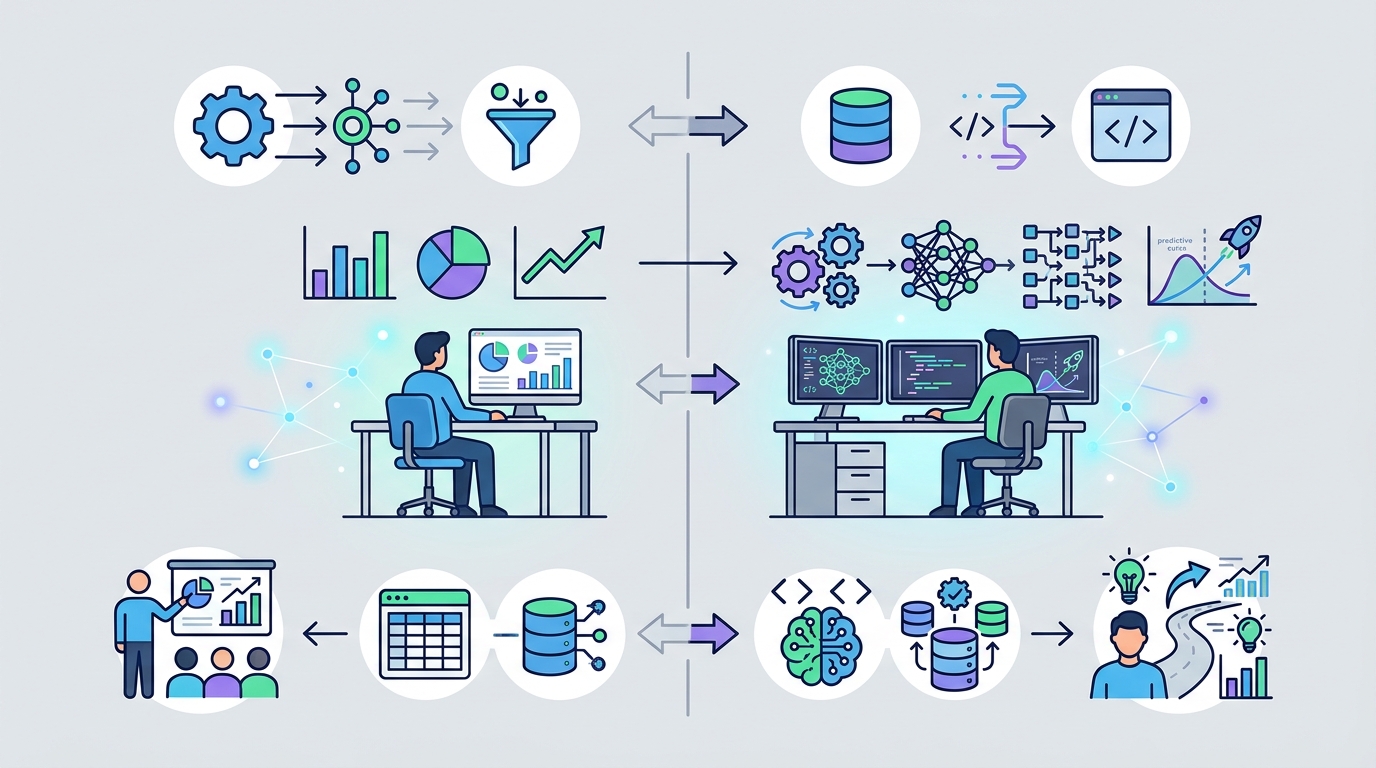
What differs in practice is the work: analyst roles lean toward reporting and dashboard upkeep, while data scientist roles lean toward processing large data sets with statistical software. That difference drives how much preparation you need before your first offer.
Data Analyst vs. Data Scientist at a Glance
| Dimension | Data analyst (Business Intelligence Analyst, 15-2051.01) | Data scientist (15-2051.00) |
|---|---|---|
| Where median pay is published | No separate wage series exists: ONET's wage page for 15-2051.01 displays wage, employment, and industry data labeled as 'Data Scientists' (ONET OnLine, undated). Read the current figure on that page before you negotiate. | ONET publishes a median wage for Data Scientists (15-2051.00) for 2025, plus 25th and 75th percentile annual wages for May 2025 drawn from the BLS OEWS program (ONET OnLine, 2025; INFORMS Career Center citing OEWS, May 2025). Check both numbers directly. |
| Typical schedule and setting | Counted inside the same occupation O*NET and BLS describe; for the closely related operations research analyst role, BLS states most work full time in office settings, with travel sometimes needed to meet clients (U.S. Bureau of Labor Statistics, undated). | BLS states data scientists typically work in an office setting (U.S. Bureau of Labor Statistics, undated). |
| Entry preparation level | ONET Job Zone Four, 'Considerable Preparation Needed'; most occupations in this zone require a four-year bachelor's degree, though some do not (ONET OnLine, undated). | ONET Job Zone Four, 'Considerable Preparation Needed', with the same four-year bachelor's expectation and the same exception (ONET OnLine, undated). |
| Physical demands | Desk and screen work; the comparable operations research analyst occupation is office-based with occasional client travel (U.S. Bureau of Labor Statistics, undated). | Desk and screen work in an office setting (U.S. Bureau of Labor Statistics, undated). No lifting, shift, or field requirements are listed. |
| Core output | 'Generate standard or custom reports summarizing business, financial, or economic data for review by executives, managers, clients, and other stakeholders' and 'maintain or update business intelligence tools, databases, dashboards, or methods' (O*NET OnLine, undated). | 'Analyze, manipulate, or process large sets of data using statistical software' and 'create graphs, charts, or other visualizations to convey the results of data analysis using specialized software' (O*NET OnLine, undated). |
| Upward path and outlook | Promotion usually means taking on the 15-2051.00 scientist tasks inside the same code; growth figures below therefore apply to both titles. | About 275,600 jobs in 2025 rising to about 371,000 by 2035, a 35% increase of roughly 95,400 jobs, listed among the fastest growing detailed occupations in the economy (INFORMS Career Center citing BLS Employment Projections, August 27, 2026; U.S. Bureau of Labor Statistics, August 27, 2026). |
If you want a nearby occupation with its own separate BLS wage series to compare against, look at operations research analysts: BLS publishes a median annual wage for them for May 2025, a 2025 employment count, and a 2025–2035 projection with average annual openings (U.S. Bureau of Labor Statistics, 2025).
Day-to-Day Differences
Picture a Tuesday in each role. The hours below are the writer's estimate of a standard full-time week, since BLS states only that most workers in the closely related operations research analyst occupation work full time in office settings (U.S. Bureau of Labor Statistics, undated).
A data analyst's Tuesday. The morning usually starts with a broken or stale report. You open the dashboard tool, trace a figure that executives queried, and find a source table that changed shape overnight — roughly 90 minutes of checking SQL queries against the warehouse and reconciling totals against last month's version. Mid-morning goes to the task ONET lists first for this role: generating standard or custom reports summarizing business, financial, or economic data for review by executives, managers, clients, and other stakeholders (ONET OnLine, undated). That might be two hours building a custom cut of regional sales for a manager who needs it before a 2 p.m. meeting. The afternoon tends to go to the second listed task — maintaining or updating business intelligence tools, databases, dashboards, or methods (O*NET OnLine, undated) — which in practice means renaming fields, fixing a filter, documenting a metric definition, and answering three Slack questions about which number is correct. You are usually responding to other people's deadlines.
A data scientist's Tuesday. The shape is lumpier. A morning block of two to three hours goes to analyzing, manipulating, or processing large sets of data using statistical software (ONET OnLine, undated): pulling a sample, cleaning it in Python or R, testing whether a relationship holds when you control for something else. Much of that produces nothing presentable, and you are expected to keep going. The afternoon often turns to creating graphs, charts, or other visualizations to convey the results of data analysis using specialized software (ONET OnLine, undated) — fewer outputs than the analyst makes, but each one has to survive questions about method, sample, and assumptions.
The practical difference is tolerance for unfinished work. Analyst days end with something delivered. Data scientist days often end mid-experiment, with a result you cannot yet defend. Both are office-based desk jobs (U.S. Bureau of Labor Statistics, undated), so the contrast is cognitive, not physical.
Pay, Hours, and Entry Requirements Compared
| Row | Data analyst (15-2051.01) | Data scientist (15-2051.00) |
|---|---|---|
| Median pay and where to find it | ONET's wage page for Business Intelligence Analysts displays wage, employment, and industry data labeled as 'Data Scientists', not a separate analyst series (ONET OnLine, undated) — so published medians do not distinguish the two titles. | ONET publishes a 2025 median wage for Data Scientists (15-2051.00), and INFORMS Career Center publishes 25th and 75th percentile annual wages for 15-2051 from the BLS OEWS program for May 2025 (ONET OnLine, 2025; INFORMS citing OEWS, May 2025). Check the live pages for the current figures. |
| Separate wage series to benchmark against | None published; use the shared 15-2051 series above. | For a distinct comparator, BLS publishes a median annual wage for operations research analysts for May 2025 (U.S. Bureau of Labor Statistics, 2025). |
| Typical weekly hours | Writer's estimate: about 40 hours, with longer weeks at month-end and quarter-end reporting deadlines. Reasoning: BLS reports most workers in the comparable operations research analyst occupation work full time (U.S. Bureau of Labor Statistics, undated). | Writer's estimate: about 40 hours, with longer weeks when a model or study has a delivery date. Same reasoning and the same office setting BLS describes (U.S. Bureau of Labor Statistics, undated). |
| Required credential | No state license or board exam exists for the title. ONET Job Zone Four: most occupations in this zone require a four-year bachelor's degree, though some do not (ONET OnLine, undated). | Same Job Zone Four classification and the same four-year bachelor's expectation (O*NET OnLine, undated). BLS lists mathematics, statistics, and computer science among common fields of degree for data scientists (U.S. Bureau of Labor Statistics, undated). |
| Graduate study | Not required for entry. In the neighbouring operations research analyst occupation, BLS notes some employers require or prefer a master's degree (U.S. Bureau of Labor Statistics, undated). | Not required by the Job Zone Four classification, but the same employer preference for a master's appears in the related analyst occupation BLS describes (U.S. Bureau of Labor Statistics, undated). |
| Average time to entry | Writer's estimate: 6–12 months of part-time study if you already hold a bachelor's degree and your current job involves spreadsheets, reporting, or operations data. Reasoning: the listed tasks are reporting and dashboard upkeep, which you can demonstrate with work samples. | Writer's estimate: 12–24 months of part-time study from the same starting point. Reasoning: the listed tasks require statistical software and large-data processing, which usually means coursework in statistics on top of the bachelor's expectation. |
| Degree route from scratch | 4 years full time for a bachelor's, per the Job Zone Four description (O*NET OnLine, undated). | 4 years full time for a bachelor's, per the same Job Zone Four description (O*NET OnLine, undated). |
On cost: do not accept a provider's description of its price. Ask each program you shortlist for a written total in dollars covering tuition, fees, and any required software, and compare that against the published per-credit cost of the same subject at your nearest public university. Both numbers should be on paper before you enrol.
Questions to Ask Yourself Before Choosing
Answer each of these with a yes, a no, or a number taken from your own situation. If more than two answers point the same way, that is your direction.
- Do you already hold a four-year bachelor's degree? Both roles sit in ONET Job Zone Four, where most occupations require one, though some do not (ONET OnLine, undated).
- Is your degree in mathematics, statistics, or computer science — the fields BLS lists as common for data scientists (U.S. Bureau of Labor Statistics, undated)? If no, count how many college-level statistics courses you have passed.
- How many hours per week, as a number, can you reliably study while keeping your current job? Compare that against 6–12 months of part-time study for analyst-level tasks or 12–24 months for data scientist tasks (writer's estimate, reasoning above).
- How many months of living expenses do you have saved? Write the figure down before you decide whether to study part-time while employed or stop working.
- Can you name three reports or dashboards you have built or maintained at work? That is the evidence an employer looks for against the listed analyst tasks of generating reports and maintaining dashboards and databases (O*NET OnLine, undated).
- Have you completed a project where you processed a large data set with statistical software and produced a chart defending the result? Those are the two core data scientist tasks ONET lists (ONET OnLine, undated).
- Have you looked up the current median and the May 2025 25th and 75th percentile wages for occupation 15-2051 on O*NET and the BLS OEWS pages, and written both numbers down next to your current salary? Do this before, not after, you commit money to retraining.
Frequently asked questions
Is a data analyst the same thing as a data scientist?
Not in the tasks, but yes in the official data. O*NET lists Business Intelligence Analysts as 15-2051.01 under Data Scientists 15-2051.00, and the analyst page displays wage, employment, and industry data labeled 'Data Scientists' (O*NET OnLine, undated). Both sit in Job Zone Four, 'Considerable Preparation Needed'.
Which pays more, a data analyst or a data scientist?
Published federal data cannot tell you, because both titles fall inside occupation 15-2051 — the code BLS counted at about 275,600 jobs in 2025 (INFORMS Career Center citing BLS, August 27, 2026). Check O*NET's 2025 median and the May 2025 25th and 75th percentile wages, then compare employer-posted ranges yourself.
Do I need a master's degree to become a data scientist?
Not by classification. O*NET places both roles in Job Zone Four, where most occupations require a four-year bachelor's degree, though some do not (O*NET OnLine, undated). BLS does note that some employers of operations research analysts, a closely related occupation, require or prefer a master's (U.S. Bureau of Labor Statistics, undated).
Sources
- U.S. Bureau of Labor Statistics — Data Scientists : Occupational Outlook Handbook
- O*NET OnLine (National Center for O*NET Development / U.S. Dept. of Labor) — 15-2051.00 - Data Scientists
Your coach for this guide
Yuki covers early-career life, internships, and the strange first years of figuring out what work is for. She writes with the fresh impatience of someone still sorting out her own path.