A Day in the Life of a Long-Haul Truck Driver
From the pre-trip inspection to the 10-hour reset, here is how the hours-of-service clock shapes a driver's tasks, paperwork and time alone on the road.

By Desmond OkaforOct 28, 2026 · 9 min read
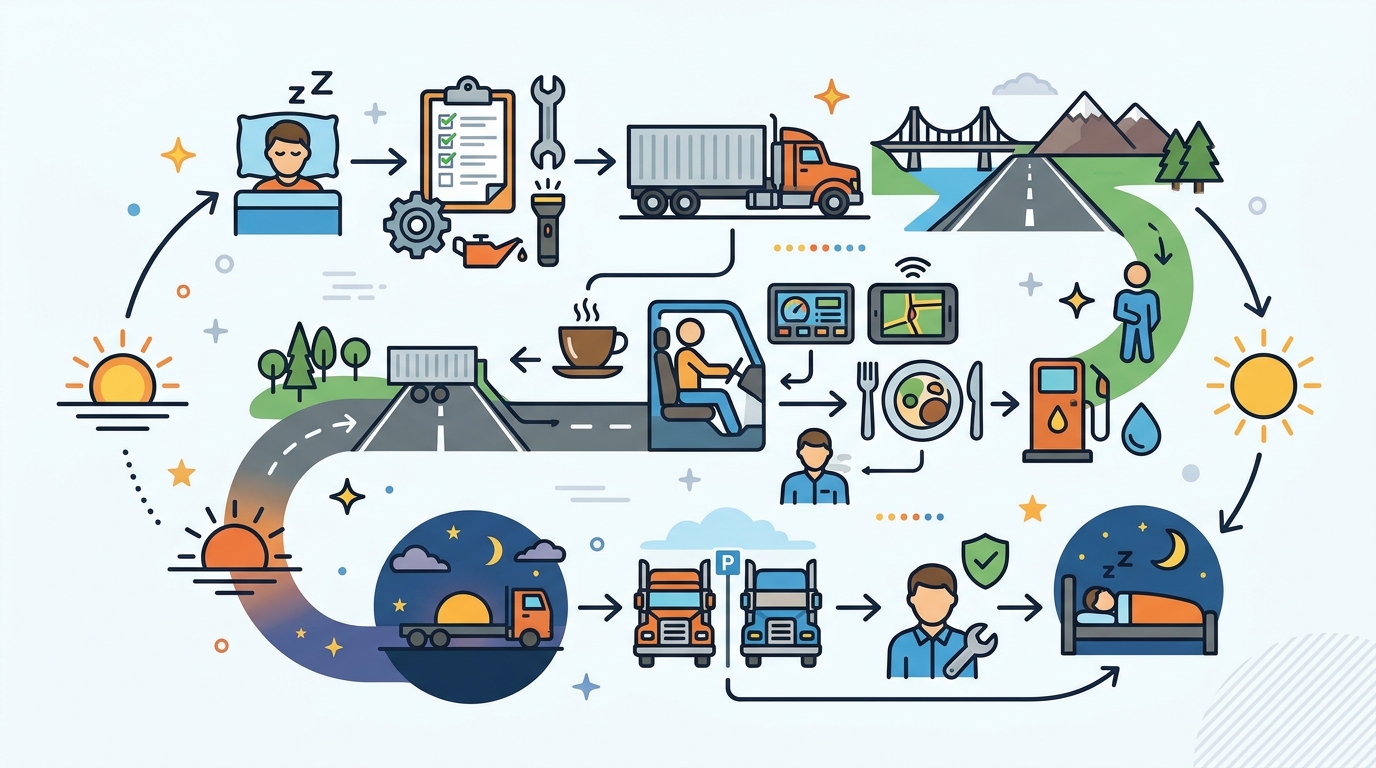
A long-haul truck driver's day is built around a legal clock, not an office schedule. Federal rules let property-carrying drivers drive up to 11 hours after 10 consecutive hours off duty, inside a 14-hour on-duty window, with a 30-minute break after 8 cumulative driving hours (49 CFR Part 395).
Everything else fits around that window. The U.S. Bureau of Labor Statistics (2026-08-27) describes the core of the job as driving long distances, reporting incidents to a dispatcher, securing cargo with ropes, blocks, chains or covers, inspecting trailers before and after each trip, maintaining a log of working hours and reporting mechanical problems.
Hour-by-Hour: A Typical Shift
This is a composite day — a solo dry-van driver running a delivery about 500 miles out. Start times shift with appointment windows, and team runs differ, because one driver sleeps in the berth behind the cab while the other drives (U.S. Bureau of Labor Statistics, 2026-08-27).
4:45 a.m. – 5:30 a.m. — Pre-trip inspection. You come out of the sleeper berth, go on duty in the electronic logging device, and walk the tractor and trailer: tires, wheel seals, lights, air lines, glad hands, brake adjustment, fifth-wheel coupling. Pre- and post-trip trailer inspections and reporting mechanical problems are standard duties (U.S. Bureau of Labor Statistics, 2026-08-27). Defects go on the driver vehicle inspection report and get a call to the shop.
5:30 a.m. – 6:00 a.m. — Dock paperwork. You take the bills of lading from the shipping clerk, check load documentation for completeness and accuracy, and inspect the load to confirm cargo is secure — both tasks O*NET OnLine (2026) lists for this occupation. On a dry van that means seal numbers, pallet count and load bars; on a flatbed, straps, chains and tarps.
6:00 a.m. – 10:00 a.m. — First driving leg. Four hours with the GPS set for truck-legal height, weight and bridge restrictions. You message the dispatcher through the truck cab computer to confirm you're rolling; O*NET (2026) lists cab computers, CB radios, phones and GPS as the tools drivers use to exchange information with bases and supervisors.
10:00 a.m. – 10:30 a.m. — Fuel stop and scale check. Fuel card at the pump, diesel exhaust fluid topped off, a walk-around to thump tires and check for leaks, then a weigh to confirm axle weights before the first state scale. Receipt and scale ticket go in the trip envelope.
10:30 a.m. – 2:30 p.m. — Second driving leg. Another four hours, putting you at eight cumulative driving hours. Construction zones, a backed-up weigh station or a crash ahead get reported to the dispatcher, since reporting incidents is a listed duty (U.S. Bureau of Labor Statistics, 2026-08-27).
2:30 p.m. – 3:00 p.m. — Required 30-minute break. You park, switch the log off duty, eat and plan the approach to the receiver. Under 49 CFR Part 395 this break is required after eight cumulative driving hours.
3:00 p.m. – 5:00 p.m. — Final leg. Two more hours brings the day to 10 driving hours, inside the 11-hour limit. You call the receiver's shipping office to confirm the dock door and check-in procedure.
5:00 p.m. – 6:15 p.m. — Delivery and post-trip. Check in at the guard shack, back into the dock, break the seal in front of the receiving clerk, and either watch the load come off or help break it down — some long-distance drivers load and unload cargo (U.S. Bureau of Labor Statistics, 2026-08-27). Get the bill of lading signed, note damage or short count, then log the post-trip inspection.
6:15 p.m. onward — Reset. The 14-hour window is nearly closed, so you find legal parking, go off duty, and start the 10 consecutive hours off required before the next working period (U.S. Bureau of Labor Statistics, 2026-08-27).
Core Responsibilities Beyond the Clock
- Daily — hours logging. Drivers must record hours in a log and keep it current (U.S. Bureau of Labor Statistics, 2026-08-27). The deliverable is a dispute-free record that matches your dispatch and fuel receipts.
- Weekly — the 60/70-hour recap. You are capped at 60 hours in 7 days or 70 in 8 (U.S. Bureau of Labor Statistics, 2026-08-27), so each week you plan which loads you can legally accept and when hours run out, rather than stranding a shipment mid-route.
- Weekly or biweekly — the 34-hour restart. After the weekly cap you take 34 hours off before another 7- or 8-day run (U.S. Bureau of Labor Statistics, 2026-08-27) — which means choosing where to park for a day and a half.
- Weekly or per trip — settlement paperwork. Signed bills of lading, fuel receipts and scale tickets get scanned or turned in so miles and accessorials are paid. Pay is usually by miles driven plus bonuses, with some owner-operators paid a share of shipping revenue (U.S. Bureau of Labor Statistics, 2026-08-27), so missing documents mean missing pay.
- Monthly — preventive maintenance. Oil, filters, brake adjustment and tire depth at the shop, producing an inspection-ready truck and a written defect record.
- Seasonal — weather and freight cycles. Chains and de-icing in winter, tarping flatbed loads in heat and rain, tighter appointment windows during retail and produce peaks.
- Every two years — DOT physical. Federal regulations require CDL drivers to pass a physical every two years and keep a clean record, with random drug and alcohol testing (U.S. Bureau of Labor Statistics, 2026-08-27). The deliverable is a current medical certificate on file.
Who Tends to Thrive in This Role
Methodical people do well, because the 4:45 a.m. pre-trip and the 6:15 p.m. post-trip are the same checks in the same order every day, and skipping a wheel seal or brake adjustment earns a roadside out-of-service order. The same trait shows at 5:30 a.m., matching seal numbers and pallet counts against the bill of lading with a shipping clerk waiting — a task where being fast and approximate costs you later.
Comfort with your own company matters more here than in most jobs. The 6:00 a.m. to 10:00 a.m. leg is four hours with nobody in the cab, and the reset at 6:15 p.m. usually happens in a truck stop lot, not at a kitchen table. The U.S. Bureau of Labor Statistics (2026-08-27) frames long-haul driving as a lifestyle choice precisely because drivers can be away for days or weeks and spend much of that time alone.
You also need to think in clock time. Deciding at 10:00 a.m. whether to fuel now or push on, and timing the 2:30 p.m. break so it lands before a mountain grade rather than halfway up it, is the difference between making an appointment and sitting out a 10-hour reset 40 miles short.
Physical durability is not optional. Driving can be physically demanding and tiring, and some drivers load and unload cargo (U.S. Bureau of Labor Statistics, 2026-08-27) — which is what the 5:00 p.m. delivery looks like with no dock crew and pallets to break down after 10 hours at the wheel. Drivers also have one of the highest rates of injuries and illnesses of all occupations, and one of the highest rates of occupational fatalities (U.S. Bureau of Labor Statistics, 2026-08-27).
The reward is equally concrete: a signed bill of lading after backing a 53-foot trailer into a tight door on the first try, with the load you strapped down that morning arriving intact.
How to Get Started
- Confirm the age rule (days). You must be at least 18 to drive intrastate and at least 21 to drive interstate or haul hazardous materials (Driving-Tests.org). Long-haul across state lines means 21.
- Pass the DOT physical and check sensory standards (1–2 weeks). Federal regulations require at least 20/40 vision with a 70-degree field in each eye, the ability to distinguish traffic-light colors, and hearing a forced whisper in one ear at 5 feet (U.S. Bureau of Labor Statistics, 2026-08-27). Do this before paying for training.
- Complete Entry-Level Driver Training from a registered provider. Effective February 7, 2022, FMCSA's ELDT rules require first-time Class A or B applicants, B-to-A upgrades, and first-time passenger, school bus or hazmat endorsement applicants to train with a provider on FMCSA's Training Provider Registry before the CDL skills or knowledge test (Federal Motor Carrier Safety Administration).
- Attend truck-driving school (3–6 months). A private school or community college program lasting 3 to 6 months ends in a certificate of completion (U.S. Bureau of Labor Statistics, 2026-08-27). Confirm the provider is on the Training Provider Registry.
- Pass your state's CDL tests (weeks). All long-haul drivers need a commercial driver's license; qualifications vary by state but generally include a knowledge test and a driving test (U.S. Bureau of Labor Statistics, 2026-08-27). Your state licensing agency sets fees and permit holding periods.
- Add endorsements (several weeks). A hazardous materials endorsement requires an additional knowledge test and a background check (U.S. Bureau of Labor Statistics, 2026-08-27), with registered ELDT training first for new applicants.
- Complete mentor training after hiring (several weeks). New drivers normally run accompanied by an experienced mentor-driver in the passenger seat (U.S. Bureau of Labor Statistics, 2026-08-27).
- Stay current (every two years, ongoing). Pass the physical, keep a clean driving record, expect random testing.
Frequently asked questions
How long are long-haul drivers away from home?
It varies by employer and route. The U.S. Bureau of Labor Statistics (2026-08-27) describes long-haul driving as a lifestyle choice because drivers can be away for days or weeks at a time and spend much of that time alone. Regional and dedicated routes generally get you home more often than over-the-road work. Ask a recruiter for the specific home-time pattern in writing before accepting a schedule.
How is long-haul truck driver pay structured?
Most heavy and tractor-trailer drivers are paid by miles driven plus bonuses, with the per-mile rate varying by employer and depending on cargo type and experience. Some long-distance drivers, especially owner-operators, are paid a share of shipping revenue (U.S. Bureau of Labor Statistics, 2026-08-27). For current figures, check the Bureau of Labor Statistics Occupational Outlook Handbook and state-level wage data.
Do I need a college degree to become a truck driver?
No. The route in is a commercial driver's license plus training — a private truck-driving school or community college program of 3 to 6 months, ending in a certificate of completion (U.S. Bureau of Labor Statistics, 2026-08-27). First-time Class A or B applicants must also train with a provider on FMCSA's Training Provider Registry before testing (Federal Motor Carrier Safety Administration).
What does a team driving job involve?
Companies sometimes use two drivers, known as teams, on long runs to minimize downtime, with one sleeping in the berth behind the cab while the other drives (U.S. Bureau of Labor Statistics, 2026-08-27). Freight keeps moving around the clock, but you share a small space continuously and sleep while the truck is in motion. Hours-of-service limits still apply to each driver individually.
How many truck driving jobs are there?
Heavy and tractor-trailer truck drivers held about 2.2 million jobs in 2025, and employment is projected to grow 4 percent from 2025 to 2035, with roughly 214,500 openings projected each year on average over the decade (U.S. Bureau of Labor Statistics). Openings cluster around freight corridors and distribution hubs, so demand is uneven by state and freight type.
Sources
- U.S. Bureau of Labor Statistics — Heavy and Tractor-Trailer Truck Drivers : Occupational Outlook Handbook (2026-08-27)
- Federal Motor Carrier Safety Administration — ELDT Applicability - Training Provider Registry
Your coach for this guide
Desmond covers workplace culture and the unwritten rules that shape who gets ahead. He likes talking to people mid-career, after the certainty has worn off and the real questions start.