A Day in the Life of a Bartender
A composite evening shift behind the bar, from the opening cash count and ice wells to last call, tip-outs and the inventory sheet at 2 a.m.

By Desmond OkaforOct 28, 2026 · 9 min read
Bartending is a standing, talking, counting job. You mix drinks to recipe and pour wine, beer and other drinks (U.S. Bureau of Labor Statistics, 2025), but you also check IDs, judge when someone has had enough, open and close tabs, and keep the bar stocked — often late at night, on weekends and on holidays (U.S. Bureau of Labor Statistics, 2025).
The shift below is a composite of a busy evening at a full-service restaurant bar — the setting that employs about 41% of bartenders, with drinking places employing another 25% (U.S. Bureau of Labor Statistics, 2025). Your hours, duties and closing routine will differ by employer and by state alcohol law.
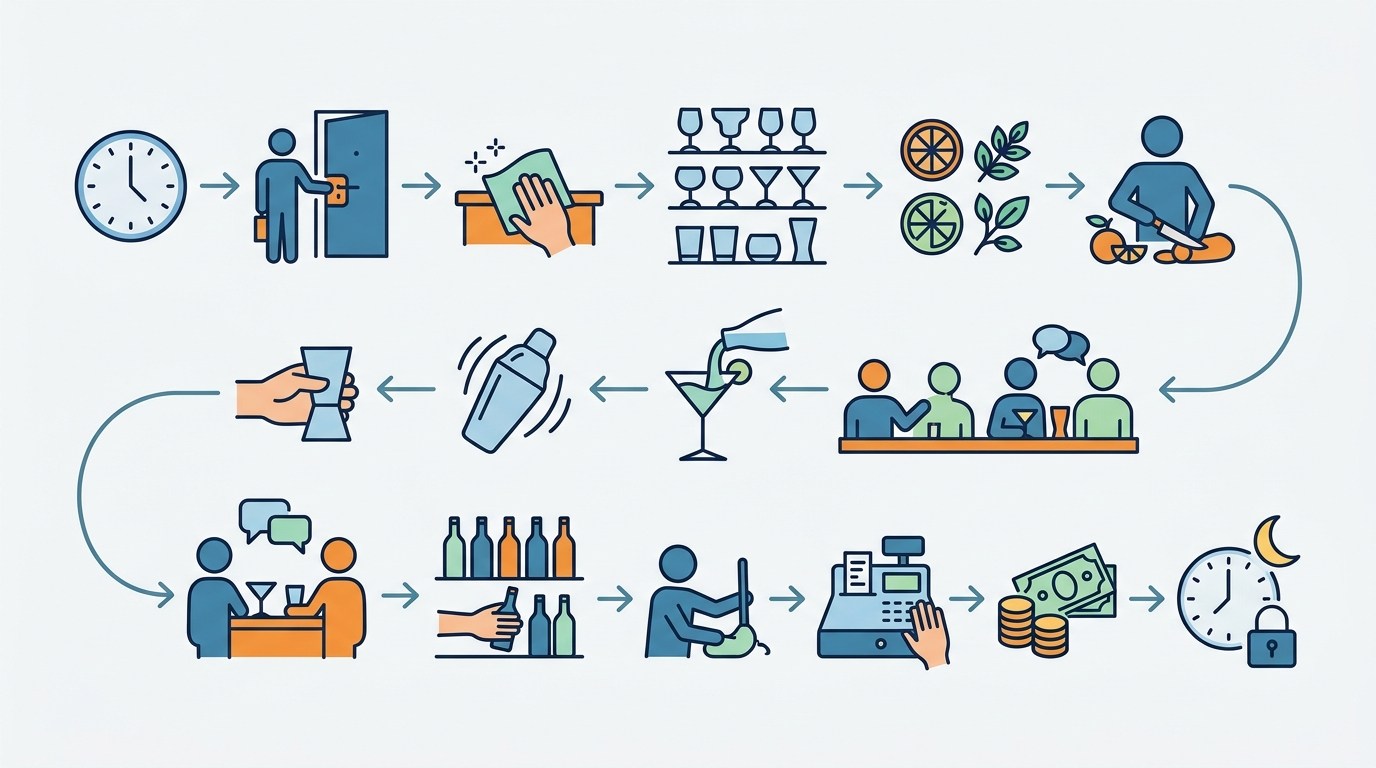
Hour-by-Hour: A Typical Shift
This is a composite day built from tasks common to a full-service restaurant bar. Clock-in time, closing paperwork and last call depend on your employer and your state's service laws.
3:30 p.m.–4:00 p.m. — Clock in and count the drawer. You punch in at the POS terminal, read the manager's pre-shift notes (86'd items, a party of 12 at 7), and count the opening cash bank with the floor manager. Both of you initial the cash count sheet.
4:00 p.m.–5:00 p.m. — Set up the well. With the barback you carry cases of beer and liquor up from the walk-in — cases that may weigh up to 50 pounds (U.S. Bureau of Labor Statistics, 2025) — fill speed rails, pack the ice wells, change a keg at the coupler, and cut citrus and garnish trays with a paring knife.
5:00 p.m.–6:30 p.m. — Happy hour. You pour wine and draft and mix cocktails from the house spec book (U.S. Bureau of Labor Statistics, 2025), check identification on anyone near the line using a license and, in many bars, an ID scanner (U.S. Bureau of Labor Statistics, 2025), and open tabs by pre-authorizing cards on the POS (U.S. Bureau of Labor Statistics, 2025).
6:30 p.m.–8:00 p.m. — Service bar plus your own guests. Server tickets print on the bar printer in bursts while bar guests order face to face. You work shaker tins and jigger, call the expo window when a guest's food is late, and keep the glasswasher cycling so you don't run out of rocks glasses.
8:00 p.m.–10:30 p.m. — Peak. Three deep at the rail. You are under pressure to serve quickly while making sure no alcohol goes to a minor or an overly intoxicated guest (U.S. Bureau of Labor Statistics, 2025). You batch rounds, split tabs on the POS, and spend the whole stretch walking or standing (U.S. Bureau of Labor Statistics, 2025).
10:30 p.m.–12:00 a.m. — The judgment call. A guest from the 7 o'clock party has crossed the line. You stop serving, tell the manager and host, hold the card and arrange a rideshare — monitoring intoxication, denying service and arranging safe transportation are part of the job (U.S. Bureau of Labor Statistics, 2025). You note the refusal in the shift log.
12:00 a.m.–1:00 a.m. — Last call and pre-close. You announce last call, close open tabs on the POS, break down garnishes, cover the wells, and run the last racks through the three-compartment sink with the barback.
1:00 a.m.–2:15 a.m. — Close out. You run the end-of-shift POS report, count the drawer against it, fill in the tip-out sheet for barback and servers, mark the par sheet for liquor and mixers needing restock (U.S. Bureau of Labor Statistics, 2025), lock the liquor cabinet and hand the deposit bag to the closing manager.
Core Responsibilities Beyond the Clock
- Weekly inventory count and order (one slow afternoon shift): walk the back bar, walk-in and stockroom with a par sheet, record bottle-by-bottle counts and submit an order to the distributor rep. Bartenders are usually responsible for stocking and maintaining liquor, mixer and supply inventory (U.S. Bureau of Labor Statistics, 2025).
- Draft line and equipment maintenance (every two weeks to monthly): coordinate line cleaning with the vendor, replace worn faucet washers and log CO2 tank changes so beer pours clear rather than foamy.
- Menu and spec work (monthly to quarterly): test new cocktails with the bar manager, cost them against invoices and produce printed spec cards. Deliverable: a signed-off recipe sheet behind the bar.
- Holiday and event coverage (year-round): late evenings, weekends and holidays are normal, and schedules may vary week to week (U.S. Bureau of Labor Statistics, 2025). Expect to submit availability ahead and be scheduled for New Year's Eve and private buyouts.
- Server-certificate renewal (typically every one to a few years, set by your state or locality): retake the responsible-server course and keep the current certificate on file. Many states and localities require this course, covering alcohol sales laws, responsible serving practices and conflict management (U.S. Bureau of Labor Statistics, 2025).
- Training a new barback (a few weeks per hire): walk them through well layout, keg changes and ID checks until they can set up the bar alone.
Who Tends to Thrive in This Role
People who do well behind a bar stay calm when work stacks up. The 8:00 p.m.–10:30 p.m. stretch, three deep with server tickets printing, is the test: you serve fast while still checking IDs and watching for guests who have had too much (U.S. Bureau of Labor Statistics, 2025). If a queue of ten plus a split-tab request makes you freeze, that is the longest part of your week.
You also need to be comfortable saying no to someone friendly who is spending money. The 10:30 p.m. refusal — stopping service, telling the manager, holding a card, arranging a rideshare — is a core duty, not an exception (U.S. Bureau of Labor Statistics, 2025), and so is turning away a happy-hour guest whose ID doesn't hold up at the scanner.
Physical durability matters as much as temperament. The 4 p.m. setup means carrying cases up to 50 pounds (U.S. Bureau of Labor Statistics, 2025), and from happy hour to the last rack at the sink you are on your feet; 79% of bartenders report standing continually or almost continually (U.S. Bureau of Labor Statistics). Sore feet and a sore lower back are the real complaint.
Finally, you need to be accurate with money while tired. The 1 a.m. drawer count against the POS report and the tip-out sheet have to balance, and tabs opened at 5 p.m. have to close to the right cards (U.S. Bureau of Labor Statistics, 2025). The satisfying part is just as concrete: regulars who sit in your section because you remember their drink, and a 200-cover Saturday where the tickets cleared and the drawer balanced.
How to Get Started
- Confirm the legal age to serve in your state (a few hours of research). Most states require workers who serve alcoholic beverages to be at least 18 (U.S. Bureau of Labor Statistics, 2025), and some set a higher age to bartend. Check with your state's alcoholic beverage control agency.
- Finish or document a high school diploma if you don't have one (GED preparation often takes 2–6 months). No formal credential is typically needed, though some employers require or prefer a diploma (U.S. Bureau of Labor Statistics, 2025).
- Take a responsible-server course if your state or locality requires one (usually a few hours online or in class). It covers alcohol sales laws, responsible serving practices and conflict management (U.S. Bureau of Labor Statistics, 2025). Check your state regulator's approved-provider list before paying.
- Get hired into the room, often as a barback or server first (weeks to a few months of searching). Full-service restaurants employ about 41% of bartenders and drinking places about 25% (U.S. Bureau of Labor Statistics, 2025), so apply to both.
- Learn the job on the job (a few weeks of training is typical). On-the-job training usually lasts a few weeks (U.S. Bureau of Labor Statistics, 2025), and the occupation sits in Job Zone 1–2, 'Very Little to Some Preparation Needed,' with training ranging from a few days to one year (O*NET OnLine, U.S. Department of Labor).
- Consider optional certification once you're working (days to weeks of study). Bartending certification is optional but may demonstrate basic knowledge or competency; CareerOneStop lists certification information (U.S. Bureau of Labor Statistics, 2025).
- Check pay and demand for your area (ongoing). Pay is typically an hourly base plus tips, with tip-credit rules differing by state. Bartenders held about 762,600 jobs in 2025, employment is projected to grow 5 percent from 2025 to 2035, and about 121,200 openings are projected each year on average (U.S. Bureau of Labor Statistics, 2025).
Frequently asked questions
Do I need to go to bartending school?
Usually not. Training is typically provided on the job and lasts a few weeks (U.S. Bureau of Labor Statistics, 2025), and the occupation is classified in Job Zone 1–2 (O*NET OnLine, U.S. Department of Labor). A paid school can help you learn builds faster, but no school can promise placement. Check whether your state instead requires an approved responsible-server course — that is the credential many employers actually ask for.
How do bartenders usually get paid?
Most earn an hourly base plus tips. Tips may be kept individually or pooled with barbacks and servers, and some states let employers count tips toward the minimum wage while others don't. Because the structure differs by state and employer, ask how tips are split before accepting shifts, and look up current wage figures in BLS Occupational Employment and Wage Statistics data and with your state labor department.
Can I bartend part time around school or another job?
Often, yes. Part-time work is common and schedules may vary week to week (U.S. Bureau of Labor Statistics, 2025). The trade-off is that the busiest shifts fall on late evenings, weekends and holidays, so you'll work when friends are off. If you need fixed days, say so when you're hired — availability is set before the schedule is written.
Is it hard to get a bartending job right now?
Openings exist in volume: about 121,200 bartender openings are projected each year on average over the decade, with employment projected to grow 5 percent from 2025 to 2035 (U.S. Bureau of Labor Statistics, 2025). Busy bars still favor people with floor experience, so barbacking or serving first is the common route. Nobody can guarantee a hire, but applying to both restaurants and drinking places widens your options.
What happens if I serve a minor or an intoxicated guest by mistake?
Consequences are set by state and local alcohol law and can affect both you and the venue's license, which is why checking identification and judging intoxication are treated as core duties (U.S. Bureau of Labor Statistics, 2025). Employers generally expect you to follow a written refusal procedure and document it. For the rules and penalties where you work, contact your state's alcoholic beverage control agency rather than relying on co-workers.
Sources
- U.S. Bureau of Labor Statistics — Bartenders : Occupational Outlook Handbook (2025)
- O*NET OnLine (U.S. Dept. of Labor) — Bartenders - Summary Report
Your coach for this guide
Desmond covers workplace culture and the unwritten rules that shape who gets ahead. He likes talking to people mid-career, after the certainty has worn off and the real questions start.